
Crafty Vesper Mouse
Calomys callidus
Red List assessment
Least Concernon the IUCN Red List
- EXExtinct
- EWExtinct in the Wild
- CRCritically Endangered
- ENEndangered
- VUVulnerable
- NTNear Threatened
- LCLeast Concern
The Crafty Vesper Mouse is recorded in 4 countries across South America. The IUCN Red List assesses the Crafty Vesper Mouse as Least Concern. No precise population estimate exists; the species is presumed to have a stable population given its adaptability and broad distribution.
- Family
- Cricetidae
- Order
- Rodentia
- Genus
- Calomys
- Countries recorded
- 4
- Continents
- South America
- Red List category
- Least Concern
- Data updated
- August 9, 2026
What is the Crafty Vesper Mouse?
Calomys callidus, the Crafty Vesper Mouse, is a small rodent native to the grasslands and scrublands of southern South America. It belongs to the diverse genus Calomys, known as vesper mice, which are ecologically important small mammals in Neotropical ecosystems. The species is relatively understudied but appears well-adapted to open and semi-open habitats. Its common name likely derives from its elusive, cautious nature.
Where does the Crafty Vesper Mouse live?
South America, primarily Argentina, Brazil, Paraguay, and Uruguay
Found in southern South America, including parts of Argentina, Brazil, Paraguay, and Uruguay, particularly in the Pampas and Chaco ecoregions. Its range centers around the border regions of these countries.
Altitude and depth
Typically found at low to moderate elevations, generally below 500 meters, consistent with lowland grassland habitats.
Seasonal movements
No migratory behavior; breeding activity likely increases during warmer, wetter seasons corresponding to increased food availability.
Habitat of the Crafty Vesper Mouse
Inhabits grasslands, savannas, and scrubland vegetation, often in areas with sandy or well-drained soils. It is also found in agricultural edges and disturbed habitats, showing some tolerance for human-modified landscapes.
Adaptations to its environment
Possesses efficient kidneys adapted for water conservation in semi-arid environments. Its small size and burrowing behavior help it avoid temperature extremes and predators in open habitats.
Conservation status and numbers
Listed as Least Concern (LC) by the IUCN due to its wide distribution and presumed stable population, with no major range-wide threats currently identified.
Estimated population
No precise population estimate exists; the species is presumed to have a stable population given its adaptability and broad distribution.
What threatens the Crafty Vesper Mouse?
Habitat conversion for agriculture and livestock grazing poses a localized threat, though the species shows some adaptability to disturbed landscapes.
Diseases and parasites
Like many rodents, may host ectoparasites such as fleas and mites, and could be a reservoir for certain zoonotic pathogens, though specific studies are limited.
What is being done to protect it?
No species-specific conservation programs are known; general habitat protection within regional grassland reserves may incidentally benefit this species.
Recommended actions
Further taxonomic and ecological research is needed to clarify population trends and habitat requirements; monitoring of grassland habitat loss is recommended.
What the Crafty Vesper Mouse looks like
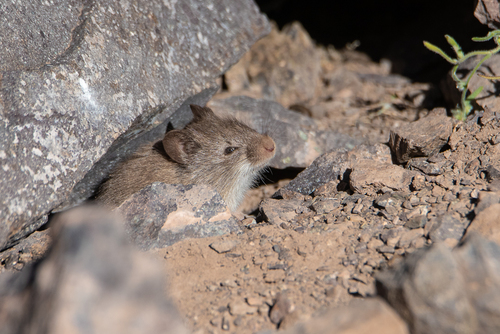
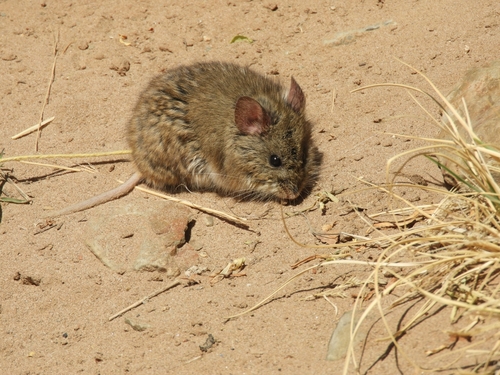
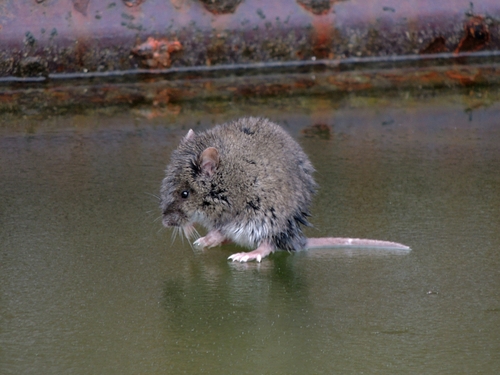
Has soft, grayish-brown to tawny dorsal fur with a paler, whitish or cream-colored underside. The tail is moderately long and sparsely haired, typical of vesper mice.
Size
Body length typically ranges from 7-10 cm, with a tail length of approximately 6-9 cm.
Weight
Weighs approximately 10-20 grams, typical for small Calomys species.
Distinctive features
Distinguished from closely related Calomys species primarily through cranial and dental morphology, as external features are similar across the genus.
Differences between males and females
Minimal sexual dimorphism; males and females are similar in size and coloration.
Behaviour and diet of the Crafty Vesper Mouse
Likely solitary or living in small family groups, consistent with behavior observed in related Calomys species; not known to form large social colonies.
When it is active
Primarily nocturnal, foraging for food under cover of darkness to avoid predators and extreme daytime temperatures.
Diet
Omnivorous, feeding on seeds, grasses, and invertebrates such as insects when available.
Communication
Communicates via scent marking and ultrasonic vocalizations, common among small rodents for territory marking and mother-offspring recognition.
Interactions with other species
Serves as prey for various predators including owls, foxes, and snakes; may compete with other small rodents for food and burrow resources.
Role in its ecosystem
Plays a role in seed dispersal and as a prey species within grassland food webs, contributing to nutrient cycling and predator population support.
Reproduction and lifecycle
Breeding likely occurs multiple times per year with gestation lasting approximately 20-25 days, typical for the genus, producing litters of 3-6 pups.
Raising the young
Females provide primary care for offspring, including nursing and protecting young in nest burrows until weaning at a few weeks of age.
Maturity and lifespan
Reaches sexual maturity within 2-3 months; lifespan in the wild is typically less than 1-2 years due to high predation pressure.
Taxonomy and naming of the Crafty Vesper Mouse
Classification
Mammalia > Rodentia > Cricetidae > Calomys > Calomys callidus
Scientific synonyms
Previously considered part of the Calomys laucha species complex; taxonomic revisions have clarified its status as a distinct species
What research says
Recent studies
Recent taxonomic studies using molecular data have helped clarify species boundaries within the Calomys laucha complex, leading to the recognition of C. callidus as a distinct species.
Compared with similar species
Similar in appearance to other Calomys species like Calomys laucha, but distinguished by subtle cranial and genetic differences rather than obvious external traits.
The Crafty Vesper Mouse and people
Despite its 'crafty' common name, little behavioral data exists to confirm particularly cunning behavior; the name may simply reflect its elusive nature. It is part of a genus important for hantavirus research in South America.
Where and how to see it
Best observed at night in grassland habitats within its range countries using live-trapping methods typical for small mammal surveys, as it is rarely seen due to nocturnal habits.
Risks to humans
Some Calomys species are known hantavirus reservoirs, so handling wild specimens carries potential zoonotic disease risk; direct risk from bites is minimal.
Countries where the Crafty Vesper Mouse is recorded
The 4 countries named in the range description of its IUCN Red List assessment.
Questions about the Crafty Vesper Mouse
Where does the Crafty Vesper Mouse live?
The Crafty Vesper Mouse is recorded in Argentina, Brazil, Paraguay and Uruguay across South America. These countries come from the range description of its IUCN Red List assessment, and they are what place the species on the interactive map.
Is the Crafty Vesper Mouse endangered?
The IUCN Red List assesses the Crafty Vesper Mouse as Least Concern. The species is widespread and abundant enough not to qualify for any threatened category. It does not mean the species is safe forever, only that nothing in the current data raises an alarm.
How many are left in the wild?
No precise population estimate exists; the species is presumed to have a stable population given its adaptability and broad distribution. This figure comes from the species assessment on the IUCN Red List; population estimates for wild mammals are ranges, not counts, and are revised at each assessment.
What habitat does the Crafty Vesper Mouse live in?
Inhabits grasslands, savannas, and scrubland vegetation, often in areas with sandy or well-drained soils.
What is the scientific name of the Crafty Vesper Mouse?
The Crafty Vesper Mouse is Calomys callidus, in the family Cricetidae, order Rodentia.
Other species in the genus Calomys
Other species in the family Cricetidae
Sources
Conservation status, range description and population estimate come from the IUCN Red List assessment for Calomys callidus. Countries are derived from that range description, not from a mapped country list. Last refreshed on .
The distribution map is drawn from the IUCN Red List spatial data compiled in 2008. IUCN (International Union for Conservation of Nature)