
Delicate Vesper Mouse
Calomys tener
Red List assessment
Least Concernon the IUCN Red List
- EXExtinct
- EWExtinct in the Wild
- CRCritically Endangered
- ENEndangered
- VUVulnerable
- NTNear Threatened
- LCLeast Concern
The Delicate Vesper Mouse is recorded in one country, Brazil across South America. The IUCN Red List assesses the Delicate Vesper Mouse as Least Concern. No precise global population estimate exists, but the species is considered common within its range; population trend is presumed stable.
- Family
- Cricetidae
- Order
- Rodentia
- Genus
- Calomys
- Countries recorded
- 1
- Continents
- South America
- Red List category
- Least Concern
- Data updated
- August 9, 2026
What is the Delicate Vesper Mouse?
Calomys tener, the Delicate Vesper Mouse, is a small nocturnal rodent native to the grasslands and savannas of central Brazil. It is a member of the diverse genus Calomys, commonly known as vesper mice, which are widespread across South America. This species is notable primarily for its ecological role in Cerrado ecosystems rather than any striking physical feature. It is classified as Least Concern due to its relatively wide distribution and tolerance of some habitat disturbance.
Where does the Delicate Vesper Mouse live?
Central and southeastern Brazil, particularly the Cerrado region
Found in central and southeastern Brazil, with records concentrated in the states of Minas Gerais, São Paulo, Goiás, and neighboring Cerrado biome states. Its range is largely restricted to the Brazilian Cerrado and transitional zones.
Altitude and depth
Typically found at elevations between 500-1200 meters, consistent with the Cerrado plateau region.
Seasonal movements
No true hibernation or long-distance migration; breeding activity and population density may fluctuate with wet and dry seasons typical of the Cerrado climate.
Habitat of the Delicate Vesper Mouse
Inhabits open grasslands, savanna (Cerrado), and scrubland habitats, often in areas with grassy or herbaceous ground cover. Also found in agricultural fields and disturbed or secondary vegetation areas adjacent to natural habitat.
Adaptations to its environment
Possesses a compact body and efficient kidneys suited to the seasonally dry Cerrado climate. Nocturnal habits help avoid predators and thermal stress during hot daytime periods. Burrowing or nesting in grass tussocks provides shelter from temperature extremes and predators.
Conservation status and numbers
Listed as Least Concern (LC) by the IUCN due to a relatively broad distribution and presumed large population without evidence of significant decline.
Estimated population
No precise global population estimate exists, but the species is considered common within its range; population trend is presumed stable.
What threatens the Delicate Vesper Mouse?
Habitat conversion for agriculture (soybean, cattle pasture) and urban expansion in the Cerrado biome pose the main threats, alongside habitat fragmentation reducing connectivity between populations.
Diseases and parasites
As with many Calomys species, it may harbor ectoparasites (fleas, mites) and could be a reservoir for certain arenaviruses, though specific pathogen studies for C. tener are limited.
What is being done to protect it?
No species-specific conservation programs exist; protection is indirect through Cerrado conservation units and protected areas such as national parks in Minas Gerais and Goiás.
Recommended actions
Continued monitoring of Cerrado habitat loss, expansion of protected grassland areas, and further taxonomic and ecological studies to clarify population status and distribution limits.
What the Delicate Vesper Mouse looks like
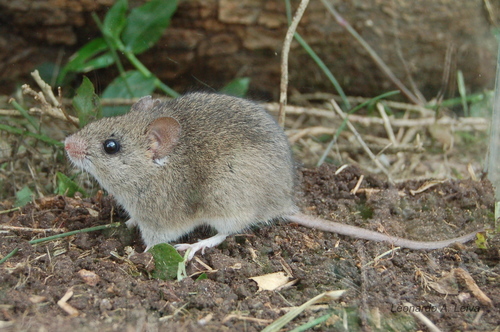
Small rodent with soft, grayish-brown to buffy dorsal fur, lighter or whitish ventral fur, large dark eyes, and moderately sized rounded ears. The tail is thinly haired and bicolored.
Size
Head-body length approximately 60-90 mm, with a tail roughly similar in length or slightly shorter than the body.
Weight
Approximately 10-20 grams, typical for small Calomys species.
Distinctive features
Distinguished from other Calomys species by subtle differences in skull morphology, dental characteristics, and pelage coloration that require careful taxonomic examination for confirmation.
Differences between males and females
Minimal sexual dimorphism; males and females are similar in size and coloration with only slight average size differences.
Behaviour and diet of the Delicate Vesper Mouse
Generally solitary or found in loose, low-density populations; social interactions are limited mainly to breeding encounters and territorial spacing.
When it is active
Primarily nocturnal, foraging and moving under cover of darkness to avoid predators and daytime heat.
Diet
Omnivorous diet consisting mainly of seeds, grasses, and other plant material, supplemented occasionally with insects and other invertebrates.
Communication
Communication likely involves ultrasonic vocalizations, scent marking through urine and glandular secretions, and tactile interactions during mating and maternal care, consistent with related Calomys species.
Interactions with other species
Serves as prey for a variety of predators including owls, snakes, and small carnivorous mammals; may compete with other small rodents for food and shelter resources in Cerrado habitats.
Role in its ecosystem
Plays an important ecological role as a seed disperser and prey species within Cerrado food webs, contributing to nutrient cycling and supporting predator populations.
Reproduction and lifecycle
Breeding likely occurs multiple times per year, with gestation lasting approximately 21-25 days as typical for the genus, producing litters of around 3-6 pups.
Raising the young
Females provide primary care, nursing and protecting young in nests until weaning, which occurs within a few weeks after birth as is typical for small murid rodents.
Maturity and lifespan
Sexual maturity is typically reached within 2-3 months; lifespan in the wild is generally short, around 1-2 years, though captive individuals of related species can live slightly longer.
Taxonomy and naming of the Delicate Vesper Mouse
Classification
Mammalia > Rodentia > Cricetidae > Calomys > Calomys tener
Scientific synonyms
Hesperomys tener (original combination)
What research says
Recent studies
Recent taxonomic revisions within the genus Calomys have used molecular phylogenetics to clarify species boundaries, though C. tener-specific genomic studies remain limited.
Compared with similar species
Similar in size and ecology to other Cerrado-dwelling Calomys species such as Calomys expulsus, but distinguished by subtle cranial and dental features requiring specialist identification.
The Delicate Vesper Mouse and people
Despite its common name suggesting fragility, this mouse is a hardy survivor adapted to the fire-prone, seasonally dry Cerrado ecosystem. It is one of many cryptic Calomys species that can only be reliably distinguished through detailed morphological or genetic analysis.
Where and how to see it
Best observed at night in Cerrado grassland reserves within Minas Gerais or Goiás using live-trapping methods typical of small mammal surveys, as the species is inconspicuous and rarely seen without targeted effort.
Risks to humans
No notable risk to humans, though as with other rodents there is a general low-level concern regarding zoonotic disease transmission through contact with feces or urine.
Countries where the Delicate Vesper Mouse is recorded
The 1 countries named in the range description of its IUCN Red List assessment.
Questions about the Delicate Vesper Mouse
Where does the Delicate Vesper Mouse live?
The Delicate Vesper Mouse is recorded in Brazil across South America. These countries come from the range description of its IUCN Red List assessment, and they are what place the species on the interactive map.
Is the Delicate Vesper Mouse endangered?
The IUCN Red List assesses the Delicate Vesper Mouse as Least Concern. The species is widespread and abundant enough not to qualify for any threatened category. It does not mean the species is safe forever, only that nothing in the current data raises an alarm.
How many are left in the wild?
No precise global population estimate exists, but the species is considered common within its range; population trend is presumed stable. This figure comes from the species assessment on the IUCN Red List; population estimates for wild mammals are ranges, not counts, and are revised at each assessment.
What habitat does the Delicate Vesper Mouse live in?
Inhabits open grasslands, savanna (Cerrado), and scrubland habitats, often in areas with grassy or herbaceous ground cover.
What is the scientific name of the Delicate Vesper Mouse?
The Delicate Vesper Mouse is Calomys tener, in the family Cricetidae, order Rodentia.
Other species in the genus Calomys

Other species in the family Cricetidae



Sources
Conservation status, range description and population estimate come from the IUCN Red List assessment for Calomys tener. Countries are derived from that range description, not from a mapped country list. Last refreshed on .
The distribution map is drawn from the IUCN Red List spatial data compiled in 2008. IUCN (International Union for Conservation of Nature)