
Highland Grass Mouse
Akodon aerosus
Red List assessment
Least Concernon the IUCN Red List
- EXExtinct
- EWExtinct in the Wild
- CRCritically Endangered
- ENEndangered
- VUVulnerable
- NTNear Threatened
- LCLeast Concern
The Highland Grass Mouse is recorded in 2 countries across South America. The IUCN Red List assesses the Highland Grass Mouse as Least Concern. No precise global population estimate is available.
- Family
- Cricetidae
- Order
- Rodentia
- Genus
- Akodon
- Countries recorded
- 2
- Continents
- South America
- Red List category
- Least Concern
- Data updated
- August 9, 2026
What is the Highland Grass Mouse?
The Highland Grass Mouse (Akodon aerosus) is a small sigmodontine rodent endemic to the Andean highlands of Peru and Ecuador. It inhabits high-altitude grasslands, páramo, and montane scrub, typically above 2,000 meters. Like other members of the genus Akodon, it is a ground-dwelling generalist omnivore well adapted to cold, humid mountain environments. Its broad ecological tolerance within its altitudinal range contributes to its Least Concern conservation status.
Where does the Highland Grass Mouse live?
Andes of northern and central Peru and southeastern Ecuador, primarily in montane grassland and cloud forest zones.
Found along the Andes of Ecuador (particularly Zamora-Chinchipe, Loja provinces) and northern to central Peru (departments of Amazonas, San Martín, Cajamarca, and Huánuco). Its range is largely restricted to the eastern and western Andean slopes and intermontane valleys.
Altitude and depth
Typically occurs between 2,000 and 4,000 meters above sea level, with peak abundance in the 2,500–3,500 m zone.
Seasonal movements
No major seasonal migrations documented. Activity levels and reproductive rates may fluctuate with seasonal rainfall patterns typical of Andean environments, with higher reproductive activity during warmer, wetter months.
Habitat of the Highland Grass Mouse
Primarily occupies high-altitude grasslands (jalca and puna), páramo shrublands, and the ecotone between montane cloud forest and open grassland. It is also found in disturbed habitats such as agricultural margins and roadside vegetation at appropriate elevations.
Adaptations to its environment
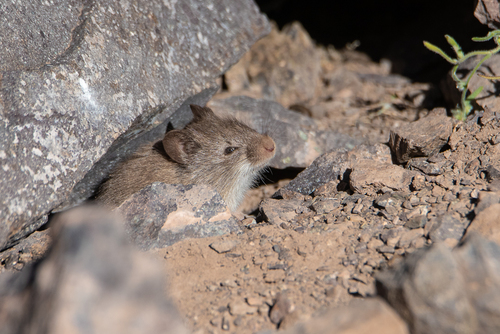
Dense, insulating fur provides thermoregulation in cold high-altitude climates with significant temperature fluctuations. Its robust, generalist dentition allows exploitation of a wide variety of food sources. Small body size and agile locomotion allow navigation through dense bunch-grass and rocky terrain.
Conservation status and numbers
Least Concern (LC) on the IUCN Red List. The species has a sufficiently broad distribution and tolerates some habitat modification, and no major population declines have been documented to warrant a higher threat category.
Estimated population
No precise global population estimate is available. The species is considered relatively common within suitable habitat; population trend is presumed stable, though localized declines may occur due to habitat pressures.
What threatens the Highland Grass Mouse?
Habitat degradation from overgrazing by livestock (cattle, sheep, llamas), agricultural expansion, burning of grasslands, and mining activities in the Andes. Climate change poses a long-term threat by shifting the altitudinal range of suitable páramo and puna habitats upward.
Diseases and parasites
Like other Akodon species, likely hosts ectoparasites (fleas, mites, ticks) and endoparasites (nematodes, cestodes). Some Akodon species are known reservoirs for hantaviruses, though specific data for A. aerosus are lacking.
What is being done to protect it?
Benefits indirectly from protected areas within its range such as national parks and reserves in Peru and Ecuador (e.g., Podocarpus National Park). No species-specific conservation programs are known to exist.
Recommended actions
Monitoring of population trends across the altitudinal range; protection and restoration of páramo and puna grasslands; regulation of livestock grazing in critical habitats; further taxonomic and ecological studies to clarify population structure and range limits.
What the Highland Grass Mouse looks like
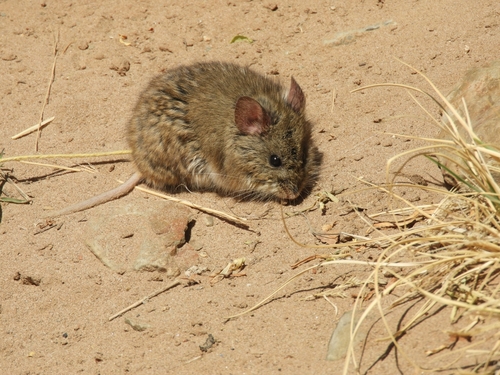
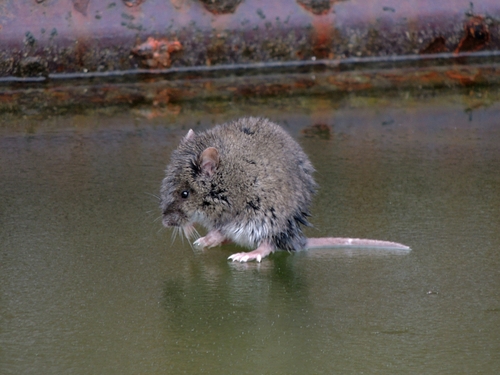
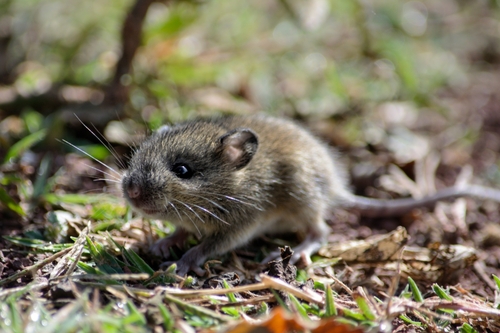
Dorsal fur is brownish to grayish-brown, often with a slightly grizzled appearance due to mixed dark and pale-tipped hairs. The ventral surface is grayish-white to pale buff. The tail is bicolored (darker above, paler below), relatively short, and lightly haired. Eyes and ears are moderately sized.
Size
Head-body length approximately 85–120 mm; tail length 60–90 mm (shorter than body length, as typical for Akodon).
Weight
Approximately 15–35 grams; slight variation between individuals depending on season and resource availability.
Distinctive features
Distinguished from closely related Akodon species by subtle cranial and dental morphology; in the field, it is very difficult to separate from sympatric congeners such as Akodon orophilus or Akodon torques without detailed morphological or genetic analysis. Its relatively short tail and robust build are consistent with other highland Akodon.
Differences between males and females
Minimal sexual dimorphism; males and females are similar in size and coloration. Males may be marginally larger on average, as is common in the genus.
Behaviour and diet of the Highland Grass Mouse
Largely solitary outside of the breeding season, as is typical for most small sigmodontine rodents. Individuals maintain small home ranges that may overlap with those of conspecifics.
When it is active
Predominantly nocturnal and crepuscular, with most foraging activity occurring during the night. Some diurnal activity may occur during cooler, overcast conditions typical of high-altitude environments.
Diet
Omnivorous; diet includes seeds, plant material (grass stems, roots, tubers), invertebrates (insects, larvae, earthworms), and fungi. The proportion of animal vs. plant matter likely varies seasonally with resource availability.
How it feeds and hunts
Forages actively on the ground, using its sensitive vibrissae to detect food items. Roots and scratches through leaf litter, soil, and grass tussocks to uncover invertebrates and buried seeds.
Communication
Communicates via ultrasonic vocalizations (common in sigmodontine rodents), scent marking with urine and glandular secretions to demarcate home ranges, and tactile signals during social interactions.
Interactions with other species
Prey for barn owls (Tyto alba), other raptors (hawks, falcons), Andean foxes (Lycalopex culpaeus), weasels (Mustela frenata), and various snakes. May compete with other small rodents such as Akodon orophilus or Thomasomys species for food and nesting sites.
Role in its ecosystem
Plays an important ecological role as a seed disperser and prey item in Andean food webs. Its burrowing and foraging activities contribute to soil aeration and nutrient cycling in high-altitude grassland ecosystems.
Reproduction and lifecycle
Breeding is likely opportunistic and linked to rainfall and food availability. Gestation period is approximately 21–23 days (as typical for Akodon). Litter size ranges from 2 to 5 pups, and multiple litters per year are probable under favorable conditions.
Raising the young
Altricial young are raised in a grass-lined nest by the female. Pups are weaned at approximately 2–3 weeks. Males provide little to no direct parental care.
Maturity and lifespan
Sexual maturity is likely reached at 1–3 months of age, as is typical for the genus. Lifespan in the wild is estimated at 1–2 years; individuals may survive longer in captivity.
Taxonomy and naming of the Highland Grass Mouse
Classification
Mammalia > Rodentia > Cricetidae (Sigmodontinae) > Akodon > Akodon aerosus
Scientific synonyms
Originally described by Oldfield Thomas (1914); occasionally referenced under broader Akodon boliviensis complex groupings in older literature, but currently treated as a distinct species.
What research says
Recent studies
Recent phylogeographic studies of Andean Akodon have clarified species boundaries within the A. boliviensis and related species groups, affirming A. aerosus as a distinct taxon. Molecular studies have highlighted the high cryptic diversity within highland Akodon assemblages.
Genome and DNA
The genus Akodon is notable for unusual sex chromosome variation, including XY females documented in some species. The diploid chromosome number for A. aerosus has not been widely published; related species typically have 2n = 24–40.
Compared with similar species
Akodon aerosus is closely related to Akodon orophilus (also Peruvian highlands) and Akodon torques; these species are nearly identical externally and require skull measurements or genetic data for reliable identification. It differs from lowland Akodon species (e.g., A. cursor) by its denser fur and higher altitudinal preferences.
The Highland Grass Mouse and people
The genus Akodon contains some of the most speciose rodent assemblages in the world, with over 40 species recognized, making it a hotspot of small mammal diversity. Some Akodon species are famous among mammalogists for having fertile XY females — a rare chromosomal anomaly in mammals. Despite being tiny and inconspicuous, highland grass mice are key components of Andean ecosystems, sustaining entire raptor and carnivore communities at altitudes where few other prey species exist.
Where and how to see it
Best observed at night using a headlamp along trail edges, grassland margins, and stream banks in the Andes of southern Ecuador and northern Peru at elevations above 2,500 m. Sherman live-trapping surveys in dense bunch-grass habitats are the most reliable detection method. Areas around Podocarpus National Park (Ecuador/Peru) offer good opportunities.
Risks to humans
No notable direct risk to humans. As with all wild rodents, there is a theoretical risk of disease transmission (e.g., hantavirus) through contact with feces or urine; standard precautions are advised when handling live or dead individuals.
Countries where the Highland Grass Mouse is recorded
The 2 countries named in the range description of its IUCN Red List assessment.
Questions about the Highland Grass Mouse
Where does the Highland Grass Mouse live?
The Highland Grass Mouse is recorded in Ecuador and Peru across South America. These countries come from the range description of its IUCN Red List assessment, and they are what place the species on the interactive map.
Is the Highland Grass Mouse endangered?
The IUCN Red List assesses the Highland Grass Mouse as Least Concern. The species is widespread and abundant enough not to qualify for any threatened category. It does not mean the species is safe forever, only that nothing in the current data raises an alarm.
How many are left in the wild?
No precise global population estimate is available. This figure comes from the species assessment on the IUCN Red List; population estimates for wild mammals are ranges, not counts, and are revised at each assessment.
What habitat does the Highland Grass Mouse live in?
Primarily occupies high-altitude grasslands (jalca and puna), páramo shrublands, and the ecotone between montane cloud forest and open grassland.
What is the scientific name of the Highland Grass Mouse?
The Highland Grass Mouse is Akodon aerosus, in the family Cricetidae, order Rodentia.
Other species in the genus Akodon

Other species in the family Cricetidae
Sources
Conservation status, range description and population estimate come from the IUCN Red List assessment for Akodon aerosus. Countries are derived from that range description, not from a mapped country list. Last refreshed on .
The distribution map is drawn from the IUCN Red List spatial data compiled in 2008. IUCN (International Union for Conservation of Nature)