
Grey-handed Night Monkey
Aotus griseimembra
Red List assessment
Vulnerableon the IUCN Red List
- EXExtinct
- EWExtinct in the Wild
- CRCritically Endangered
- ENEndangered
- VUVulnerable
- NTNear Threatened
- LCLeast Concern
The Grey-handed Night Monkey is recorded in 2 countries across South America. The IUCN Red List assesses the Grey-handed Night Monkey as Vulnerable. No precise global population estimate is available.
- Family
- Aotidae
- Order
- Primates
- Genus
- Aotus
- Countries recorded
- 2
- Continents
- South America
- Red List category
- Vulnerable
- Data updated
- August 9, 2026
What is the Grey-handed Night Monkey?
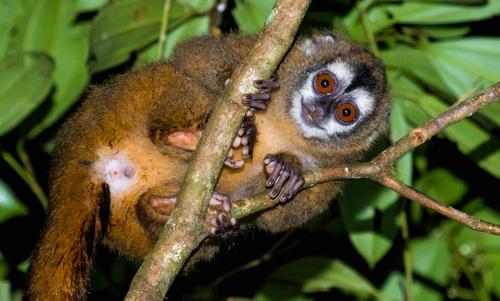
The Grey-handed Night Monkey is a small, nocturnal primate belonging to the family Aotidae, found in northern Colombia and northwestern Venezuela. It is distinguished by its grey-furred hands and limbs, large owl-like eyes adapted for night vision, and distinctive tricolored facial stripes. It is one of the only truly nocturnal anthropoid primates in the world, making it highly remarkable among New World monkeys. The species is considered Vulnerable due to severe habitat loss and fragmentation across its restricted range.
Where does the Grey-handed Night Monkey live?
Northern Colombia and northwestern Venezuela, primarily in lowland and foothill forests of the Caribbean and Andean slopes
Restricted to northern and northwestern Colombia (departments of Antioquia, Córdoba, Sucre, Bolívar, Atlántico, Chocó, and the Urabá Gulf region) and northwestern Venezuela (Zulia and Mérida states). The range broadly aligns with the Caribbean lowlands and the lower Andean foothills on both sides of the Colombia–Venezuela border.
Altitude and depth
Typically found from sea level to approximately 1500 m elevation, with the core of the population concentrated below 800 m in humid lowland and foothill forest zones.
Seasonal movements
No true seasonal migration recorded. Fruiting seasonality influences foraging patterns and home range use, as the species shifts diet composition in response to fruit availability. Activity levels and territorial behavior may intensify during peak reproductive periods.
Habitat of the Grey-handed Night Monkey
Primarily inhabits tropical lowland rainforests, gallery forests, and humid foothill forests up to approximately 1500 m elevation. It can tolerate secondary and fragmented forest patches but requires dense canopy cover for resting and foraging. It also uses forest edges and occasionally enters disturbed habitats near agricultural land.
Adaptations to its environment
Possesses exceptionally large eyes with an expanded tapetum lucidum, allowing highly efficient light capture in near-total darkness. The retina is rod-dominated, enabling sharp nocturnal vision. Its quiet, deliberate locomotion and cryptic coloration help avoid predators at night. Pair-bonding and small group size reduce resource competition and facilitate coordinated vigilance.
Conservation status and numbers
Listed as Vulnerable (VU) on the IUCN Red List (assessed 2015), primarily due to an estimated population decline exceeding 30% over three generations, driven by large-scale deforestation and habitat fragmentation across its already restricted range in Colombia and Venezuela.
Estimated population
No precise global population estimate is available. The population is considered declining, with fragmented subpopulations of variable and often small size across the northern Colombian departments and northwestern Venezuela.
What threatens the Grey-handed Night Monkey?
Deforestation for cattle ranching, agriculture (particularly banana and palm plantations in the Urabá region), and urban expansion are the primary threats. Illegal capture for the biomedical research trade (malaria studies) and the exotic pet trade pose additional pressure. Habitat fragmentation isolates populations and reduces genetic connectivity.
Diseases and parasites
Susceptible to Plasmodium vivax and P. falciparum malaria, which has made the genus Aotus extensively used in biomedical research. Known to harbor various intestinal helminths and ectoparasites. Herpesvirus and other viral pathogens documented in captive populations.
What is being done to protect it?
Listed on CITES Appendix II, restricting commercial international trade. Several protected areas within its range provide some habitat security, including the Paramillo National Natural Park and various regional reserves in Antioquia, Colombia. Captive colonies have been maintained for biomedical research under regulated conditions.
Recommended actions
Priority actions include expanding and connecting protected forest areas across the Colombian Caribbean lowlands, enforcing anti-deforestation laws in Antioquia and Córdoba, regulating and reducing capture for biomedical purposes, and conducting updated population surveys. Corridor restoration between forest fragments is critical to maintain gene flow among isolated subpopulations.
What the Grey-handed Night Monkey looks like
Dorsal fur is greyish-brown to agouti-brown; ventral fur ranges from pale grey to orange-buff. The hands and feet are distinctly grey, giving the species its common name. The face bears three bold black stripes (one median, two lateral) on a white background, with a black crown. The large, forward-facing eyes are dark brown with no tapetal eyeshine visible under direct light.
Size
Head-body length: 24–37 cm; tail length: 31–40 cm. Relatively compact build with a rounded head and no external ear pinnae visible through thick fur.
Weight
Typically 600–1100 g. Males and females are similar in body size with minimal weight dimorphism.
Distinctive features
Distinguished from the closely related Aotus lemurinus by its greyer extremities (hands and feet) and generally paler, more uniform dorsal coloration. Compared to the red-necked group (e.g., Aotus vociferans), it lacks the reddish-orange neck and flank coloration. The grey limbs are the most reliable visual marker for field identification.
Differences between males and females
Sexual dimorphism is minimal. Males and females are nearly identical in size and coloration. No significant secondary sexual characteristics are known, consistent with the monogamous mating system of the genus.
Behaviour and diet of the Grey-handed Night Monkey
Lives in monogamous pair-bonded family groups of 2–5 individuals, typically a mated adult pair and one to three offspring of different ages. Groups are cohesive, territorial, and maintain exclusive home ranges of approximately 5–12 hectares defended through vocalizations and scent marking.
When it is active
Strictly nocturnal. Activity begins shortly after sunset and ends before dawn. The species rests in tree holes, dense vine tangles, or leaf nests during daylight hours. Peak foraging occurs in the first half of the night.
Diet
Omnivorous, with diet varying seasonally. Ripe fruits form the dietary staple; supplemented with leaves, flowers, nectar, insects (orthopterans, beetles, moths), spiders, and occasionally small vertebrates such as frogs and lizards. Insects become proportionally more important during periods of fruit scarcity.
How it feeds and hunts
Insects and small prey are located by visual detection under low-light conditions, facilitated by exceptional nocturnal eyesight. The monkey moves slowly and deliberately through the understory and mid-canopy, gleaning insects from leaf surfaces and bark. Ambush-style capture with rapid hand grasping is used for mobile prey.
Communication
Uses a rich repertoire of vocalizations including hoots, grunts, screams, and resonant low-frequency calls ('resonance calls') produced using an enlarged hyoid apparatus. Scent marking via anogenital rubbing and urine washing is used to define territory boundaries. Visual signals include piloerection and body posturing during agonistic encounters.
Interactions with other species
Natural predators include large owls (e.g., Spectacled Owl, Pulsatrix perspicillata), ocelots, and arboreal snakes such as Corallus and Boa species. Competes with other frugivores (bats, other primates) for food resources. Acts as a seed disperser for various forest tree species consumed during frugivory.
Role in its ecosystem
Functions as a seed disperser for a range of fruiting plants in the Neotropical forest understory and mid-canopy. As a nocturnal insectivore-frugivore, it occupies a niche largely separate from diurnal primates, reducing interspecific competition. It is also part of the prey base for nocturnal apex predators.
Reproduction and lifecycle
Breeding appears to occur year-round with some seasonal peaks. Gestation lasts approximately 133 days. A single infant is born per birth event (twins are rare). Interbirth interval is roughly 12 months.
Raising the young
The father assumes primary infant-carrying duties after the first week of life, a hallmark behavior of the Aotus genus. The male carries, grooms, and protects the infant, returning it to the mother only for nursing. Older offspring may assist in carrying younger siblings (allomaternal care). Juveniles remain with the family group for 1–2 years.
Maturity and lifespan
Sexual maturity is reached at approximately 2–2.5 years of age. Lifespan in the wild is estimated at 12–15 years; in captivity, individuals have lived up to 20 years under optimal conditions.
Taxonomy and naming of the Grey-handed Night Monkey
Classification
Mammalia > Primates > Aotidae > Aotus > Aotus griseimembra
Subspecies
No recognized subspecies. Aotus griseimembra was formerly treated as a subspecies of Aotus lemurinus (Lemurine Night Monkey); current taxonomy recognizes it as a distinct species based on morphological and genetic data.
Scientific synonyms
Aotus lemurinus griseimembra (Elliot, 1912); sometimes historically included under Aotus trivirgatus in broad taxonomic treatments.
What research says
Recent studies
Recent phylogenetic analyses using mitochondrial and nuclear markers have reinforced the recognition of A. griseimembra as a distinct species separate from A. lemurinus. Studies on malaria parasite–host interactions in captive Aotus colonies have contributed significantly to vaccine development research. Updated IUCN assessments have refined range boundaries using locality records and remote-sensing deforestation data.
Genome and DNA
Belongs to the 'grey-necked' karyotype group of Aotus; the diploid chromosome number is reported as 2n = 54 for this group. The Aotus genus is notable for extraordinary karyotypic variation across species, with chromosome numbers ranging from 2n = 46 to 58, making it a model system for chromosomal evolution studies.
Compared with similar species
Most closely related to Aotus lemurinus (Lemurine Night Monkey) of the central Andes, from which it differs in extremity coloration and range. Both belong to the grey-necked group. Compared to Aotus vociferans (Noisy Night Monkey) of the Amazon, A. griseimembra has a more restricted range, greyer coloration, and lacks the orange neck patches typical of the red-necked group.
The Grey-handed Night Monkey and people
The Grey-handed Night Monkey is one of only two genera of truly nocturnal anthropoid primates on Earth (the other being the slow lorises of Asia). Aotus fathers are among the most dedicated primate dads known, carrying infants up to 90% of the time outside of nursing bouts. Despite their silent, cryptic nature at rest, family groups produce haunting, resonant hoots audible over hundreds of meters through dense forest at night.
Where and how to see it
Best observed in protected areas such as Paramillo National Natural Park in Córdoba, Colombia, or riverine forests along the lower Atrato and Sinú rivers. Observation requires nocturnal spotlighting surveys after dusk, listening for characteristic low hooting calls. A red-light headlamp minimizes disturbance. Local ecotourism guides in the Antioquia and Chocó departments may assist in locating known family territories.
Risks to humans
No notable risk to humans. The species is shy, cryptic, and nocturnal, making encounters rare. Bites can occur if the animal is handled (e.g., in capture for research), and as with all wild primates, zoonotic disease transmission is a theoretical risk, but documented cases are extremely rare.
Human uses
Historically captured for use in biomedical research, particularly as a model organism for human malaria vaccine and drug efficacy studies, due to its unique susceptibility to Plasmodium parasites. Also taken illegally for the pet trade. Such uses are regulated under CITES Appendix II, though illegal capture persists in some regions.
Myths and legends
Local communities in the Urabá and Sinú river regions of Colombia sometimes refer to night monkeys generically as 'martejas' or 'micos nocturnos.' They are occasionally regarded with superstition due to their eerie nocturnal calls and owl-like eyes, sometimes associated in rural folklore with omens or spirits of the forest. No specific mythological tradition uniquely attributed to this species is well documented.
Countries where the Grey-handed Night Monkey is recorded
The 2 countries named in the range description of its IUCN Red List assessment.
Questions about the Grey-handed Night Monkey
Where does the Grey-handed Night Monkey live?
The Grey-handed Night Monkey is recorded in Colombia and Venezuela across South America. These countries come from the range description of its IUCN Red List assessment, and they are what place the species on the interactive map.
Is the Grey-handed Night Monkey endangered?
Yes. The IUCN Red List assesses the Grey-handed Night Monkey as Vulnerable, one of the three threatened categories. The species faces a high risk of extinction in the wild. It is the first of the three threatened categories: numbers are falling, the range is shrinking, or the population is small enough that a single bad event could do lasting damage.
How many are left in the wild?
No precise global population estimate is available. This figure comes from the species assessment on the IUCN Red List; population estimates for wild mammals are ranges, not counts, and are revised at each assessment.
What habitat does the Grey-handed Night Monkey live in?
Primarily inhabits tropical lowland rainforests, gallery forests, and humid foothill forests up to approximately 1500 m elevation.
What is the scientific name of the Grey-handed Night Monkey?
The Grey-handed Night Monkey is Aotus griseimembra, in the family Aotidae, order Primates.
Other species in the genus Aotus

Species that share its range
Sources
Conservation status, range description and population estimate come from the IUCN Red List assessment for Aotus griseimembra. Countries are derived from that range description, not from a mapped country list. Last refreshed on .
The distribution map is drawn from the IUCN Red List spatial data compiled in 2008. IUCN (International Union for Conservation of Nature)