
Golden Spiny Mouse
Acomys russatus
Red List assessment
Least Concernon the IUCN Red List
- EXExtinct
- EWExtinct in the Wild
- CRCritically Endangered
- ENEndangered
- VUVulnerable
- NTNear Threatened
- LCLeast Concern
The Golden Spiny Mouse is recorded in 9 countries across Africa and Asia. The IUCN Red List assesses the Golden Spiny Mouse as Least Concern. No precise global population estimate is available.
- Family
- Muridae
- Order
- Rodentia
- Genus
- Acomys
- Countries recorded
- 9
- Continents
- Africa and Asia
- Red List category
- Least Concern
- Data updated
- August 9, 2026
What is the Golden Spiny Mouse?
The Golden Spiny Mouse is a small, arid-adapted rodent belonging to the family Muridae, named for its striking reddish-golden dorsal fur interspersed with stiff, spine-like hairs. It inhabits rocky desert and semi-arid environments across the Middle East and northeastern Africa, where it is remarkably well adapted to extreme heat and water scarcity. Uniquely among mammals, it possesses the ability to autotomize and completely regenerate large patches of skin—including hair follicles and sebaceous glands—without scarring, making it a subject of intense biomedical research. It is also one of the very few small rodents that are predominantly diurnal or crepuscular.
Where does the Golden Spiny Mouse live?
Egypt (Sinai Peninsula), Israel (Negev and Judean Deserts), Jordan, Saudi Arabia, Yemen, Oman, and parts of Sudan and Ethiopia.
Distributed across the Sinai Peninsula (Egypt), the Negev and Judean Deserts (Israel), Jordan including the Petra region, much of the Arabian Peninsula (Saudi Arabia, Yemen, Oman), and marginally into northeastern Sudan and possibly Eritrea.
Altitude and depth
Typically found from near sea level up to approximately 2,000 m elevation; most abundant in rocky desert terrain at low to moderate altitudes.
Seasonal movements
Non-migratory; no true hibernation. Activity patterns may shift seasonally, with reduced midday activity during peak summer heat. Breeding can occur year-round under favorable conditions but peaks in spring and autumn.
Habitat of the Golden Spiny Mouse
Rocky desert, arid and semi-arid scrubland, boulder fields, wadis (seasonal desert riverbeds), and limestone outcrops. It strongly prefers areas with rocky shelters and crevices that provide shade, protection from predators, and stable microclimates.
Adaptations to its environment
Produces highly concentrated urine and dry fecal pellets to minimize water loss. Can extract metabolic water from dry seeds. Dense spiny fur reduces heat absorption and may deter predators. Skin autotomy (shedding skin when grabbed) is a unique anti-predator defense. Its large eyes and ears enhance sensory detection in open rocky terrain.
Conservation status and numbers
Least Concern (LC) on the IUCN Red List, assessed as of 2016. The species has a wide range, tolerates a variety of arid conditions, and shows no evidence of rapid population decline. Local pressures exist but do not currently threaten the species at a global scale.
Estimated population
No precise global population estimate is available. The population is considered stable overall, though locally variable depending on habitat quality and human pressure.
What threatens the Golden Spiny Mouse?
Habitat degradation from urban expansion and tourism development near desert areas (e.g., Sinai, Negev). Overgrazing by livestock that alters rocky scrub vegetation. Climate change increasing aridity beyond tolerable limits. Introduced predators such as feral cats.
Diseases and parasites
Susceptible to ectoparasites including fleas, mites, and ticks. Can serve as a reservoir host for Leishmania parasites (cutaneous leishmaniasis). Has been used in research on metabolic and renal disease models.
What is being done to protect it?
Protected within several nature reserves including the Negev Highland reserves (Israel) and Sinai protected areas (Egypt). Israeli nature protection laws cover the species. No species-specific conservation programs are currently in place given its Least Concern status.
Recommended actions
Monitor population trends in peripheral range areas. Control invasive predators near key rocky habitats. Incorporate desert microhabitat protection into land-use planning. Support genetic studies to clarify subspecific diversity and manage potential future threats.
What the Golden Spiny Mouse looks like
Dorsal fur is reddish-golden to orange-brown with stiff, spine-like hairs mixed into the pelage. The undersides (belly, chin, feet) are white to cream. The face is pointed with large, dark eyes and prominent, lightly furred ears. The tail is scaly and lightly haired.
Size
Head-body length: 7–11 cm; tail length: 9–13 cm (tail roughly equal to or slightly longer than body).
Weight
Typically 30–70 g; males and females are similar in weight with slight male-biased size advantage.
Distinctive features
Distinguished from the closely related Cairo Spiny Mouse (Acomys cahirinus) by its warmer, more intensely golden-reddish coloration and slightly larger body size. Its spines are more conspicuous and its overall build is more robust. The two species overlap geographically but partition habitat and activity time.
Differences between males and females
Minimal; males and females are nearly identical in external appearance. Males may be marginally larger on average, but the difference is not reliably field-detectable.
Behaviour and diet of the Golden Spiny Mouse
Lives in small family groups or loose colonies centered around shared rock crevice dens. Communal nesting and alloparental care have been documented. Some territorial behavior is observed, especially between males.
When it is active
Primarily diurnal and crepuscular, which is exceptional among small desert rodents. In areas of sympatry with the nocturnal A. cahirinus, A. russatus shifts to strictly daytime activity to minimize interspecific competition—a textbook example of temporal niche partitioning.
Diet
Omnivorous. Diet includes dry seeds, plant material (leaves, fruits), insects, snails, and other invertebrates. Proportions shift seasonally based on resource availability; invertebrates become more important in dry seasons when seeds are scarce.
How it feeds and hunts
Actively forages among rocks, soil crevices, and desert vegetation using olfaction, vision, and hearing to detect invertebrate prey. Caches seeds opportunistically. Does not pursue swift prey; relies on close-range detection.
Communication
Uses high-frequency vocalizations for alarm and social bonding. Scent marking via urine and specialized glandular secretions communicates reproductive status and territory. Tactile interactions (grooming, huddling) play an important role in group cohesion.
Interactions with other species
Predated by barn owls (Tyto alba), desert snakes (e.g., Cerastes cerastes), red foxes (Vulpes vulpes), and domestic cats. Competes with A. cahirinus for food and shelter where ranges overlap. May share rocky retreats loosely with other small desert vertebrates.
Role in its ecosystem
Functions as a secondary consumer and seed disperser in desert ecosystems. As prey, it plays an important role in the diet of desert predators. Its burrowing and caching behavior may contribute to soil aeration and localized seed redistribution.
Reproduction and lifecycle
Breeding can occur year-round but peaks in spring and autumn. Gestation lasts approximately 38–42 days, notably long for a rodent of this size. Litter size is 1–3 pups (average 2). Young are born precocial—eyes open, well-furred, and mobile within hours of birth.
Raising the young
Both the mother and other group members (communal helpers) participate in pup care, including huddling for warmth and defense. Pups are weaned at approximately 3–4 weeks. The precocial nature of newborns reduces the period of vulnerability.
Maturity and lifespan
Sexual maturity is reached at approximately 6–10 weeks of age. In the wild, lifespan is estimated at 1.5–3 years. In captivity, individuals have been recorded living up to 5–6 years.
Taxonomy and naming of the Golden Spiny Mouse
Classification
Mammalia > Rodentia > Muridae > Acomys > Acomys russatus
Subspecies
Several subspecies have been proposed, including Acomys russatus russatus (Sinai, Israel, Jordan), Acomys russatus lewisi (Thomas, 1919; Arabian Peninsula), and Acomys russatus harrisoni (Setzer, 1971); however, their taxonomic validity is debated.
Scientific synonyms
Originally described as Mus russatus by Wagner in 1840; also formerly referenced under Acomys dimidiatus russatus in some older literature.
What research says
Recent studies
A landmark 2012 study in Nature (Seifert et al.) demonstrated that spiny mice, including A. russatus, can regenerate full-thickness skin—complete with hair follicles, sebaceous glands, and even cartilage—without fibrotic scarring, a capacity previously unknown in mammals. Subsequent studies have explored the mechanisms of this regeneration for potential applications in human wound-healing therapies.
Genome and DNA
Diploid chromosome number: 2n = 66. The genus Acomys has been the focus of significant genomic research related to wound healing and scarless tissue regeneration; studies have identified key differences in immune and extracellular matrix gene expression compared to scarring mammals.
Compared with similar species
Most closely related to Acomys cahirinus (Cairo Spiny Mouse), which is more widespread, nocturnal, and found in a broader range of habitats including human settlements. A. russatus is more strictly xeric and diurnal, and has a more vivid golden coloration. Both species share the remarkable skin regeneration trait. A. russatus is also more reproductively conservative (smaller litters, longer gestation) than most comparably sized murid rodents.
The Golden Spiny Mouse and people
1) The Golden Spiny Mouse can voluntarily shed large patches of its skin when grabbed by a predator—and then regenerate it completely without any scar tissue, a nearly unique ability among mammals. 2) Despite being a tiny rodent, it gives birth to precocial young with open eyes and functional legs, resembling a miniature guinea pig rather than a blind, naked mouse pup. 3) It is one of the very few small mammals on Earth that is active during the scorching daytime hours of desert summer, exploiting a temporal niche avoided by most competitors and some predators.
Where and how to see it
Best observed in the Negev Highlands and Ramon Crater (Israel) or the Sinai highlands (Egypt) during early morning (07:00–10:00) or late afternoon (16:00–19:00). Look carefully around large boulders and rocky crevices in wadis. The species is curious and may approach slowly moving observers. Spring and autumn offer the most activity.
Risks to humans
No notable direct risk to humans. May bite if handled carelessly. Can carry ectoparasites and potentially act as a reservoir for Leishmania in endemic areas; appropriate precautions should be taken when handling wild individuals.
Human uses
Used extensively as a laboratory model animal for research on desert physiology, renal water conservation, and—most prominently—scarless wound healing and tissue regeneration, with implications for human regenerative medicine. Not used for food or traditional medicine.
Countries where the Golden Spiny Mouse is recorded
The 9 countries named in the range description of its IUCN Red List assessment.
Questions about the Golden Spiny Mouse
Where does the Golden Spiny Mouse live?
The Golden Spiny Mouse is recorded in Egypt, Eritrea, Ethiopia, Israel and Jordan, among 9 countries in total across Africa and Asia. These countries come from the range description of its IUCN Red List assessment, and they are what place the species on the interactive map.
Is the Golden Spiny Mouse endangered?
The IUCN Red List assesses the Golden Spiny Mouse as Least Concern. The species is widespread and abundant enough not to qualify for any threatened category. It does not mean the species is safe forever, only that nothing in the current data raises an alarm.
How many are left in the wild?
No precise global population estimate is available. This figure comes from the species assessment on the IUCN Red List; population estimates for wild mammals are ranges, not counts, and are revised at each assessment.
What habitat does the Golden Spiny Mouse live in?
Rocky desert, arid and semi-arid scrubland, boulder fields, wadis (seasonal desert riverbeds), and limestone outcrops.
What is the scientific name of the Golden Spiny Mouse?
The Golden Spiny Mouse is Acomys russatus, in the family Muridae, order Rodentia.
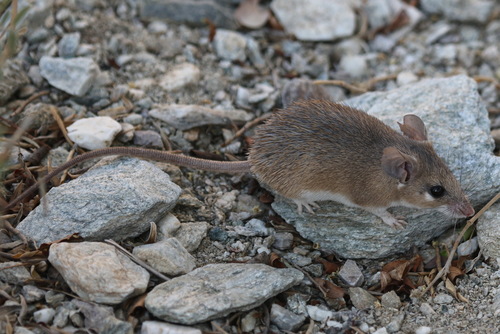
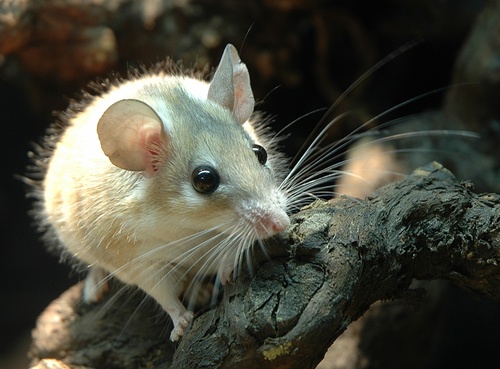
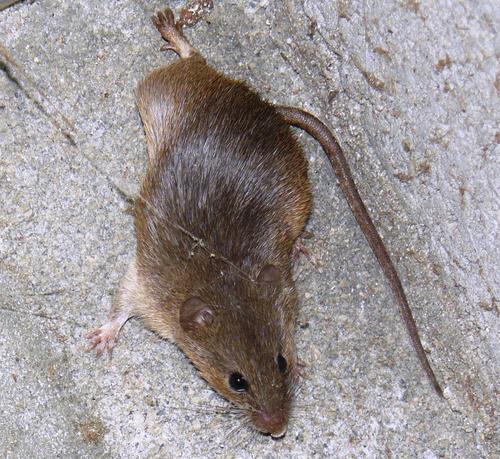
Other species in the genus Acomys
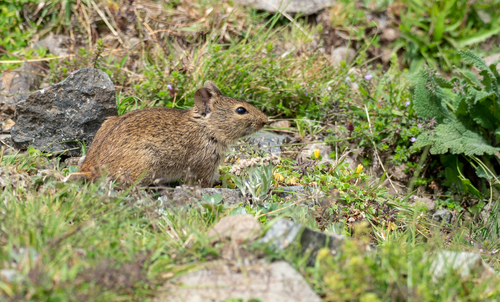
Other species in the family Muridae
Sources
Conservation status, range description and population estimate come from the IUCN Red List assessment for Acomys russatus. Countries are derived from that range description, not from a mapped country list. Last refreshed on .
The distribution map is drawn from the IUCN Red List spatial data compiled in 2008. IUCN (International Union for Conservation of Nature)