
Sulawesi Fruit Bat
Acerodon celebensis
Red List assessment
Vulnerableon the IUCN Red List
- EXExtinct
- EWExtinct in the Wild
- CRCritically Endangered
- ENEndangered
- VUVulnerable
- NTNear Threatened
- LCLeast Concern
The Sulawesi Fruit Bat is recorded in one country, Indonesia across Asia. The IUCN Red List assesses the Sulawesi Fruit Bat as Vulnerable. No precise global population estimate is available.
- Family
- Pteropodidae
- Order
- Chiroptera
- Genus
- Acerodon
- Countries recorded
- 1
- Continents
- Asia
- Red List category
- Vulnerable
- Data updated
- August 9, 2026
What is the Sulawesi Fruit Bat?
The Sulawesi Fruit Bat is a large megabat endemic to the island of Sulawesi and its satellite islands in Indonesia. It belongs to the genus Acerodon, which encompasses some of the largest bats on Earth, and is closely related to the famous Giant Golden-crowned Flying Fox. This species plays a critical ecological role as a seed disperser and pollinator in the island's tropical forest ecosystem. It is threatened by hunting and rapid deforestation, earning it Vulnerable status on the IUCN Red List.
Where does the Sulawesi Fruit Bat live?
Endemic to Sulawesi (Indonesia) and several surrounding smaller islands including Buton, Peleng, and the Togian Islands.
Strictly endemic to the Wallacea biogeographic region; found across Sulawesi (Indonesia) and associated smaller islands including Buton, Peleng, the Togian Islands, and possibly Bangka Island off North Sulawesi. Not found outside Indonesia.
Altitude and depth
Primarily found from sea level up to approximately 1,000–1,200 m, with most records from lowland forests below 800 m.
Seasonal movements
No formal long-distance migration is documented. However, local nomadic movements across the island in search of fruiting trees are likely, following seasonal fruiting patterns of key food plants.
Habitat of the Sulawesi Fruit Bat
Primarily inhabits lowland and foothill primary tropical rainforests, but also uses secondary forests and forest edges. It requires large, undisturbed trees for roosting and relies on mature forest for food resources such as ripe figs and other forest fruits.
Adaptations to its environment
Large wingspan enables efficient gliding over fragmented forest landscapes in search of fruiting trees. Keen olfactory and visual senses (large eyes adapted to low-light conditions) help locate ripe fruit at night. The robust skull and dentition are adapted to processing hard-skinned tropical fruits.
Conservation status and numbers
Vulnerable (VU) on the IUCN Red List. The species has experienced significant population declines estimated at over 30% across three generations, driven primarily by heavy hunting pressure and extensive habitat loss due to agricultural expansion and logging in Sulawesi.
Estimated population
No precise global population estimate is available. The population trend is considered declining, as evidenced by reduced colony sizes at known roosting sites and contraction of suitable forest habitat across Sulawesi.
What threatens the Sulawesi Fruit Bat?
The primary threat is unsustainable hunting for bushmeat, as these large bats are considered a delicacy and are harvested in large numbers at roost sites. Large-scale deforestation for agriculture (particularly cacao, palm oil, and rice) eliminates essential roosting and foraging habitat. Roost disturbance from logging and human encroachment also reduces reproductive success.
Diseases and parasites
Like other Acerodon and Pteropus species, it may harbor coronaviruses, paramyxoviruses, and ectoparasites (mites, flies of family Nycteribiidae). Its role as a potential reservoir for zoonotic viruses has received limited specific study compared to related genera.
What is being done to protect it?
The species occurs within several protected areas in Sulawesi, including Bogani Nani Wartabone National Park and Lore Lindu National Park. Indonesian national law provides some protection for wildlife, but enforcement at roost sites is inconsistent. The species is listed on CITES Appendix II, regulating international trade.
Recommended actions
Strengthening legal protection and enforcement against hunting at known roost sites is a priority. Expansion and improved management of protected areas covering key lowland forest habitats is urgently needed. Community-based conservation programs that offer alternative livelihoods to bat hunters, and long-term population monitoring programs, are also recommended.
What the Sulawesi Fruit Bat looks like
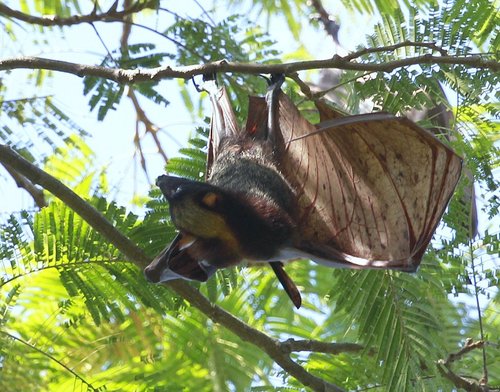
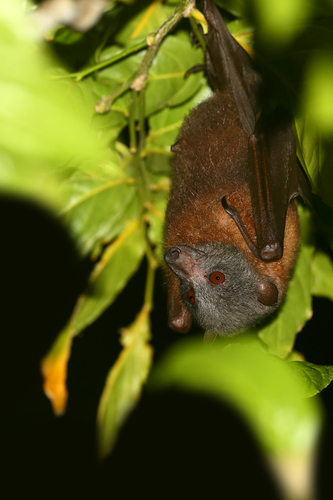
The fur is typically dark brown to blackish on the back, with a contrasting rufous-orange or golden-brown mantle around the neck and shoulders. The underparts are generally darker brown. The face is elongated and dog-like, characteristic of fruit bats, with large, forward-facing dark eyes and simple, unmodified ears.
Size
Head-body length approximately 22–30 cm. Wingspan estimated at 80–110 cm, making it one of the larger bat species in the Wallacea region.
Weight
Estimated body weight ranges from approximately 300 to 650 g, though precise data for this species are limited in the literature.
Distinctive features
Distinguished from other Sulawesi fruit bats (such as Pteropus species on the island) by the characteristic Acerodon skull morphology — specifically the absence of a post-orbital process — as well as its distinctive rufous neck mantle contrasting with the darker dorsal fur. It is smaller overall than the giant Acerodon jubatus of the Philippines.
Differences between males and females
Males are generally slightly larger than females, and males possess scrotal testes and may have slightly brighter mantle coloration during the breeding season. Overall dimorphism is moderate and not dramatically pronounced.
Behaviour and diet of the Sulawesi Fruit Bat
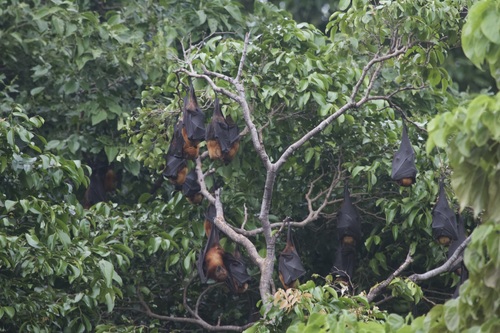
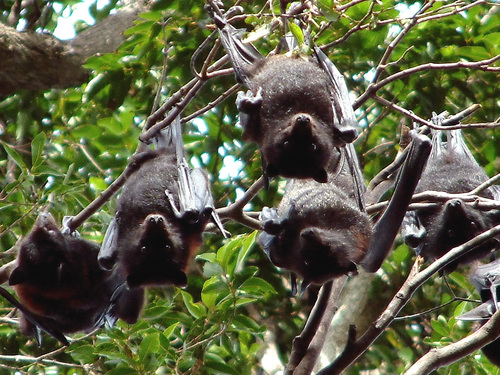
Roosts colonially, sometimes in mixed-species colonies alongside Pteropus species. Colonies can number from dozens to hundreds of individuals at a single roost tree. Within roosts, individuals maintain small individual space but tolerate close proximity to conspecifics.
When it is active
Nocturnal. The bat leaves roost sites at dusk and returns before dawn. Daytime is spent hanging in roost trees, often in exposed positions in the forest canopy.
Diet
Strictly frugivorous, with a diet consisting primarily of soft, fleshy tropical fruits (especially figs, Ficus spp.), as well as nectar and pollen from forest flowers. It may also consume young leaves occasionally. It is considered a keystone species for forest regeneration.
How it feeds and hunts
Forages by flying through the forest canopy and using olfaction and vision to locate ripe fruit. Fruit is either eaten in place or carried to a feeding perch. It employs a 'traplining' strategy, revisiting reliable fruiting trees along a nightly route.
Communication
Uses vocalizations including high-pitched screeches and social calls at roost sites, particularly during disputes over roosting positions or during mating. Scent glands on the shoulders (especially in males) may play a role in individual recognition and mate attraction.
Interactions with other species
Large raptors such as the Sulawesi Hawk-Eagle may be natural predators, particularly targeting young or injured individuals. The bat has an important mutualistic relationship with many tree species as a seed disperser and pollinator, making it a keystone species in Sulawesi's forest ecosystem. It may share roosting trees with other pteropodid species.
Role in its ecosystem
Functions as a critical seed disperser for large-seeded tropical trees and as a pollinator of night-blooming forest plants, contributing significantly to forest regeneration and biodiversity maintenance in Sulawesi. Its decline could trigger cascading effects on forest composition and regeneration.
Reproduction and lifecycle
Like most megabats, this species likely produces a single pup per birth event, with births typically timed to coincide with peak fruit availability. Gestation is estimated at around 5–6 months. Precise breeding seasonality data for this species from Sulawesi are limited.
Raising the young
Mothers nurse and carry the young pup for several weeks after birth. Pups are left at the roost while the mother forages at night once the pup grows too heavy to carry. Weaning likely occurs after 2–4 months, which is typical of pteropodid bats.
Maturity and lifespan
Sexual maturity is likely reached at 1–2 years of age, consistent with related pteropodid species. Lifespan in the wild is estimated at 10–20 years; captive lifespans for large fruit bats can exceed 20–25 years.
Taxonomy and naming of the Sulawesi Fruit Bat
Classification
Mammalia > Chiroptera > Pteropodidae > Acerodon > Acerodon celebensis
Scientific synonyms
Pteropus celebensis (Temminck, 1837); occasionally listed as Acerodon celebensis celebensis in older literature, though no formally recognized subspecies are currently accepted.
What research says
Recent studies
Recent field surveys in Sulawesi have documented the continued decline of roost colony sizes and confirmed ongoing hunting pressure even within protected areas. Biogeographic studies of Wallacean bats have highlighted Acerodon celebensis as a priority species for conservation given its restricted range and ecological importance.
Genome and DNA
No published complete genome sequence is available specifically for Acerodon celebensis. Phylogenetic studies using mitochondrial and nuclear markers have confirmed its placement within the genus Acerodon and its close relationship to A. jubatus of the Philippines.
Compared with similar species
Most closely related to the Giant Golden-crowned Flying Fox (Acerodon jubatus) of the Philippines, which is the world's largest bat by wingspan. Acerodon celebensis is generally smaller than A. jubatus and lacks the distinctive golden crown. It shares its ecosystem with several Pteropus species in Sulawesi, from which it is distinguished by skull morphology and mantle coloration.
The Sulawesi Fruit Bat and people
1) As a member of the genus Acerodon, this bat belongs to a lineage that includes the world's largest bat species by wingspan — making it a relative of true giants of the bat world. 2) This bat can travel tens of kilometers in a single night in search of fruiting trees, acting as a long-distance ecological engineer by depositing seeds far from parent trees. 3) Despite its large size, it is entirely harmless to humans and feeds exclusively on plant material, playing a role more akin to a flying pollinator than a typical bat.
Where and how to see it
The best opportunities for observing this species are at dusk near known roost sites in lowland forests of South and Central Sulawesi, particularly within or near Lore Lindu National Park and Bogani Nani Wartabone National Park. Dawn and dusk are ideal times as the bats leave or return to roost. Binoculars are recommended, as roost trees are typically in tall forest canopy.
Risks to humans
No notable risk to humans under normal circumstances. Like all wild bats, it should not be handled without protective equipment due to the theoretical risk of zoonotic virus transmission, but it presents no aggressive threat and does not attack humans.
Human uses
Heavily hunted for bushmeat across Sulawesi; the meat is sold in local markets and is considered a traditional food source in many communities. This hunting pressure is the primary driver of its population decline. There is no significant use in traditional medicine or the international pet trade.
Myths and legends
In parts of Sulawesi, large fruit bats are generally regarded as a food resource rather than a feared creature. Local communities in some areas have traditional beliefs connecting bat colonies to the health of the forest, though specific myths centered on Acerodon celebensis are not well documented in the scientific literature.
Countries where the Sulawesi Fruit Bat is recorded
The 1 countries named in the range description of its IUCN Red List assessment.
Questions about the Sulawesi Fruit Bat
Where does the Sulawesi Fruit Bat live?
The Sulawesi Fruit Bat is recorded in Indonesia across Asia. These countries come from the range description of its IUCN Red List assessment, and they are what place the species on the interactive map.
Is the Sulawesi Fruit Bat endangered?
Yes. The IUCN Red List assesses the Sulawesi Fruit Bat as Vulnerable, one of the three threatened categories. The species faces a high risk of extinction in the wild. It is the first of the three threatened categories: numbers are falling, the range is shrinking, or the population is small enough that a single bad event could do lasting damage.
How many are left in the wild?
No precise global population estimate is available. This figure comes from the species assessment on the IUCN Red List; population estimates for wild mammals are ranges, not counts, and are revised at each assessment.
What habitat does the Sulawesi Fruit Bat live in?
Primarily inhabits lowland and foothill primary tropical rainforests, but also uses secondary forests and forest edges.
What is the scientific name of the Sulawesi Fruit Bat?
The Sulawesi Fruit Bat is Acerodon celebensis, in the family Pteropodidae, order Chiroptera.
Other species in the genus Acerodon
Other species in the family Pteropodidae


Species that share its range
Sources
Conservation status, range description and population estimate come from the IUCN Red List assessment for Acerodon celebensis. Countries are derived from that range description, not from a mapped country list. Last refreshed on .
The distribution map is drawn from the IUCN Red List spatial data compiled in 2022. IUCN (International Union for Conservation of Nature)