
Sunda Fruit Bat
Acerodon mackloti
Red List assessment
Vulnerableon the IUCN Red List
- EXExtinct
- EWExtinct in the Wild
- CRCritically Endangered
- ENEndangered
- VUVulnerable
- NTNear Threatened
- LCLeast Concern
The Sunda Fruit Bat is recorded in one country, Indonesia across Asia. The IUCN Red List assesses the Sunda Fruit Bat as Vulnerable. No precise global population estimate is available; the population is inferred to be in the tens of thousands at most, with a clearly declining trend based on reduced colony sizes and hunting records over recent decades.
- Family
- Pteropodidae
- Order
- Chiroptera
- Genus
- Acerodon
- Countries recorded
- 1
- Continents
- Asia
- Red List category
- Vulnerable
- Data updated
- August 9, 2026
What is the Sunda Fruit Bat?
Acerodon mackloti is a medium-to-large Old World fruit bat (family Pteropodidae) endemic to the Lesser Sunda Islands of Indonesia. Like other members of the genus Acerodon, it has a dog-like facial profile, large forward-facing eyes, and long narrow wings adapted for sustained flight. It is ecologically vital as a pollinator and seed disperser across fragmented island forests. The species is listed as Vulnerable due to ongoing hunting pressure and rapid habitat loss.
Where does the Sunda Fruit Bat live?
Indonesia, specifically the Lesser Sunda Islands (Nusa Tenggara region), including Lombok, Sumbawa, Flores, Sumba, Timor, and adjacent smaller islands.
Restricted to Indonesia's Lesser Sunda Islands: Lombok, Sumbawa, Flores, Sumba, Savu, Rote, and Timor (both Indonesian West Timor and the eastern portions of Timor island), along with several smaller surrounding islands in the Nusa Tenggara archipelago.
Altitude and depth
Primarily found from sea level to approximately 1,200 m altitude; most foraging and roosting activity recorded below 800 m in lowland and foothill forest zones.
Seasonal movements
No long-distance seasonal migrations are recorded; local nomadic movements between islands or across the landscape likely occur in response to the availability of fruiting and flowering trees, which varies with the pronounced dry and wet seasons of this region.
Habitat of the Sunda Fruit Bat
Primary and secondary lowland tropical rainforest, montane forest up to moderate elevations, and forest edges adjacent to fruiting trees. Occasionally uses mangrove fringes and garden-forest mosaics near human settlements when natural habitat is degraded.
Adaptations to its environment
Large eyes provide excellent low-light vision for nocturnal foraging. A highly developed olfactory system aids in detecting ripe fruit over long distances. Strong pectoral muscles and elongated wing bones enable efficient flapping flight across island straits. Roost site fidelity helps exploit predictable food patches in seasonally variable forests.
Conservation status and numbers
Vulnerable (VU) on the IUCN Red List. The species qualifies because population size is estimated to have declined by at least 30% over three generations (approximately 15–18 years) due to combined pressures of unsustainable hunting and continuing deforestation across its restricted island range.
Estimated population
No precise global population estimate is available; the population is inferred to be in the tens of thousands at most, with a clearly declining trend based on reduced colony sizes and hunting records over recent decades.
What threatens the Sunda Fruit Bat?
Intense hunting for bushmeat is the primary driver of decline; large fruit bats fetch high prices at local markets across Nusa Tenggara. Rapid deforestation for agriculture (particularly palm oil and smallholder farming), logging, and land conversion destroys roosting colonies and reduces food availability. Cave roost disturbance and illegal wildlife trade compound these pressures.
Diseases and parasites
Known to harbor various bat flies (Diptera: Streblidae) and mite species as ectoparasites. Fruit bats in Southeast Asia are recognized reservoirs for coronaviruses and other paramyxoviruses; specific viral surveillance data for A. mackloti are limited, but spillover risk is considered low under normal conditions.
What is being done to protect it?
Parts of its range fall within Indonesian national parks and protected areas such as Komodo National Park and Kelimutu National Park (Flores). Indonesian national law (PP No. 7/1999 and its revisions) lists large fruit bats under restricted-trade regulations, though enforcement is inconsistent. Regional wildlife monitoring programs by NGOs operate intermittently.
Recommended actions
Strengthen and enforce hunting moratoriums across all Lesser Sunda Islands. Expand and effectively manage protected areas to include key roosting colonies. Conduct systematic population surveys to establish baseline data. Develop community-based conservation incentives to reduce reliance on bushmeat. Promote habitat restoration corridors between fragmented forest patches.
What the Sunda Fruit Bat looks like
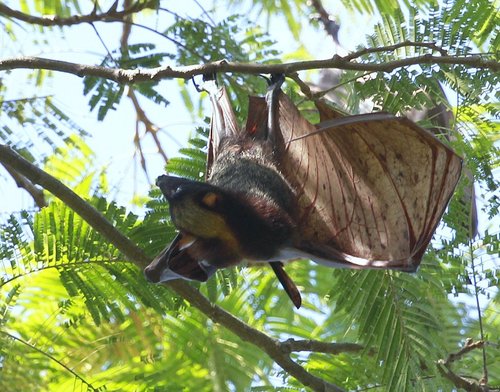
Fur on the back is predominantly dark brown to blackish-brown, with slightly paler underfur on the belly ranging from tawny-brown to pale buff. The face is elongated and fox-like, with a relatively pointed muzzle. Wing membranes are dark brownish-black and leathery. The eyes are proportionally large and amber-brown.
Size
Head-body length approximately 20–25 cm; forearm length roughly 130–155 mm; wingspan estimated at 70–90 cm. No tail or extremely rudimentary tail.
Weight
Approximately 250–450 g; males tend to be slightly larger than females, though precise sex-specific weight ranges are not well documented for this species.
Distinctive features
Distinguished from sympatric Pteropus species by the characteristic Acerodon skull morphology: a prominent sagittal crest and robust zygomatic arches adapted for hard-fruit crushing. Smaller overall than Acerodon jubatus and lacking the golden crown of that species. The mantle coloration is generally more uniform dark-brown compared to the contrasting pale nape seen in some congeners.
Differences between males and females
Males are marginally larger than females in body mass and forearm length. Males possess prominent scrotal testes and may have slightly broader skulls. No striking color differences between sexes are reported.
Behaviour and diet of the Sunda Fruit Bat
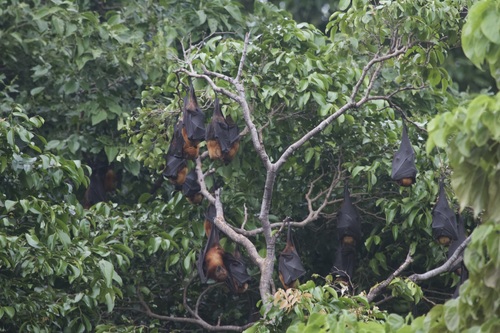
Colonial and gregarious; roosts in trees (and occasionally caves) in groups ranging from dozens to several hundred individuals. Mixed-sex colonies are typical outside the breeding season. Dominance hierarchies within roost trees occur, with larger individuals monopolizing central, sheltered roost positions.
When it is active
Primarily nocturnal, leaving roosts at dusk to forage and returning before dawn. Some crepuscular activity around dusk and dawn transitions. During the day, individuals roost hanging from branches, often fanning themselves with wings in high temperatures.
Diet
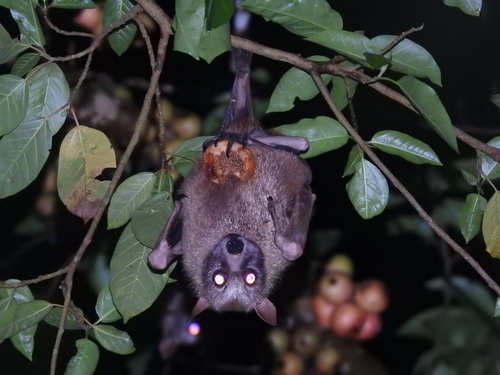
Frugivorous and nectarivorous; diet consists mainly of soft, ripe fruits (figs, wild mangoes, papayas, and various forest fruits), supplemented by flower nectar and pollen from large blossoms. Occasionally consumes leaf buds and bark moisture during dry seasons.
How it feeds and hunts
Forages by flying through forest canopy and subcanopy, using vision and olfaction to locate ripe fruits and flowers. Fruit is plucked in flight or while hanging; fibrous material is often chewed and the juice extracted before spitting out the pulp. Individuals may travel 20–40 km per night in search of food.
Communication
Vocalizations include high-pitched squeaks and chattering calls used for social interaction at roosts, as well as low-frequency visual and olfactory signals. Scent glands on the chest and neck (more prominent in males) may play a role in mate attraction and territory marking at roost sites.
Interactions with other species
Key seed dispersers and pollinators for many native island trees, including species with large, bat-adapted flowers. Potential predators include large owls (e.g., Tyto species), large snakes, and raptors. Competes with Pteropus species where ranges overlap. Ectoparasites such as bat flies (Streblidae) and mites are expected based on related species.
Role in its ecosystem
Acts as a critical 'keystone' pollinator and long-distance seed disperser across the Lesser Sunda island ecosystems, maintaining forest regeneration and plant diversity. Its nightly foraging flights link fragmented forest patches, making it particularly important in a landscape heavily modified by human activity.
Reproduction and lifecycle
Breeding biology is not well studied for this species specifically. Based on related Acerodon and Pteropus species, a single pup per year is typical. Mating likely peaks in the late dry season, with births timed to coincide with peak fruit availability in the wet season. Gestation estimated at approximately 150–180 days.
Raising the young
The mother carries the newborn pup clinging to her chest during early weeks of life. As the pup grows too heavy for transport, it is left at the roost while the mother forages. Weaning likely occurs at 3–5 months. Paternal care is not documented.
Maturity and lifespan
Sexual maturity is estimated at 1–2 years of age, consistent with other Acerodon species. Maximum lifespan in the wild is estimated at 10–15 years; captive lifespans for congeners can exceed 20 years under managed care.
Taxonomy and naming of the Sunda Fruit Bat
Classification
Mammalia > Chiroptera > Pteropodidae > Acerodon > Acerodon mackloti
Subspecies
No firmly recognized subspecies are currently accepted; some historical descriptions have proposed geographic variants across different islands, but these await formal revision.
Scientific synonyms
Originally described as Pteropus mackloti Temminck, 1837; also referenced in older literature under Cynopterus mackloti. The species epithet honors Dutch naturalist Heinrich Christian Macklot (1799–1832).
What research says
Recent studies
Recent systematic revisions of Pteropodidae using molecular phylogenetics have re-evaluated the relationships between Acerodon species. Hunting pressure and market surveys in Nusa Tenggara have highlighted A. mackloti as among the most commercially traded bats in eastern Indonesia, drawing increased conservation attention.
Genome and DNA
No published chromosome count or full genome sequence is available specifically for Acerodon mackloti. Phylogenomic studies on Pteropodidae place Acerodon as a well-supported monophyletic genus sister to or nested within a broader Pteropus clade.
Compared with similar species
Compared to the critically endangered Acerodon jubatus (Giant Golden-crowned Flying Fox) of the Philippines, A. mackloti is considerably smaller and lacks the distinctive golden mantle. It is similar in size to Acerodon celebensis (Sulawesi Fruit Bat) but has a more restricted range and darker, more uniform dorsal pelage. Both differ from Pteropus species in skull morphology and the presence of a pronounced sagittal crest.
The Sunda Fruit Bat and people
Acerodon mackloti can travel up to 40 km in a single night of foraging, effectively acting as a flying forest gardener that deposits seeds across multiple habitat patches. Like all Old World fruit bats, it lacks the echolocation system of microbats and instead relies almost entirely on its large eyes and acute sense of smell to navigate and find food. Its role as a pollinator is so significant that some island trees have evolved flowers that open exclusively at night, shaped precisely for bat-pollination.
Where and how to see it
Best observed at dusk when colonies depart roost trees en masse; look for large communal roosts in tall emergent trees within or near Komodo National Park (Flores) and forested areas of Sumbawa and Timor. Local wildlife guides and conservation NGOs in Labuan Bajo (Flores) can assist in locating active roost sites. Avoid disturbing roosts during the midday heat when bats are most vulnerable.
Risks to humans
No notable direct risk to humans under normal observation conditions. As with all wild bats, handling should be avoided due to the theoretical risk of bat-associated viruses. It does not possess venom. Bite risk exists only if an animal is cornered or handled without protection.
Human uses
Heavily hunted for bushmeat across Nusa Tenggara; large fruit bats are sold at local markets and consumed as a traditional protein source. Some trade in live animals and their products occurs at regional wildlife markets. No significant role in traditional medicine specific to this species has been documented, though broader cultural use of bats for medicinal purposes exists in the region.
Myths and legends
In some communities across Nusa Tenggara, large fruit bats are considered omens or are associated with ancestral spirits. Their gathering in large roost trees at dusk is sometimes interpreted as a sign of a fertile or spiritually significant landscape. However, no widely documented mythology is specifically attributed to this species.
Countries where the Sunda Fruit Bat is recorded
The 1 countries named in the range description of its IUCN Red List assessment.
Questions about the Sunda Fruit Bat
Where does the Sunda Fruit Bat live?
The Sunda Fruit Bat is recorded in Indonesia across Asia. These countries come from the range description of its IUCN Red List assessment, and they are what place the species on the interactive map.
Is the Sunda Fruit Bat endangered?
Yes. The IUCN Red List assesses the Sunda Fruit Bat as Vulnerable, one of the three threatened categories. The species faces a high risk of extinction in the wild. It is the first of the three threatened categories: numbers are falling, the range is shrinking, or the population is small enough that a single bad event could do lasting damage.
How many are left in the wild?
No precise global population estimate is available; the population is inferred to be in the tens of thousands at most, with a clearly declining trend based on reduced colony sizes and hunting records over recent decades. This figure comes from the species assessment on the IUCN Red List; population estimates for wild mammals are ranges, not counts, and are revised at each assessment.
What habitat does the Sunda Fruit Bat live in?
Primary and secondary lowland tropical rainforest, montane forest up to moderate elevations, and forest edges adjacent to fruiting trees.
What is the scientific name of the Sunda Fruit Bat?
The Sunda Fruit Bat is Acerodon mackloti, in the family Pteropodidae, order Chiroptera.
Other species in the genus Acerodon
Other species in the family Pteropodidae


Species that share its range
Sources
Conservation status, range description and population estimate come from the IUCN Red List assessment for Acerodon mackloti. Countries are derived from that range description, not from a mapped country list. Last refreshed on .
The distribution map is drawn from the IUCN Red List spatial data compiled in 2008. IUCN (International Union for Conservation of Nature)