
Giraffe
Giraffa camelopardalis
Red List assessment
Vulnerableon the IUCN Red List
- EXExtinct
- EWExtinct in the Wild
- CRCritically Endangered
- ENEndangered
- VUVulnerable
- NTNear Threatened
- LCLeast Concern
The Giraffe is recorded in 11 countries across Africa. The IUCN Red List assesses the Giraffe as Vulnerable. Approximately 117,000 individuals remain in the wild as of recent surveys, with an overall declining trend, though some populations in southern Africa are stable or increasing due to conservation efforts.
- Family
- Giraffidae
- Order
- Artiodactyla
- Genus
- Giraffa
- Countries recorded
- 11
- Continents
- Africa
- Red List category
- Vulnerable
- Data updated
- August 9, 2026
What is the Giraffe?
The giraffe is the tallest living terrestrial animal, renowned for its extraordinarily long neck and legs which allow it to browse high foliage inaccessible to other herbivores. Native to the savannas, grasslands, and open woodlands of sub-Saharan Africa, it plays a key ecological role as a browser shaping vegetation structure. Its distinctive patterned coat, unique gait, and gentle demeanor have made it an iconic symbol of African wildlife.
Where does the Giraffe live?
Sub-Saharan Africa, primarily in savanna and woodland regions of countries such as Kenya, Tanzania, Namibia, Botswana, South Africa, and Niger.
Historically widespread across sub-Saharan Africa, giraffes now occur in fragmented populations across East Africa (Kenya, Tanzania, Uganda), Southern Africa (Namibia, Botswana, South Africa, Zimbabwe, Zambia), and small pockets in West and Central Africa (Niger, Chad, Cameroon). They have been extirpated from much of their former West African range.
Altitude and depth
Typically found from sea level up to about 2000 meters elevation, depending on habitat availability and vegetation type.
Seasonal movements
Giraffes do not undergo long-distance migrations but may shift ranges seasonally in response to rainfall patterns and forage/water availability, moving to more productive areas during dry seasons.
Habitat of the Giraffe
Giraffes inhabit savannas, open woodlands, and acacia-dominated grasslands where scattered trees provide browsing opportunities. They avoid dense forests and rely on areas with sufficient tree cover interspersed with open space for predator detection.
Adaptations to its environment
Giraffes possess specialized cardiovascular adaptations including a large, powerful heart and tight skin on the legs to manage blood pressure changes from their height. Their long prehensile tongues (up to 45 cm) and tough lips allow them to browse thorny acacia trees, while their height gives them access to food unavailable to competitors and excellent predator vigilance.
Conservation status and numbers
Vulnerable (VU) according to IUCN Red List, reflecting an estimated population decline of approximately 30% over the past three decades due to habitat loss, poaching, and civil unrest in parts of their range. Some subspecies, like the Kordofan and Nubian giraffe, are Critically Endangered or Endangered.
Estimated population
Approximately 117,000 individuals remain in the wild as of recent surveys, with an overall declining trend, though some populations in southern Africa are stable or increasing due to conservation efforts.
What threatens the Giraffe?
Major threats include habitat loss and fragmentation from agricultural expansion, illegal poaching for meat and body parts, civil conflict in parts of Africa, and human-wildlife conflict due to expanding human settlements.
Diseases and parasites
Giraffes can be affected by giraffe skin disease (a poorly understood dermatological condition), ticks, and various parasitic worms, as well as anthrax outbreaks in some regions.
What is being done to protect it?
Conservation initiatives include protected areas and national parks across Africa, community-based conservation programs, anti-poaching patrols, and translocation projects to establish new populations. Organizations like the Giraffe Conservation Foundation lead research and awareness campaigns.
Recommended actions
Priority actions include strengthening anti-poaching enforcement, protecting and connecting fragmented habitats via wildlife corridors, supporting community-based conservation incentives, and conducting further genetic research to guide subspecies-specific conservation strategies.
What the Giraffe looks like
Giraffes have a distinctive coat pattern of brown or chestnut patches separated by lighter cream-colored lines, unique to each individual like a fingerprint. Their long neck, elongated legs, sloping back, and small ossicones (skin-covered horns) atop the head give them an unmistakable silhouette.
Size
Adult giraffes stand 4.3 to 5.7 meters tall, with males generally taller than females; body length excluding neck is around 3.5 to 4.5 meters.
Weight
Males typically weigh 800 to 1,930 kg, while females weigh 550 to 1,180 kg, making giraffes one of the heaviest terrestrial herbivores.
Distinctive features
The combination of extreme height, patchwork coat pattern, ossicones, and prehensile blue-black tongue distinguishes giraffes from all other mammals. Different subspecies can be identified by variations in coat pattern shape and coloration.
Differences between males and females
Males are generally larger and heavier than females, with thicker, balder ossicones due to sparring behavior, while females retain hair-tufted ossicones. Males also exhibit darker coat coloration with age.
Behaviour and diet of the Giraffe
Giraffes live in loose, fluid social groups called towers, typically consisting of females and young, with no fixed membership or strict hierarchy. Adult males are often more solitary or move between groups searching for mates, and social bonds can shift frequently.
When it is active
Giraffes are primarily diurnal but display polyphasic activity, resting only a few hours per day and sleeping in short bursts (often standing), remaining largely active throughout daylight hours.
Diet
Giraffes are herbivorous browsers feeding mainly on acacia leaves, shoots, and fruits, consuming up to 30 kg of vegetation daily. They also eat other trees and shrubs depending on availability, showing preference for nutrient-rich new growth.
Communication
Giraffes communicate through body postures, visual displays, and low-frequency infrasonic sounds inaudible to humans, along with occasional grunts, snorts, and hums. Necking behavior (neck sparring) among males also serves as a communication and dominance display.
Interactions with other species
Adult giraffes have few natural predators aside from lions, which occasionally prey on adults, while young calves are vulnerable to lions, hyenas, and leopards. They often share habitat with other herbivores like zebras and antelope, sometimes benefiting from mutual predator vigilance.
Role in its ecosystem
As browsers, giraffes play a key role in shaping woodland structure by pruning tall vegetation, and their movement and dung contribute to seed dispersal and nutrient cycling within savanna ecosystems.
Reproduction and lifecycle
Breeding occurs year-round with no strict seasonality; gestation lasts about 400-460 days (13-15 months), and females typically give birth to a single calf standing over 1.8 meters tall at birth. Calves can stand and walk within hours of birth.
Raising the young
Mothers provide primary care, nursing calves for up to a year while calves also begin browsing within weeks. Calves are vulnerable to predation and are sometimes left in nursery groups (crèches) guarded by one adult while others forage.
Maturity and lifespan
Females typically reach sexual maturity around 4-5 years and males around 4-6 years, though males often don't breed until later due to competition. Lifespan in the wild is around 20-25 years, while captive individuals can live up to 28 years or more.
Taxonomy and naming of the Giraffe
Classification
Class Mammalia > Order Artiodactyla > Family Giraffidae > Genus Giraffa > Species Giraffa camelopardalis
Subspecies
Traditionally nine subspecies recognized including G. c. camelopardalis (Nubian, Sudan/South Sudan), G. c. reticulata (Reticulated, Kenya), G. c. rothschildi (Rothschild's, Uganda/Kenya), G. c. tippelskirchi (Masai, Tanzania/Kenya), G. c. giraffa (South African, Botswana/South Africa), G. c. angolensis (Angolan, Namibia/Botswana), G. c. antiquorum (Kordofan, Chad/CAR), G. c. peralta (West African, Niger), G. c. thornicrofti (Thornicroft's, Zambia). Recent genetic studies suggest these may represent up to four distinct species.
Scientific synonyms
Camelopardalis giraffa; formerly classified under a single polytypic species though genetic evidence now supports splitting into multiple species (G. reticulata, G. tippelskirchi, etc.).
What research says
Recent studies
Genetic research published in 2016 revealed that giraffes may actually comprise four distinct species rather than one polytypic species, prompting ongoing taxonomic revision and updated conservation assessments for each lineage.
Genome and DNA
Giraffes have 30 pairs of chromosomes (2n=30); recent genomic studies have identified genetic mutations related to cardiovascular adaptations supporting their unique body structure and blood pressure regulation.
Compared with similar species
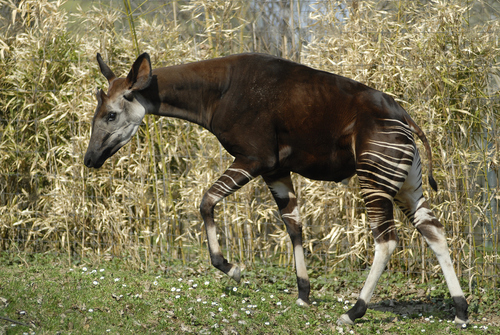
Giraffes are the only living members of genus Giraffa, with their closest living relative being the okapi (Okapia johnstoni), a forest-dwelling relative that shares similar dental structure and elongated tongue but lacks the extreme neck elongation.
The Giraffe and people
Giraffes have the same number of neck vertebrae as humans (seven), just greatly elongated. Their tongues are blue-black, possibly to prevent sunburn during extensive foraging, and each individual's coat pattern is unique like a human fingerprint.
Where and how to see it
Giraffes are best observed in national parks such as Serengeti (Tanzania), Etosha (Namibia), and Kruger (South Africa), during early morning or late afternoon when they are most active. Safari vehicles offer excellent viewing opportunities as giraffes are generally tolerant of distant human presence.
Risks to humans
No notable risk to humans under normal circumstances, though a defensive kick from a giraffe can be extremely powerful and potentially lethal if provoked or cornered.
Human uses
Historically, some African communities have used giraffe hide for shields, ropes, and drum skins, and giraffe tail hair for bracelets and fly whisks; giraffes are also significant in ecotourism as a major wildlife attraction.
Myths and legends
Ancient Egyptians and various African cultures depicted giraffes in rock art and hieroglyphs as symbols of grace and the exotic nature of the African interior. In some folklore, giraffes are seen as peaceful, gentle giants representing calmness and vision.
Countries where the Giraffe is recorded
The 11 countries named in the range description of its IUCN Red List assessment.
Questions about the Giraffe
Where does the Giraffe live?
The Giraffe is recorded in Botswana, Cameroon, Chad, Kenya and Namibia, among 11 countries in total across Africa. These countries come from the range description of its IUCN Red List assessment, and they are what place the species on the interactive map.
Is the Giraffe endangered?
Yes. The IUCN Red List assesses the Giraffe as Vulnerable, one of the three threatened categories. The species faces a high risk of extinction in the wild. It is the first of the three threatened categories: numbers are falling, the range is shrinking, or the population is small enough that a single bad event could do lasting damage.
How many are left in the wild?
Approximately 117,000 individuals remain in the wild as of recent surveys, with an overall declining trend, though some populations in southern Africa are stable or increasing due to conservation efforts. This figure comes from the species assessment on the IUCN Red List; population estimates for wild mammals are ranges, not counts, and are revised at each assessment.
What habitat does the Giraffe live in?
Giraffes inhabit savannas, open woodlands, and acacia-dominated grasslands where scattered trees provide browsing opportunities.
What is the scientific name of the Giraffe?
The Giraffe is Giraffa camelopardalis, in the family Giraffidae, order Artiodactyla.
Other species in the family Giraffidae
Species that share its range

Sources
Conservation status, range description and population estimate come from the IUCN Red List assessment for Giraffa camelopardalis. Countries are derived from that range description, not from a mapped country list. Last refreshed on .
The distribution map is drawn from the IUCN Red List spatial data compiled in 2018. IUCN (International Union for Conservation of Nature)