
Okapi
Okapia johnstoni
Red List assessment
Endangeredon the IUCN Red List
- EXExtinct
- EWExtinct in the Wild
- CRCritically Endangered
- ENEndangered
- VUVulnerable
- NTNear Threatened
- LCLeast Concern
The Okapi is recorded in one country, Democratic Republic of the Congo across Africa. The IUCN Red List assesses the Okapi as Endangered. Estimated 10,000-20,000 individuals remaining in the wild, with a declining population trend.
- Family
- Giraffidae
- Order
- Artiodactyla
- Genus
- Okapia
- Countries recorded
- 1
- Continents
- Africa
- Red List category
- Endangered
- Data updated
- August 9, 2026
What is the Okapi?
The okapi is a forest-dwelling relative of the giraffe, endemic to the Ituri Forest and surrounding rainforests of the Democratic Republic of the Congo. Despite its zebra-striped legs, it is more closely related to giraffes, sharing an elongated neck (though much shorter) and similar ossicones in males. It was unknown to Western science until 1901, earning it the nickname 'African unicorn'. It remains elusive and rarely observed in the wild due to its shy, solitary nature and dense forest habitat.
Where does the Okapi live?
Democratic Republic of the Congo (northeastern and central Congo Basin rainforest)
Endemic to the northeastern and central Democratic Republic of the Congo, primarily within the Ituri Forest and Congo Basin rainforest, including the Okapi Wildlife Reserve.
Altitude and depth
500-1000m
Seasonal movements
No major migration; okapis are largely sedentary but may shift activity slightly with rainfall patterns affecting food availability.
Habitat of the Okapi
Dense lowland tropical rainforest with a closed canopy, particularly areas with a mix of primary forest and clearings with understory vegetation. Prefers areas near rivers and streams with abundant leafy vegetation.
Adaptations to its environment
Long, flexible tongue (up to 30cm) used to strip leaves and even clean its own eyes and ears. Striped hindquarters provide camouflage in dappled forest light, helping calves follow their mothers. Large ears provide excellent hearing to detect predators in dense vegetation.
Conservation status and numbers
Endangered (EN) according to IUCN, due to an estimated population decline of more than 50% over the past 24 years driven by habitat loss and poaching. Listed on CITES Appendix II.
Estimated population
Estimated 10,000-20,000 individuals remaining in the wild, with a declining population trend.
What threatens the Okapi?
Habitat destruction from logging, mining, and agricultural expansion; poaching for bushmeat and skin; illegal armed groups operating within protected areas; civil unrest limiting conservation access.
Diseases and parasites
Susceptible to internal parasites such as nematodes and external parasites like ticks; captive individuals have shown susceptibility to certain viral and bacterial infections.
What is being done to protect it?
Protected within the Okapi Wildlife Reserve (a UNESCO World Heritage Site), supported by organizations like the Okapi Conservation Project. Captive breeding programs exist in zoos worldwide as an assurance population.
Recommended actions
Strengthen anti-poaching patrols and law enforcement, stabilize regional political security, expand community engagement and education programs, and support sustainable land-use planning to reduce habitat fragmentation.
What the Okapi looks like
Dark chocolate-brown to reddish body with striking white horizontal stripes on the upper legs and white rings around the ankles, resembling a zebra pattern. Head resembles a small giraffe head with large ears and a long, dark, prehensile tongue. Coat is short, dense, and velvety, providing water resistance in humid rainforest conditions.
Size
Body length approximately 1.9-2.5m, shoulder height 1.5-1.7m, with a neck adding significant additional height.
Weight
200-350 kg, with males and females of similar weight.
Distinctive features
Combination of a giraffe-like body and zebra-like leg stripes is unique among mammals. Males possess short, skin-covered ossicones similar to those of giraffes, absent in females.
Differences between males and females
Males have small ossicones (horn-like structures) on the head, while females lack them and are typically slightly larger in body size.
Behaviour and diet of the Okapi
Primarily solitary, with individuals maintaining home ranges that may overlap slightly. Brief social interactions occur mainly between mothers and calves or during mating encounters.
When it is active
Primarily diurnal but can show some crepuscular activity patterns, resting during the hottest parts of the day.
Diet
Herbivorous browser feeding on over 100 species of plants, including leaves, buds, fruits, ferns, and fungi. Occasionally consumes clay or charcoal from burnt trees for mineral supplementation.
Communication
Uses infrasound vocalizations below human hearing range for long-distance communication, along with scent marking via urine and glandular secretions on vegetation. Body posture and ear movements also convey social signals.
Interactions with other species
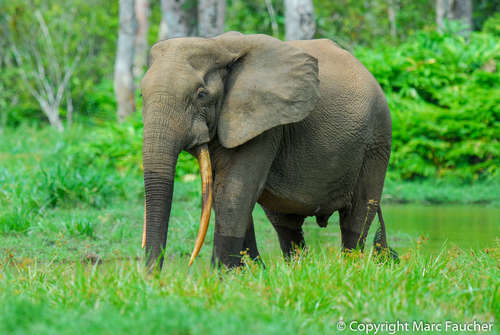
Main natural predator is the leopard, especially targeting calves and juveniles. Competes indirectly with other forest herbivores like duikers and forest elephants for food resources.
Role in its ecosystem
As a browser, the okapi plays a role in shaping forest understory vegetation and may contribute to seed dispersal for various plant species it consumes.
Reproduction and lifecycle
Breeding can occur year-round with peaks in the dry season; gestation lasts about 14-15 months, producing a single calf. Calves are weaned around 6 months but may stay near the mother for up to a year.
Raising the young
Mothers hide calves in secluded spots for the first weeks of life, visiting periodically to nurse, a strategy called 'hiding behavior' that reduces predation risk. Calves grow rapidly and become independent within a year.
Maturity and lifespan
Sexual maturity is reached around 2-3 years of age; lifespan is approximately 20-30 years in captivity, with wild lifespan likely shorter due to predation and environmental pressures.
Taxonomy and naming of the Okapi
Classification
Mammalia > Artiodactyla > Giraffidae > Okapia > Okapia johnstoni
Scientific synonyms
Equus johnstoni (original 1901 misclassification by Ray Lankester)
What research says
Recent studies
Recent camera-trap and genetic studies have focused on population density estimates and connectivity between fragmented habitat patches in the Ituri Forest region.
Genome and DNA
Diploid chromosome number of 2n=46; genetic studies have helped confirm its close phylogenetic relationship to the giraffe within Giraffidae.
Compared with similar species
Unlike its relative the giraffe, the okapi has a much shorter neck and lives in dense forest rather than open savanna. Its zebra-like stripes are a striking convergent feature not shared by any other giraffid.
The Okapi and people
The okapi was so elusive that it was nicknamed the 'African unicorn' before being formally described in 1901. Its tongue is long enough to clean its own eyelids and ears, a rare ability among mammals. Despite the stripes, it is genetically far closer to giraffes than to zebras.
Where and how to see it
Best observed in the Okapi Wildlife Reserve in the Ituri Forest, DRC, though sightings in the wild are extremely rare due to its shy and elusive nature; captive individuals can be reliably seen in select zoos with dedicated okapi exhibits.
Risks to humans
No notable risk to humans; okapis are shy, non-aggressive animals that avoid human contact.
Human uses
Historically hunted by local communities for bushmeat and hide; today primarily valued for ecotourism and as a conservation flagship species representing Congo Basin rainforest biodiversity.
Myths and legends
Local Mbuti and other Congolese forest peoples had long known of the okapi and referred to it as a shy forest spirit-like creature, while Western explorers dismissed early reports as myth until physical evidence was obtained in 1901.
Countries where the Okapi is recorded
The 1 countries named in the range description of its IUCN Red List assessment.
Questions about the Okapi
Where does the Okapi live?
The Okapi is recorded in Democratic Republic of the Congo across Africa. These countries come from the range description of its IUCN Red List assessment, and they are what place the species on the interactive map.
Is the Okapi endangered?
Yes. The IUCN Red List assesses the Okapi as Endangered, one of the three threatened categories. The species faces a very high risk of extinction in the wild — a step below Critically Endangered, but still on a trajectory that ends badly without intervention.
How many are left in the wild?
Estimated 10,000-20,000 individuals remaining in the wild, with a declining population trend. This figure comes from the species assessment on the IUCN Red List; population estimates for wild mammals are ranges, not counts, and are revised at each assessment.
What habitat does the Okapi live in?
Dense lowland tropical rainforest with a closed canopy, particularly areas with a mix of primary forest and clearings with understory vegetation.
What is the scientific name of the Okapi?
The Okapi is Okapia johnstoni, in the family Giraffidae, order Artiodactyla.
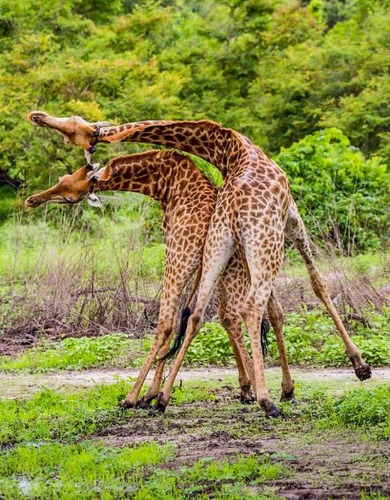
Other species in the family Giraffidae
Species that share its range

Sources
Conservation status, range description and population estimate come from the IUCN Red List assessment for Okapia johnstoni. Countries are derived from that range description, not from a mapped country list. Last refreshed on .
The distribution map is drawn from the IUCN Red List spatial data compiled in 2013. IUCN (International Union for Conservation of Nature)