
Forest Grass Mouse
Akodon sylvanus
Red List assessment
Least Concernon the IUCN Red List
- EXExtinct
- EWExtinct in the Wild
- CRCritically Endangered
- ENEndangered
- VUVulnerable
- NTNear Threatened
- LCLeast Concern
The Forest Grass Mouse is recorded in 2 countries across South America. The IUCN Red List assesses the Forest Grass Mouse as Least Concern. No precise global population estimate is available.
- Family
- Cricetidae
- Order
- Rodentia
- Genus
- Akodon
- Countries recorded
- 2
- Continents
- South America
- Red List category
- Least Concern
- Data updated
- August 9, 2026
What is the Forest Grass Mouse?
Akodon sylvanus is a small sigmodontine rodent endemic to the Yungas montane forests of northwestern Argentina and possibly southern Bolivia. Like most members of the large genus Akodon, it is a ground-dwelling, generalist omnivore adapted to life in dense forest understory and adjacent grassland edges. It is notable as a member of one of South America's most species-rich rodent genera, which serves as an important model group for understanding rapid Neotropical mammal diversification. Its preference for forested habitats distinguishes it ecologically from several open-habitat congeners.
Where does the Forest Grass Mouse live?
Northwestern Argentina (provinces of Jujuy, Salta, Tucumán, and Catamarca), with possible extension into southern Bolivia; associated with the Yungas subtropical montane forest ecoregion.
Endemic to South America, with its core range in northwestern Argentina, including the provinces of Jujuy, Salta, Tucumán, and possibly Catamarca. The range corresponds broadly to the Yungas ecoregion corridor running along the eastern slopes of the Andes. Possible occurrence in adjacent southern Bolivia has been suggested but requires confirmation.
Altitude and depth
Typically found between approximately 500 m and 2,000 m above sea level, with peak occurrence in the montane forest belt (Selva Montana) between 700 m and 1,500 m on Andean foothills slopes.
Seasonal movements
No major seasonal migrations are documented. Activity and reproduction may be influenced by rainfall seasonality, with increased resource availability and breeding activity during the wet season (November–March). No hibernation recorded.
Habitat of the Forest Grass Mouse
Primary habitat is the Yungas subtropical and montane forests (Selva Montana and Bosque Montano), including forest edges, dense understory with abundant leaf litter, shrubby clearings, and transitional zones between forest and adjacent grasslands or scrubland. It is associated with moist, vegetated environments with significant ground cover.
Adaptations to its environment
Adapted to forest floor life with strong claws for digging and foraging through leaf litter. Its brownish cryptic fur provides camouflage against the forest floor substrate. As with other Akodon, it has a robust body plan suited for terrestrial locomotion and burrowing, and a generalist diet allowing exploitation of seasonally variable food resources.
Conservation status and numbers
Least Concern (LC) on the IUCN Red List. The species is assessed as LC because it is considered to have a sufficiently wide range, presumably adequate population size, and no evidence of rapid decline meeting threatened thresholds. Ongoing habitat loss in the Yungas is a concern but has not yet driven the species to a threatened category.
Estimated population
No precise global population estimate is available. The species is considered to have a stable or possibly slowly declining population trend due to ongoing Yungas deforestation; it is not believed to be immediately threatened.
What threatens the Forest Grass Mouse?
The main threats include deforestation and habitat fragmentation of Yungas forests due to agricultural expansion (sugarcane, soybean), cattle ranching, logging, and human settlement. Fire used to clear land also degrades forest understory habitat. Climate change may alter the altitude and extent of suitable montane forest belt over time.
Diseases and parasites
Like other Akodon species, it is likely host to a range of ectoparasites (fleas, ticks, mites) and endoparasites (nematodes, cestodes). South American Akodon rodents are known reservoirs for various hantaviruses and other zoonotic pathogens, though specific data for A. sylvanus are limited.
What is being done to protect it?
The species occurs within several protected areas in northwestern Argentina, including Calilegua National Park (Jujuy) and Baritú National Park (Salta), which protect significant tracts of Yungas forest. Argentina has national legislation protecting natural areas, and the Yungas are recognized as a globally important ecoregion by WWF and other organizations.
Recommended actions
Priority actions include expanding and strengthening the protected area network within the Yungas ecoregion, controlling illegal logging and agricultural conversion, conducting systematic population surveys to establish baseline data, and continued taxonomic and ecological research to clarify the species' precise range and habitat requirements.
What the Forest Grass Mouse looks like
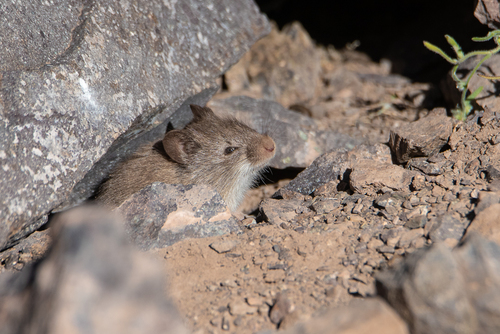
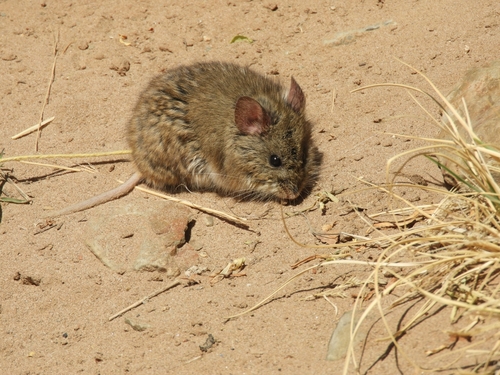
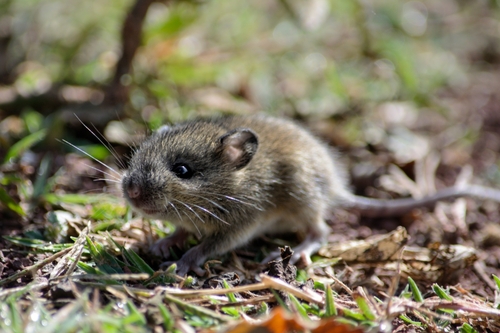
Dorsal fur is brownish to olivaceous brown, often with a slight gray wash and darker midline; ventral fur is paler, grayish to whitish. The fur is relatively soft and dense. Eyes are small and rounded, ears are moderate, and the tail is sparsely haired and bicolored (darker above, paler below).
Size
Body length (head-body) approximately 80–115 mm; tail length approximately 60–95 mm, typically shorter than or subequal to the body.
Weight
Approximately 15–35 g; specific sex-based weight data are limited, but little sexual size dimorphism is expected based on congeners.
Distinctive features
Distinguished from closely related Akodon species by a combination of its forest habitat association, specific cranial and dental morphology (including molar cusp patterns), and body proportions. Molecular genetic markers are often necessary for definitive identification from sympatric congeners such as A. fumeus or A. boliviensis.
Differences between males and females
Sexual dimorphism is minimal, as is typical for the genus Akodon. Males may be marginally larger on average, but differences in color or external morphology are negligible.
Behaviour and diet of the Forest Grass Mouse
Presumed to be largely solitary outside of reproductive periods, consistent with most Akodon species. Individuals maintain small home ranges and may show territorial behavior, particularly males. No complex social groupings are documented.
When it is active
Primarily nocturnal to crepuscular, with most foraging activity occurring after dusk. It is a terrestrial species, active mainly at the ground level in forest understory.
Diet
Omnivorous; diet likely includes seeds, fruits, fungi, green plant matter, arthropods (insects, larvae), and other invertebrates, consistent with the dietary ecology of closely related Akodon species. Seeds and invertebrates likely form the bulk of the diet.
How it feeds and hunts
Forages actively on the forest floor, rummaging through leaf litter and soil with its nose and forepaws in search of seeds and invertebrates. Does not employ specialized predatory hunting but opportunistically captures small invertebrates encountered during foraging.
Communication
Communication likely involves ultrasonic vocalizations (as in other sigmodontines), scent marking using urine and glandular secretions to demarcate territories and convey reproductive status. Tactile and olfactory signals are presumed to be important in close-range interactions.
Interactions with other species
Predated upon by owls (especially Tyto alba and Strix species), small felids, foxes (Lycalopex culpaeus), snakes, and mustelids. Competes with other small sigmodontine rodents occupying similar niches in the Yungas. May play a role in seed dispersal for small-seeded plant species consumed and cached.
Role in its ecosystem
As a small omnivorous rodent, it plays an important role in forest floor nutrient cycling, seed predation and occasional dispersal, and as prey for a wide range of mesopredators and raptors. It contributes to the regulation of invertebrate populations in the forest understory.
Reproduction and lifecycle
Breeding is likely seasonal, peaking during the wet season when food resources are most abundant. Gestation period estimated at approximately 20–23 days, consistent with Akodon congeners. Litter size typically 2–6 pups. Multiple litters per year are possible under favorable conditions.
Raising the young
Females provide primary parental care, nursing and protecting pups in a nest constructed in a burrow or beneath dense vegetation. Pups are altricial at birth and are weaned at approximately 2–3 weeks. Males do not typically participate in pup rearing.
Maturity and lifespan
Sexual maturity is likely reached at approximately 2–3 months of age, as in related Akodon species. Wild lifespan is estimated at 1–2 years due to high predation pressure; captive individuals of related species have lived up to 3 years.
Taxonomy and naming of the Forest Grass Mouse
Classification
Mammalia > Rodentia > Cricetidae > Sigmodontinae > Akodon > Akodon sylvanus (Thomas, 1902)
Scientific synonyms
Akodon sylvanus was described by Oldfield Thomas in 1902; it has been placed by some authors within the Akodon boliviensis species group and occasionally confused with closely related Akodon species such as A. boliviensis or A. fumeus prior to modern molecular revisions.
What research says
Recent studies
Akodon sylvanus has been included in broader phylogenomic studies of the Sigmodontinae family aimed at resolving species boundaries and biogeographic history within the genus. Taxonomic revisions using molecular markers have helped clarify its distinctness from morphologically similar congeners, but dedicated studies on the ecology and biology of A. sylvanus specifically remain scarce.
Genome and DNA
Specific karyotype data for A. sylvanus are not well documented; related Akodon species in the boliviensis group typically have diploid chromosome counts of 2n = 40 or 2n = 42. The genus Akodon is noted for substantial karyotypic variation among species.
Compared with similar species
Closely related to Akodon boliviensis (Bolivian Grass Mouse) and Akodon fumeus (Smoky Grass Mouse), from which it can only be reliably distinguished by molecular analysis and detailed craniodental measurements. The Forest Grass Mouse is distinguished ecologically by its stronger association with closed-canopy Yungas forest versus more open or high-altitude grassland habitats preferred by some congeners.
The Forest Grass Mouse and people
Akodon sylvanus belongs to one of the most species-rich mammal genera in the world, with over 40 recognized species — a testament to explosive Neotropical rodent diversification. Some Akodon species are among the few mammals known to have individuals with XXY sex chromosomes that are nevertheless fully fertile females, a remarkable chromosomal anomaly studied across the genus. Despite its modest appearance as a small brown mouse, it inhabits the globally threatened and biodiverse Yungas corridor, one of the most important biodiversity hotspots in South America.
Where and how to see it
Best observed in the Yungas forests of Calilegua National Park (Jujuy, Argentina) during the wet season (November–March) when activity is highest. Nocturnal live-trapping with Sherman traps baited with oats or peanut butter along forest edges and in dense understory is the standard method used by researchers. Night walks with a headlamp along forest trails may occasionally reveal individuals foraging on the ground.
Risks to humans
As with other Akodon species, there is a potential theoretical risk of zoonotic pathogen transmission (e.g., hantavirus) through contact with urine, feces, or bites, though specific confirmed cases involving A. sylvanus are not documented. Standard precautions when handling wild rodents are recommended.
Countries where the Forest Grass Mouse is recorded
The 2 countries named in the range description of its IUCN Red List assessment.
Questions about the Forest Grass Mouse
Where does the Forest Grass Mouse live?
The Forest Grass Mouse is recorded in Argentina and Bolivia across South America. These countries come from the range description of its IUCN Red List assessment, and they are what place the species on the interactive map.
Is the Forest Grass Mouse endangered?
The IUCN Red List assesses the Forest Grass Mouse as Least Concern. The species is widespread and abundant enough not to qualify for any threatened category. It does not mean the species is safe forever, only that nothing in the current data raises an alarm.
How many are left in the wild?
No precise global population estimate is available. This figure comes from the species assessment on the IUCN Red List; population estimates for wild mammals are ranges, not counts, and are revised at each assessment.
What habitat does the Forest Grass Mouse live in?
Primary habitat is the Yungas subtropical and montane forests (Selva Montana and Bosque Montano), including forest edges, dense understory with abundant leaf litter, shrubby clearings, and transitional zones between forest and adjacent grasslands or scrubland.
What is the scientific name of the Forest Grass Mouse?
The Forest Grass Mouse is Akodon sylvanus, in the family Cricetidae, order Rodentia.
Other species in the genus Akodon

Other species in the family Cricetidae
Sources
Conservation status, range description and population estimate come from the IUCN Red List assessment for Akodon sylvanus. Countries are derived from that range description, not from a mapped country list. Last refreshed on .
The distribution map is drawn from the IUCN Red List spatial data compiled in 2008. IUCN (International Union for Conservation of Nature)