
El Dorado Grass Mouse
Akodon orophilus
Red List assessment
Least Concernon the IUCN Red List
- EXExtinct
- EWExtinct in the Wild
- CRCritically Endangered
- ENEndangered
- VUVulnerable
- NTNear Threatened
- LCLeast Concern
The El Dorado Grass Mouse is recorded in one country, Peru across South America. The IUCN Red List assesses the El Dorado Grass Mouse as Least Concern. No precise global population estimate exists.
- Family
- Cricetidae
- Order
- Rodentia
- Genus
- Akodon
- Countries recorded
- 1
- Continents
- South America
- Red List category
- Least Concern
- Data updated
- August 9, 2026
What is the El Dorado Grass Mouse?
Akodon orophilus is a small, ground-dwelling rodent belonging to the diverse South American genus of grass mice. It is endemic to the cloud forests and high Andean slopes of north-central Peru, named after the type locality 'El Dorado' and the species epithet 'orophilus' (mountain-loving in Greek). It is a typical member of its genus, cryptic in coloration and secretive in habits, inhabiting dense montane vegetation. Despite being poorly studied, it plays an important ecological role in Andean ecosystems as a seed disperser and prey species.
Where does the El Dorado Grass Mouse live?
Endemic to Peru; found in the eastern Andes, primarily in the departments of San Martín, Huánuco, and adjacent regions.
Endemic to Peru; range centered on the eastern Andean slopes of north-central Peru, including San Martín and Huánuco departments. The type locality is 'El Dorado' in the montane zone of this region. Its range may extend marginally into neighboring departments such as Amazonas and La Libertad.
Altitude and depth
Typically found between approximately 1,800 and 3,500 meters above sea level, with the core of its distribution in the cloud forest belt between 2,000 and 3,000 m.
Seasonal movements
No documented seasonal migrations. Activity patterns may shift subtly with wet and dry seasons affecting food availability. No hibernation is known for this species.
Habitat of the El Dorado Grass Mouse
Primary habitat includes humid montane cloud forests (yunga) and high-altitude grasslands (jalca/páramo) on the eastern slopes of the Andes. It favors areas with dense ground cover, mosses, and leaf litter that provide shelter and foraging opportunities. Forest edges, shrubby undergrowth, and riparian strips within montane zones are also used.
Adaptations to its environment
Dense, moisture-resistant fur provides insulation against cold, wet cloud forest conditions. Short limbs and a robust body are well-suited for terrestrial locomotion through dense undergrowth and leaf litter. Like other Akodon, it likely has a flexible omnivorous diet enabling survival when specific food items are scarce.
Conservation status and numbers
Least Concern (LC) on the IUCN Red List. The species is considered to have a sufficiently large and stable population, without evidence of rapid decline, and occurs in habitats that, while threatened, still cover significant areas in the Peruvian Andes.
Estimated population
No precise global population estimate exists. The species is presumed locally common within its restricted Andean range, though trend data are lacking. Population trend is considered stable based on current IUCN assessment.
What threatens the El Dorado Grass Mouse?
Deforestation and habitat conversion for agriculture (particularly coca cultivation and cattle ranching) on Andean slopes represent the primary threats. Climate change is an emerging concern, as it shifts cloud forest belts upslope and may compress suitable habitat. Invasive species and increased fire frequency also pose risks.
Diseases and parasites
Likely hosts a range of ectoparasites (mites, fleas, lice) and endoparasites (helminths, protozoans) typical of Andean sigmodontine rodents. South American rodents in this genus are known to host hantaviruses in some regions, though specific data for A. orophilus are lacking.
What is being done to protect it?
The species likely benefits from protected areas within its range, such as Río Abiseo National Park and the Bosque de Protección Alto Mayo in San Martín. Peru's national legislation protects native wildlife, and SERNANP (Servicio Nacional de Áreas Naturales Protegidas) manages key habitats.
Recommended actions
Detailed surveys to accurately map distribution and population density are needed. Strengthening enforcement against illegal deforestation in cloud forest zones is a priority. Long-term monitoring programs and climate change vulnerability assessments for Andean small mammals would be highly valuable.
What the El Dorado Grass Mouse looks like
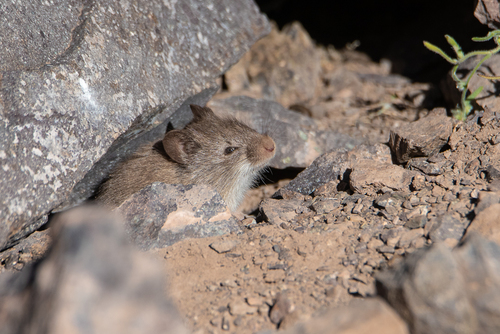
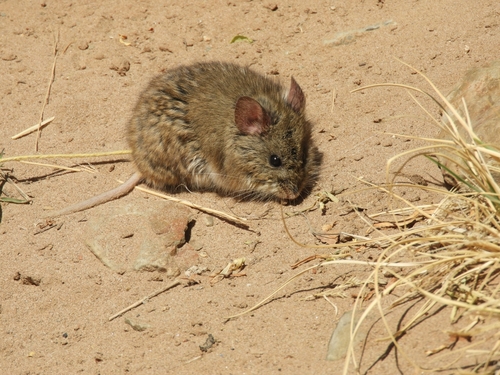
Dorsal fur is dark brownish to olivaceous-brown, often with darker mid-dorsal coloration. The ventral surface is paler, typically grayish-white or buffy. The tail is bicolored (darker above, paler below) and moderately haired. Ears are medium-sized and rounded.
Size
Body length (head and body) approximately 90–115 mm; tail length approximately 70–95 mm, slightly shorter than the body. Typical of mid-sized Akodon grass mice.
Weight
Estimated 20–40 grams, based on closely related congeners. No significant sexual weight dimorphism documented.
Distinctive features
Distinguished from closely related Akodon species by subtle cranial and dental morphological characters, including details of the molar cusp pattern and interorbital breadth. In the field, separation from sympatric Akodon species requires careful examination of skull measurements and pelage tone.
Differences between males and females
Minimal sexual dimorphism reported; males and females are similar in size and coloration, consistent with the broader Akodon genus pattern.
Behaviour and diet of the El Dorado Grass Mouse
Presumed to be largely solitary outside of breeding periods, consistent with most Akodon grass mice. Home ranges may overlap partially. No evidence of complex social hierarchies.
When it is active
Primarily nocturnal to crepuscular, with peak activity occurring during the night and at dusk and dawn. Daytime is largely spent sheltering in burrows, dense vegetation, or beneath logs and rocks.
Diet
Omnivorous; diet likely includes seeds, green plant material, fungi, invertebrates (insects, larvae, worms), and possibly small vertebrates opportunistically. Diet composition probably varies seasonally with food availability in the montane forest.
How it feeds and hunts
Forages on the ground through leaf litter and dense undergrowth using olfaction and vibrissae to detect invertebrates and seeds. May probe soil and rotting wood to find beetle larvae and earthworms.
Communication
Uses high-frequency vocalizations (ultrasonic calls) for communication, consistent with other sigmodontine rodents. Scent marking via specialized glands and urine is likely used to demarcate home ranges and signal reproductive status. Vibrissae play a role in tactile communication.
Interactions with other species
Likely preyed upon by Andean owls (e.g., Strix species), diurnal raptors (e.g., Buteo), small felids, and mustelids such as the Andean weasel (Mustela frenata). May compete with other small rodents (other Akodon, Thomasomys) for food and shelter. Contributes to seed dispersal for understory plant species.
Role in its ecosystem
Functions as an important mesoconsumer in Andean forest food webs: dispersing seeds, cycling nutrients through its consumption of fungi and invertebrates, and serving as prey for higher-order predators. Its tunneling behavior may also contribute to soil aeration.
Reproduction and lifecycle
Breeding seasonality is poorly documented but likely peaks in the wet season when food resources are most abundant. Gestation is estimated at approximately 21–23 days based on congeners. Litter size is estimated at 2–5 young, with multiple litters possible per year.
Raising the young
Altricial young are born in a nest within a burrow or dense vegetation. The female provides primary parental care including nursing and nest maintenance. Weaning is estimated to occur at around 3–4 weeks of age.
Maturity and lifespan
Sexual maturity is likely reached at 2–3 months of age, consistent with other Akodon. Lifespan in the wild is estimated at 1–2 years; captive individuals of related species may live up to 3 years.
Taxonomy and naming of the El Dorado Grass Mouse
Classification
Mammalia > Rodentia > Cricetidae > Akodon > Akodon orophilus
Scientific synonyms
Described by Osgood in 1913; no widely accepted synonyms, though early specimens were sometimes grouped with related Akodon taxa before formal revision.
What research says
Recent studies
Phylogeographic studies of Andean Akodon in the 2010s–2020s have helped clarify the species limits and distribution of A. orophilus relative to morphologically similar taxa. Continued taxonomic revisions of the genus Akodon using molecular and morphological data remain active areas of research.
Genome and DNA
Chromosome number has not been firmly established for this species specifically; related Akodon species typically have diploid numbers of 2n=40–44. Molecular phylogenetic studies have helped clarify its placement within the Akodon boliviensis species group.
Compared with similar species
Most closely related to other members of the Akodon boliviensis species group found across the Andes. It closely resembles Akodon mimus and Akodon subfuscus, differing in subtle cranial measurements and pelage characteristics. The genus Akodon as a whole is one of the most speciose rodent genera in South America, with over 40 recognized species.
The El Dorado Grass Mouse and people
The species epithet 'orophilus' literally means 'mountain lover' in Greek, a fitting name for a rodent thriving in cold, misty Andean cloud forests above 2,000 m. The genus Akodon is sometimes called the 'rats of the Andes' due to its extraordinary diversification across South American highlands. The type locality, 'El Dorado,' shares its name with the legendary city of gold sought by Spanish conquistadors in the very same Andean region.
Where and how to see it
Best observed at night along forest-edge trails in cloud forest zones of the Peruvian eastern Andes, particularly in the San Martín and Huánuco departments, using a headlamp. Sherman live-traps placed along vegetation-dense corridors near streams are the standard survey method. Protected areas such as Bosque de Protección Alto Mayo offer accessible habitat.
Risks to humans
No notable risk to humans. Like many wild rodents, it may carry ectoparasites or zoonotic pathogens (e.g., hantavirus), so direct handling without protective equipment should be avoided by researchers.
Countries where the El Dorado Grass Mouse is recorded
The 1 countries named in the range description of its IUCN Red List assessment.
Questions about the El Dorado Grass Mouse
Where does the El Dorado Grass Mouse live?
The El Dorado Grass Mouse is recorded in Peru across South America. These countries come from the range description of its IUCN Red List assessment, and they are what place the species on the interactive map.
Is the El Dorado Grass Mouse endangered?
The IUCN Red List assesses the El Dorado Grass Mouse as Least Concern. The species is widespread and abundant enough not to qualify for any threatened category. It does not mean the species is safe forever, only that nothing in the current data raises an alarm.
How many are left in the wild?
No precise global population estimate exists. This figure comes from the species assessment on the IUCN Red List; population estimates for wild mammals are ranges, not counts, and are revised at each assessment.
What habitat does the El Dorado Grass Mouse live in?
Primary habitat includes humid montane cloud forests (yunga) and high-altitude grasslands (jalca/páramo) on the eastern slopes of the Andes.
What is the scientific name of the El Dorado Grass Mouse?
The El Dorado Grass Mouse is Akodon orophilus, in the family Cricetidae, order Rodentia.
Other species in the genus Akodon

Other species in the family Cricetidae
Sources
Conservation status, range description and population estimate come from the IUCN Red List assessment for Akodon orophilus. Countries are derived from that range description, not from a mapped country list. Last refreshed on .
The distribution map is drawn from the IUCN Red List spatial data compiled in 2008. IUCN (International Union for Conservation of Nature)