
Drylands Vesper Mouse
Calomys musculinus
Red List assessment
Least Concernon the IUCN Red List
- EXExtinct
- EWExtinct in the Wild
- CRCritically Endangered
- ENEndangered
- VUVulnerable
- NTNear Threatened
- LCLeast Concern
The Drylands Vesper Mouse is recorded in 4 countries across South America. The IUCN Red List assesses the Drylands Vesper Mouse as Least Concern. Population size is not precisely quantified but is considered abundant and stable, given its status as one of the most common small mammals in its range.
- Family
- Cricetidae
- Order
- Rodentia
- Genus
- Calomys
- Countries recorded
- 4
- Continents
- South America
- Red List category
- Least Concern
- Data updated
- August 9, 2026
What is the Drylands Vesper Mouse?
Calomys musculinus is a small, terrestrial cricetid rodent native to the semi-arid grasslands and agricultural regions of central Argentina. It is one of the most abundant small mammals in the Pampas and Chaco regions, playing a key role in local food webs. The species is notable primarily as the principal natural reservoir of Junín virus, the causative agent of Argentine hemorrhagic fever, giving it significant epidemiological importance.
Where does the Drylands Vesper Mouse live?
Central and northern Argentina, with populations extending into Bolivia, Paraguay, and southern Brazil
Widely distributed across central and northern Argentina, including the Pampas, Chaco, and Monte regions, with its range extending into parts of Bolivia, Paraguay, and possibly southern Brazil.
Altitude and depth
Typically found at low to moderate elevations, from sea level up to approximately 2000 meters in some Andean foothill areas.
Seasonal movements
Population densities fluctuate seasonally, peaking in autumn after the breeding season and declining during winter; breeding activity is concentrated in spring and summer months.
Habitat of the Drylands Vesper Mouse
Inhabits open grasslands, agricultural fields (especially corn and soybean crops), fencerows, and disturbed or fallow lands. It thrives in areas with dense herbaceous cover that offers protection from predators and nesting material.
Adaptations to its environment
Possesses a compact body and strong hind limbs suited for quick movement through dense vegetation, along with a generalist diet allowing survival in variable agricultural and natural habitats. Its high reproductive rate allows rapid population recovery after environmental disturbances or crashes.
Conservation status and numbers
Listed as Least Concern by the IUCN due to its wide distribution, large population size, and tolerance of human-modified habitats such as farmland.
Estimated population
Population size is not precisely quantified but is considered abundant and stable, given its status as one of the most common small mammals in its range.
What threatens the Drylands Vesper Mouse?
No major threats to the species itself; however, intensive pesticide use in agricultural areas and habitat homogenization from monoculture farming can locally affect population dynamics.
Diseases and parasites
Serves as the primary natural reservoir for Junín virus (Argentine hemorrhagic fever) and can also host various ectoparasites like mites, fleas, and ticks.
What is being done to protect it?
No specific conservation programs target this species, as it is not threatened; however, it is monitored extensively due to its role as a disease reservoir rather than for conservation purposes.
Recommended actions
Continued ecological monitoring to track population fluctuations linked to Junín virus transmission dynamics, and sustainable agricultural practices that maintain some natural habitat heterogeneity.
What the Drylands Vesper Mouse looks like
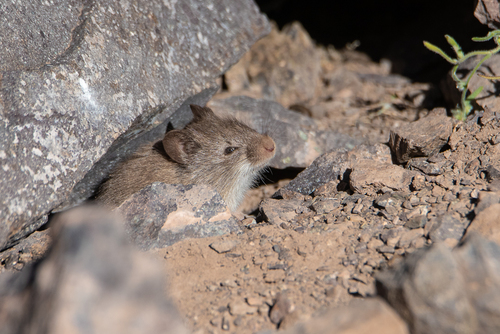
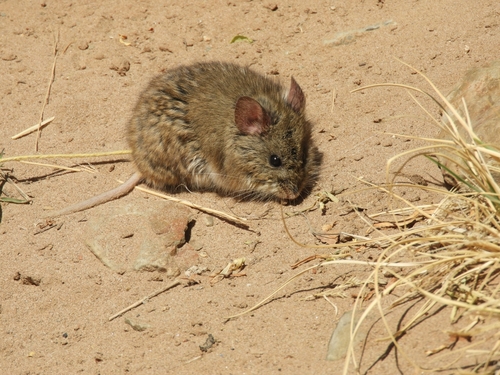
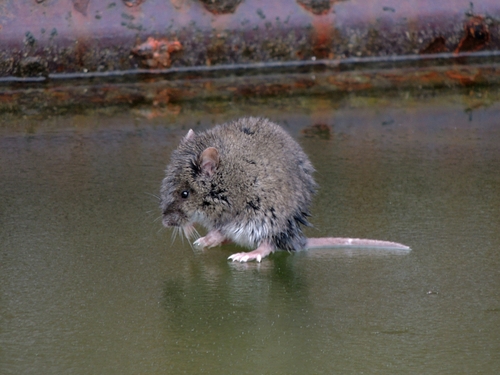
The dorsal fur is grayish-brown to tawny, while the ventral fur is pale gray to white, creating a bicolored appearance. It has large, prominent eyes, rounded ears, and a moderately long, sparsely-haired tail.
Size
Body length ranges from approximately 70-100 mm, with a tail of similar or slightly shorter length (60-90 mm).
Weight
Adults typically weigh between 10 and 25 grams, with males and females showing minimal size difference.
Distinctive features
Distinguished from closely related Calomys species by subtle differences in skull morphology, tail-to-body ratio, and pelage coloration, often requiring genetic or detailed morphometric analysis for certain identification.
Differences between males and females
Sexual dimorphism is minimal, with males and females showing very similar body size and coloration.
Behaviour and diet of the Drylands Vesper Mouse
Generally solitary or found in loose, non-territorial aggregations, though population density can be high in favorable habitats with overlapping home ranges.
When it is active
Primarily nocturnal, with peak activity occurring during dusk and nighttime hours to avoid predators and thermal stress.
Diet
Omnivorous, feeding mainly on seeds, grains, green vegetation, and invertebrates such as insects; agricultural crops like corn provide an important food source.
How it feeds and hunts
Forages on the ground and occasionally climbs low vegetation, using keen olfactory and tactile senses (whiskers) to locate seeds and small invertebrates in leaf litter and soil.
Communication
Communicates through ultrasonic vocalizations, scent marking via urine and glandular secretions, and tactile interactions during social encounters.
Interactions with other species
Preyed upon by owls, foxes, snakes, and small carnivorous mammals; it competes with other sympatric rodents such as Akodon and Oligoryzomys species for food and habitat resources.
Role in its ecosystem
Functions as an important prey species supporting populations of raptors and small carnivores, and contributes to seed dispersal and soil aeration through its burrowing and foraging activities.
Reproduction and lifecycle
Breeding occurs mainly in spring and summer, with a gestation period of about 21-24 days; females produce litters of 4-7 pups and can have multiple litters per year under favorable conditions.
Raising the young
Females provide sole parental care, nursing and protecting pups in a nest until weaning at around 3 weeks of age, after which juveniles become independent.
Maturity and lifespan
Reaches sexual maturity at approximately 2-3 months of age; average lifespan in the wild is short, around 6-12 months, though captive individuals may live slightly longer.
Taxonomy and naming of the Drylands Vesper Mouse
Classification
Class Mammalia > Order Rodentia > Family Cricetidae > Genus Calomys > Species Calomys musculinus
Scientific synonyms
Hesperomys musculinus (original combination), Calomys laucha musculinus (former subspecies designation)
What research says
Recent studies
Recent studies have focused on the ecology of Junín virus transmission dynamics, examining how rodent population cycles and land-use changes influence hemorrhagic fever outbreak risk in Argentina.
Genome and DNA
Has a diploid chromosome number of 2n=36 in most populations, with some cytogenetic variation reported among geographically distinct populations.
Compared with similar species
Similar in appearance to other Calomys species like C. laucha and C. callosus, but distinguished by habitat preference, geographic range, and specific role as the primary Junín virus reservoir.
The Drylands Vesper Mouse and people
Despite its small size, this unassuming mouse has had major public health significance as the reservoir for a deadly hemorrhagic fever virus; it can reach extremely high population densities after good rainfall years, sometimes called 'ratadas' by local farmers.
Where and how to see it
Best observed at dusk or night in agricultural fields and grassland edges in central Argentina, particularly during autumn when population densities peak; live-trapping surveys are the most reliable method for study rather than casual visual observation.
Risks to humans
Poses a significant indirect health risk as the reservoir host of Junín virus, which causes Argentine hemorrhagic fever in humans through contact with rodent excreta or aerosolized particles.
Human uses
Not used commercially, but it is extensively studied in virology and epidemiology research due to its role in Argentine hemorrhagic fever transmission.
Countries where the Drylands Vesper Mouse is recorded
The 4 countries named in the range description of its IUCN Red List assessment.
Questions about the Drylands Vesper Mouse
Where does the Drylands Vesper Mouse live?
The Drylands Vesper Mouse is recorded in Argentina, Bolivia, Brazil and Paraguay across South America. These countries come from the range description of its IUCN Red List assessment, and they are what place the species on the interactive map.
Is the Drylands Vesper Mouse endangered?
The IUCN Red List assesses the Drylands Vesper Mouse as Least Concern. The species is widespread and abundant enough not to qualify for any threatened category. It does not mean the species is safe forever, only that nothing in the current data raises an alarm.
How many are left in the wild?
Population size is not precisely quantified but is considered abundant and stable, given its status as one of the most common small mammals in its range. This figure comes from the species assessment on the IUCN Red List; population estimates for wild mammals are ranges, not counts, and are revised at each assessment.
What habitat does the Drylands Vesper Mouse live in?
Inhabits open grasslands, agricultural fields (especially corn and soybean crops), fencerows, and disturbed or fallow lands.
What is the scientific name of the Drylands Vesper Mouse?
The Drylands Vesper Mouse is Calomys musculinus, in the family Cricetidae, order Rodentia.
Other species in the genus Calomys
Other species in the family Cricetidae
Sources
Conservation status, range description and population estimate come from the IUCN Red List assessment for Calomys musculinus. Countries are derived from that range description, not from a mapped country list. Last refreshed on .
The distribution map is drawn from the IUCN Red List spatial data compiled in 2008. IUCN (International Union for Conservation of Nature)