
Desert Rat-kangaroo
Caloprymnus campestris
Red List assessment
Extincton the IUCN Red List
- EXExtinct
- EWExtinct in the Wild
- CRCritically Endangered
- ENEndangered
- VUVulnerable
- NTNear Threatened
- LCLeast Concern
The Desert Rat-kangaroo is recorded in one country, Australia across Oceania. The IUCN Red List assesses the Desert Rat-kangaroo as Extinct. Extinct; no individuals have been recorded since 1935 and the species is presumed to have died out shortly thereafter
- Family
- Potoroidae
- Order
- Diprotodontia
- Genus
- Caloprymnus
- Countries recorded
- 1
- Continents
- Oceania
- Red List category
- Extinct
- Data updated
- August 9, 2026
What is the Desert Rat-kangaroo?
The Desert Rat-kangaroo was a small, extremely fast-running marsupial endemic to the harsh stony deserts of central Australia. It was the sole member of its genus and was remarkable for its extraordinary running speed and endurance relative to its tiny size. Rediscovered briefly in the 1930s after decades presumed extinct, it vanished again and has not been confirmed since 1935, leading to its classification as extinct. Its biology remains poorly known due to the extreme rarity of observations.
Where does the Desert Rat-kangaroo live?
Central Australia, specifically the stony deserts of northeastern South Australia and southwestern Queensland
Restricted to the Sturt Stony Desert region spanning the border area of northeastern South Australia and southwestern Queensland, Australia. Historical records are extremely limited and localized to this arid interior zone.
Altitude and depth
Approximately 0-200m elevation, typical of the low-lying stony desert plains of central Australia
Seasonal movements
Likely more active following rare desert rains when ephemeral vegetation flushed, but detailed seasonal behavior was never documented before extinction
Habitat of the Desert Rat-kangaroo
Inhabited gibber (stony) deserts and clay pans with sparse low vegetation, particularly canegrass and saltbush. It preferred flat, open, hard-packed desert terrain rather than sand dunes.
Adaptations to its environment
Possessed exceptional running speed and stamina, reportedly capable of sustained high-speed flight from pursuers across open desert terrain, an adaptation to the lack of cover in gibber plains. It built simple grass nests in shallow scrapes for shelter from extreme desert heat.
Conservation status and numbers
Extinct (EX) according to IUCN, with no confirmed sightings since 1935 despite extensive later surveys of its historic range.
Estimated population
Extinct; no individuals have been recorded since 1935 and the species is presumed to have died out shortly thereafter
What threatens the Desert Rat-kangaroo?
Predation by introduced red foxes and feral cats, competition with introduced rabbits for food and habitat, and severe drought conditions in its already marginal desert habitat.
What is being done to protect it?
No conservation programs exist as the species is extinct; historical specimens are preserved in Australian museum collections. Its extinction has informed broader conservation strategies for other threatened Australian desert marsupials.
Recommended actions
None applicable for this species; however, ongoing predator control programs (fox and cat eradication) in central Australia aim to prevent similar extinctions in related potoroid species.
What the Desert Rat-kangaroo looks like
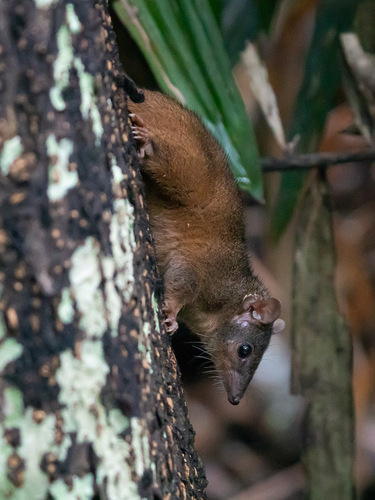
Pale sandy-buff to grayish fur above with lighter, whitish underparts, providing camouflage against the stony desert substrate. It had a long tail with a slight tuft, large hind feet adapted for fast bipedal hopping, and relatively small forelimbs.
Size
Head-body length approximately 250-290mm, with a tail length of around 300-360mm
Weight
Approximately 800-950 grams for adults
Distinctive features
Distinguished from other rat-kangaroos by its unusually elongated hind limbs proportional to body size and its exceptional sprinting ability, described by early observers as faster than a galloping horse over short distances.
Behaviour and diet of the Desert Rat-kangaroo
Believed to be largely solitary, based on limited historical observations, coming together only briefly for mating
When it is active
Primarily nocturnal, sheltering during the day in shallow scrape nests lined with grass to avoid extreme desert daytime temperatures
Diet
Herbivorous, feeding on desert plants, grasses, roots, and possibly some insects; likely opportunistic given the scarcity of vegetation in its habitat
Communication
Unknown in detail, but likely used soft vocalizations, foot-thumping, and scent marking typical of small macropods
Interactions with other species
Preyed upon by native predators and, more critically, introduced foxes and cats which are believed to have driven its extinction; competed with introduced rabbits for scarce desert vegetation
Role in its ecosystem
Functioned as a small herbivore and seed disperser within the fragile stony desert ecosystem, contributing to nutrient cycling and vegetation dynamics in an extremely resource-poor environment
Reproduction and lifecycle
Poorly documented, but likely followed typical macropod patterns with a short gestation period and development of young in a pouch; breeding may have been opportunistic following rainfall events
Raising the young
As with other macropods, presumed that the mother carried and nursed the joey in her pouch for an extended period, though specific details were never scientifically recorded
Maturity and lifespan
Unknown; comparable small macropods reach sexual maturity around 1 year with lifespans of 4-6 years in the wild, though exact figures for this species were never established
Taxonomy and naming of the Desert Rat-kangaroo
Classification
Class Mammalia > Order Diprotodontia > Family Potoroidae > Genus Caloprymnus > Species Caloprymnus campestris
Scientific synonyms
Bettongia campestris (original combination by Gould, 1843)
What research says
Recent studies
Recent taxonomic and museum-based studies have re-examined preserved specimens using morphological and limited genetic techniques to clarify its phylogenetic placement within Potoroidae, but no living population studies are possible
Compared with similar species
Similar in general body plan to other rat-kangaroos like the Boodie (Bettongia lesueur) but distinguished by markedly longer legs and superior running speed adapted to open stony terrain rather than burrowing habits.
The Desert Rat-kangaroo and people
It could reportedly run at speeds rivaling a galloping horse for short bursts, an extraordinary feat for an animal under 1kg. It was rediscovered in 1931 after being presumed extinct for nearly 90 years, only to disappear again within a few years.
Where and how to see it
Impossible to observe as the species is extinct; historical specimens can be viewed in Australian natural history museums such as the South Australian Museum.
Risks to humans
No notable risk
Countries where the Desert Rat-kangaroo is recorded
The 1 countries named in the range description of its IUCN Red List assessment.
Questions about the Desert Rat-kangaroo
Where does the Desert Rat-kangaroo live?
The Desert Rat-kangaroo is recorded in Australia across Oceania. These countries come from the range description of its IUCN Red List assessment, and they are what place the species on the interactive map.
Is the Desert Rat-kangaroo endangered?
The IUCN Red List assesses the Desert Rat-kangaroo as Extinct. No reasonable doubt remains that the last individual has died. A species is only declared Extinct after exhaustive surveys of its known range, at the times and in the seasons it would be expected to appear, have failed to record it.
How many are left in the wild?
Extinct; no individuals have been recorded since 1935 and the species is presumed to have died out shortly thereafter This figure comes from the species assessment on the IUCN Red List; population estimates for wild mammals are ranges, not counts, and are revised at each assessment.
What habitat does the Desert Rat-kangaroo live in?
Inhabited gibber (stony) deserts and clay pans with sparse low vegetation, particularly canegrass and saltbush.
What is the scientific name of the Desert Rat-kangaroo?
The Desert Rat-kangaroo is Caloprymnus campestris, in the family Potoroidae, order Diprotodontia.
Other species in the family Potoroidae
Species that share its range

Sources
Conservation status, range description and population estimate come from the IUCN Red List assessment for Caloprymnus campestris. Countries are derived from that range description, not from a mapped country list. Last refreshed on .