
Boodie
Bettongia lesueur
Red List assessment
Near Threatenedon the IUCN Red List
- EXExtinct
- EWExtinct in the Wild
- CRCritically Endangered
- ENEndangered
- VUVulnerable
- NTNear Threatened
- LCLeast Concern
The Boodie is recorded in one country, Australia across Oceania. The IUCN Red List assesses the Boodie as Near Threatened. Total population estimated in the low tens of thousands, distributed across several island and fenced mainland populations; overall trend considered stable to slightly increasing due to conservation reintroductions.
- Family
- Potoroidae
- Order
- Diprotodontia
- Genus
- Bettongia
- Countries recorded
- 1
- Continents
- Oceania
- Red List category
- Near Threatened
- Data updated
- August 9, 2026
What is the Boodie?
The Boodie is a small burrowing macropod endemic to Australia, notable for being the only bettong species that constructs and lives in warren systems, a highly unusual trait among kangaroo relatives. Once widespread across mainland Australia, it now survives naturally only on a few offshore islands off Western Australia, with reintroduced populations in fenced mainland sanctuaries. Its remarkable burrowing behavior likely helped it survive in arid, predator-rich environments prior to European colonization.
Where does the Boodie live?
Western Australia, primarily offshore islands and fenced mainland reserves
Historically distributed across most of arid and semi-arid mainland Australia; now restricted to Barrow Island, Boodie Island, Dorre and Bernier Islands off Western Australia, plus reintroduced populations at fenced mainland reserves such as Faure Island, Shark Bay area, and various conservation sanctuaries in WA, SA, and NSW.
Altitude and depth
Lowland habitats generally below 200m elevation, mostly near sea level on coastal islands and adjacent arid mainland areas.
Seasonal movements
No true migration or hibernation; breeding can occur year-round in favorable conditions, though reproductive output may increase after rainfall events that boost food availability.
Habitat of the Boodie
Arid and semi-arid shrublands, coastal dunes, tussock grasslands, and Acacia scrub with sandy or friable soils suitable for digging extensive burrow systems. Islands with limited predator pressure provide critical refuge habitat.
Adaptations to its environment
Complex communal burrow systems provide protection from extreme heat, aridity, and predators, allowing survival in harsh arid zones. Efficient kidneys and low water requirements enable persistence with minimal free water, while omnivorous foraging allows exploitation of variable desert food sources.
Conservation status and numbers
Near Threatened (NT) according to IUCN, following historic Vulnerable/Endangered status due to catastrophic mainland decline (over 99% range contraction) caused by introduced predators and habitat change; populations have stabilized somewhat through island refuges and reintroductions.
Estimated population
Total population estimated in the low tens of thousands, distributed across several island and fenced mainland populations; overall trend considered stable to slightly increasing due to conservation reintroductions.
What threatens the Boodie?
Predation by introduced red foxes and feral cats, habitat degradation from livestock grazing and altered fire regimes, and vulnerability of small isolated island/reintroduced populations to stochastic events and disease.
Diseases and parasites
Susceptible to various native ectoparasites (ticks, mites) and endoparasites typical of macropods; disease risk is heightened in small isolated populations due to limited genetic diversity.
What is being done to protect it?
Protected under Australian federal and state legislation; conservation programs include predator-free island refuges, fenced mainland reserves managed by groups like Australian Wildlife Conservancy and Bush Heritage Australia, and active reintroduction/translocation programs across former range.
Recommended actions
Continued control or exclusion of feral cats and foxes, expansion of predator-proof fenced reserves, genetic management across fragmented populations, and long-term monitoring of reintroduced populations to ensure establishment success.
What the Boodie looks like
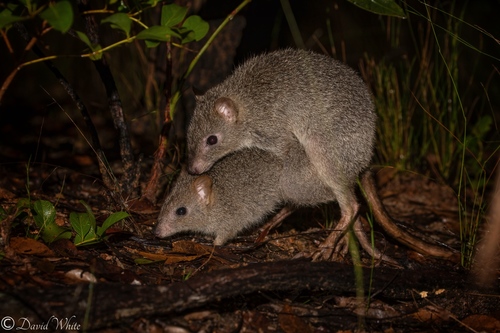
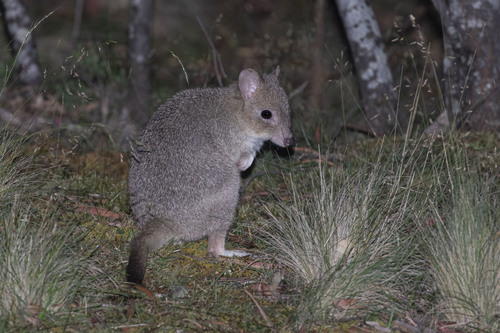
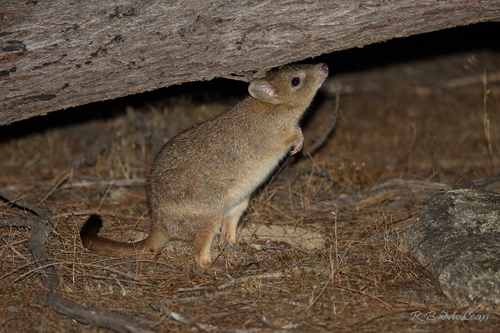
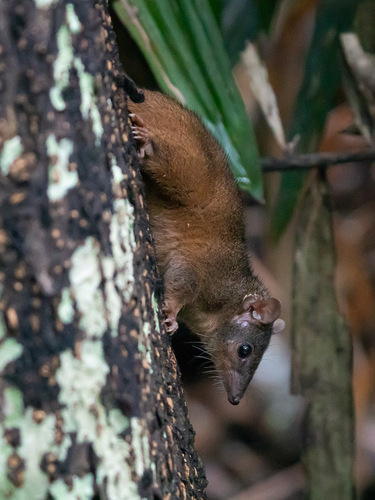
Compact, grizzled grey-brown fur above with paler, cream to grey underparts, a rounded body shape, short rounded ears, and a moderately furred tail used for carrying nesting material. The hindlimbs are proportionally strong for hopping locomotion typical of macropods.
Size
Head-body length approximately 28-36 cm, with a tail of similar or slightly shorter length (25-30 cm).
Weight
Adults typically weigh between 0.8 and 1.6 kg, with males generally slightly larger than females.
Distinctive features
Distinguished from other bettong species primarily by its unique burrowing behavior and communal warren-dwelling lifestyle, a trait unmatched among other macropods; also has a slightly stockier build than surface-nesting relatives like the Woylie.
Differences between males and females
Minimal sexual dimorphism; males are marginally larger and heavier than females, but coloration and general body shape are similar between sexes.
Behaviour and diet of the Boodie
Highly social for a macropod, living in communal warrens that may house from a few to over a hundred individuals, with multiple entrances and shared tunnel systems; individuals forage independently but shelter communally.
When it is active
Strictly nocturnal, emerging from warrens after dusk to forage and returning before dawn to shelter from heat and predators.
Diet
Omnivorous diet including tubers, bulbs, seeds, fungi, roots, and invertebrates such as insects; diet composition shifts opportunistically with seasonal food availability.
How it feeds and hunts
Forages by digging with strong forelimbs to unearth roots, tubers, and buried fungi, and opportunistically gleans surface invertebrates and plant material.
Communication
Communicates via soft vocal grunts and squeaks, scent marking around burrow entrances, and body postures/tail movements to signal alarm or social status within the warren.
Interactions with other species
Historically preyed upon by dingoes and raptors, but modern populations are most heavily impacted by introduced foxes and feral cats; burrow systems may also be shared or reused by other small native fauna.
Role in its ecosystem
Acts as an ecosystem engineer through extensive digging, which aerates soil, aids water infiltration, disperses fungal spores (many of which are mycorrhizal), and creates microhabitats used by other species.
Reproduction and lifecycle
Breeding can occur year-round given adequate resources; gestation lasts about 21 days, followed by an extended pouch period of roughly 3-4 months, with young weaned around 4-5 months of age.
Raising the young
Females provide all parental care, carrying and nursing a single joey in the pouch until it is developed enough to leave, after which the mother continues to nurse at heel for a period before full independence.
Maturity and lifespan
Sexual maturity is reached at around 6-12 months of age; lifespan in the wild is typically 4-6 years, while captive individuals may live up to 10 years or more.
Taxonomy and naming of the Boodie
Classification
Mammalia > Diprotodontia > Potoroidae > Bettongia > Bettongia lesueur
Subspecies
Bettongia lesueur lesueur (mainland/island form, now the only surviving subspecies) and the extinct Bettongia lesueur graii (southeastern mainland form).
Scientific synonyms
Bettongia lesueuri (variant spelling), Hypsiprymnus lesueur (original combination by Quoy & Gaimard, 1824)
What research says
Recent studies
Recent research has focused on genetic diversity across fragmented island and reintroduced mainland populations to optimize translocation strategies and minimize inbreeding risk, as well as studies on the species' ecosystem engineering role in arid soil ecology.
Genome and DNA
Diploid chromosome number of 2n=22, consistent with other Bettongia species; genetic studies have been used extensively to guide conservation management and assess diversity among isolated island populations.
Compared with similar species
Compared to the closely related Woylie (Bettongia penicillata), the Boodie is unique in constructing burrow warrens rather than surface nests, and has a slightly stockier build; both species suffered similar historic mainland declines due to introduced predators.
The Boodie and people
The Boodie is the only macropod species known to live in underground warrens like rabbits. It can dig extensive tunnel systems with multiple chambers and entrances shared communally by many individuals. Despite its small size, it plays an outsized ecological role by turning over large volumes of soil each year.
Where and how to see it
Best observed at night on predator-free islands such as Barrow Island or Dorre Island, or within fenced mainland sanctuaries like those managed by Australian Wildlife Conservancy, using spotlighting techniques after dusk when the animals emerge to forage.
Risks to humans
No notable risk to humans; the species is small, non-aggressive, and poses no danger through bites or disease transmission.
Human uses
Historically hunted by Indigenous Australians as a food source; today the species has no significant commercial use but is valued for ecological research and conservation tourism on protected islands.
Myths and legends
While not as prominent in Aboriginal mythology as larger macropods, bettongs including the Boodie have traditional significance in some Indigenous Australian cultures as a food source and are referenced in local ecological knowledge regarding desert fauna.
Countries where the Boodie is recorded
The 1 countries named in the range description of its IUCN Red List assessment.
Questions about the Boodie
Where does the Boodie live?
The Boodie is recorded in Australia across Oceania. These countries come from the range description of its IUCN Red List assessment, and they are what place the species on the interactive map.
Is the Boodie endangered?
The IUCN Red List assesses the Boodie as Near Threatened. The species does not qualify as threatened today, but it is close to the thresholds and likely to cross them soon. It is the category that most often changes at the next assessment.
How many are left in the wild?
Total population estimated in the low tens of thousands, distributed across several island and fenced mainland populations; overall trend considered stable to slightly increasing due to conservation reintroductions. This figure comes from the species assessment on the IUCN Red List; population estimates for wild mammals are ranges, not counts, and are revised at each assessment.
What habitat does the Boodie live in?
Arid and semi-arid shrublands, coastal dunes, tussock grasslands, and Acacia scrub with sandy or friable soils suitable for digging extensive burrow systems.
What is the scientific name of the Boodie?
The Boodie is Bettongia lesueur, in the family Potoroidae, order Diprotodontia.
Other species in the genus Bettongia
Other species in the family Potoroidae
Species that share its range

Sources
Conservation status, range description and population estimate come from the IUCN Red List assessment for Bettongia lesueur. Countries are derived from that range description, not from a mapped country list. Last refreshed on .
The distribution map is drawn from the IUCN Red List spatial data compiled in 2024. IUCN (International Union for Conservation of Nature)