
Cursor Grass Mouse
Akodon cursor
Red List assessment
Least Concernon the IUCN Red List
- EXExtinct
- EWExtinct in the Wild
- CRCritically Endangered
- ENEndangered
- VUVulnerable
- NTNear Threatened
- LCLeast Concern
The Cursor Grass Mouse is recorded in one country, Brazil across South America. The IUCN Red List assesses the Cursor Grass Mouse as Least Concern. No precise global population estimate is available.
- Family
- Cricetidae
- Order
- Rodentia
- Genus
- Akodon
- Countries recorded
- 1
- Continents
- South America
- Red List category
- Least Concern
- Data updated
- August 9, 2026
What is the Cursor Grass Mouse?
The Cursor Grass Mouse is a small, terrestrial sigmodontine rodent endemic to the Atlantic Forest region of eastern Brazil. It inhabits forest edges, secondary vegetation, and grassland-forest ecotones, and ranks among the more common small mammals in its range. The species is ecologically significant as a seed predator and invertebrate consumer, and has attracted considerable scientific interest due to its remarkable intraspecific chromosomal polymorphism. It is also relevant in epidemiological research as a potential reservoir for zoonotic pathogens.
Where does the Cursor Grass Mouse live?
Endemic to eastern Brazil, primarily within the Atlantic Forest biome, from Pernambuco state in the northeast southward through Bahia, Minas Gerais, Espírito Santo, Rio de Janeiro, and São Paulo states.
Endemic to eastern Brazil; range extends from Pernambuco and possibly Alagoas in the northeast, southward through Bahia, Minas Gerais, Espírito Santo, Rio de Janeiro, and São Paulo, reaching the northern limits of Paraná. The core of the range lies in southeastern Brazil within the Atlantic Forest domain.
Altitude and depth
Found from near sea level up to approximately 1,500 m elevation in montane Atlantic Forest settings; most records are from below 900 m. The species is predominantly associated with lowland and submontane zones.
Seasonal movements
No seasonal migration documented. Population densities fluctuate in response to rainfall patterns and food resource availability, with breeding activity and population peaks often associated with the rainy season (October–March) when invertebrate and seed resources are most abundant.
Habitat of the Cursor Grass Mouse
Primarily associated with the Atlantic Forest biome, including lowland and submontane forest edges, secondary growth, cerrado-Atlantic Forest ecotones, and grasslands. It is a habitat generalist tolerating significant levels of human-induced disturbance, and frequently occurs in agricultural margins, degraded pastures, and shrubby secondary vegetation adjacent to forest remnants.
Adaptations to its environment
As a habitat generalist, A. cursor tolerates forest fragmentation and degraded landscapes better than many specialized Atlantic Forest species. Its omnivorous diet provides flexibility under varying seasonal resource conditions. Its rapid reproductive rate (short gestation, multiple litters per year) enables fast population recovery following disturbance. The compact, robust body form typical of the genus Akodon facilitates movement through dense ground-level vegetation and leaf litter.
Conservation status and numbers
Least Concern (LC) on the IUCN Red List. The species is relatively abundant and geographically widespread across the Atlantic Forest biome, with a large extent of occurrence and demonstrated tolerance for habitat degradation. No major range-wide population decline has been detected, and it does not approach threatened thresholds under any IUCN criterion.
Estimated population
No precise global population estimate is available. The species is considered locally common within its range; population trend is presumed broadly stable, though locally declining in areas of intensive deforestation. It is frequently the most common small rodent captured in Atlantic Forest trapping surveys.
What threatens the Cursor Grass Mouse?
Continued deforestation and fragmentation of the Atlantic Forest remain the primary long-term threats, as the biome has already lost over 85% of its original cover. Agricultural expansion, urbanization, and pesticide use in adjacent agricultural areas reduce habitat quality and invertebrate prey availability. While the species persists in disturbed landscapes, heavily deforested regions may experience local population declines.
Diseases and parasites
Hosts diverse ectoparasites including fleas (Siphonaptera: Rhopalopsyllidae, Ctenophthalmidae), mites (Gamasida, Trombidiformes), and ticks (Ixodidae). Endoparasites include nematodes (e.g., Trichuris, Syphacia) and cestodes. Identified as a potential reservoir for Orthohantavirus species and Leishmania spp. in parts of its range, making it of public health concern in endemic areas.
What is being done to protect it?
Protected indirectly through Atlantic Forest conservation initiatives, including the Atlantic Forest Restoration Pact (Pacto pela Restauração da Mata Atlântica) and the network of federal and state protected areas in eastern Brazil (e.g., Serra dos Órgãos National Park, Serra da Canastra National Park). No species-specific conservation programs exist.
Recommended actions
Continued long-term population monitoring in both intact and fragmented habitats; preservation and restoration of forest corridors to maintain genetic connectivity among populations; reduction of pesticide use in agricultural zones adjacent to forest remnants; systematic inclusion of small mammal biodiversity surveys in Atlantic Forest restoration assessments.
What the Cursor Grass Mouse looks like
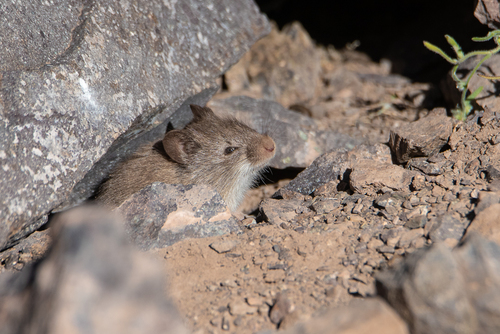
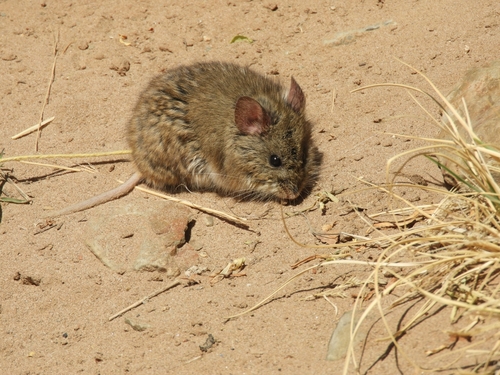
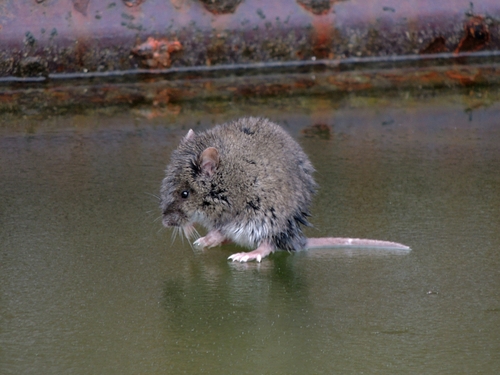
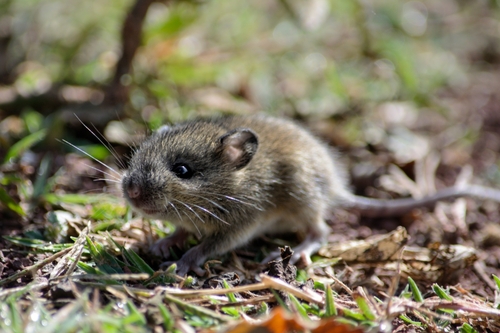
Dorsal fur is brownish to dark grayish-brown with a grizzled appearance due to the mixture of dark and pale-tipped hairs. The ventral surface is pale gray to whitish, sometimes with a faint yellowish tinge. The tail is relatively short, bicolored (darker above, paler below), and sparsely haired with visible scales. Ears are moderate and rounded, and the muzzle is blunt and robust.
Size
Head-body length 85–120 mm; tail length 60–90 mm (typically shorter than or subequal to head-body length); hindfoot length 19–23 mm; ear length 14–17 mm.
Weight
Typically 15–35 g; slight male-biased size dimorphism has been reported in some populations, but overlap between sexes is substantial.
Distinctive features
Distinguished from sympatric Akodon species (e.g., A. montensis, A. paranaensis) primarily by karyotypic characteristics (diploid number 2n = 14–16) and molecular markers rather than external morphology. The shorter tail relative to head-body length and geographic range help separate it from some congeners in the field, though definitive identification often requires laboratory analysis.
Differences between males and females
Sexual dimorphism is minimal; males are slightly larger on average than females, but measurements overlap substantially. No notable external differences in fur coloration or morphological features exist between the sexes.
Behaviour and diet of the Cursor Grass Mouse
Generally solitary outside of breeding periods. Individuals maintain small, partially overlapping home ranges; same-sex individuals may show territorial behavior, particularly males. Social encounters during the breeding season include mate-searching and male-male competitive interactions.
When it is active
Primarily nocturnal and crepuscular, with peak surface activity occurring shortly after dusk and around dawn. Daytime activity is minimal; individuals rest in burrows, under logs, or within dense ground-level vegetation during daylight hours.
Diet
Omnivorous, with diet including seeds, fleshy fruits, green vegetation, insects (especially Coleoptera and Orthoptera), earthworms, and other invertebrates. Diet composition shifts seasonally: invertebrates dominate during the wet season, while seeds and plant material become more important during drier periods.
How it feeds and hunts
Forages terrestrially by systematically exploring leaf litter and topsoil with its blunt snout, relying primarily on olfactory and tactile cues to detect seeds and invertebrate prey. Does not engage in pursuit predation; prey is located through close-range substrate exploration and captured with rapid biting movements.
Communication
Communicates via ultrasonic vocalizations (as typical of small rodents), olfactory signaling through urine marks and glandular secretions used for territorial demarcation and mate attraction, and tactile contact during social and reproductive encounters. Threat postures and aggressive vocalizations are used in competitive interactions.
Interactions with other species
Preyed upon by barn owls (Tyto furcata), strigid owls, small wild felids, colubrid and viperid snakes, and mustelids. Competes with syntopic small rodents including Oligoryzomys spp. and Calomys spp. for food and shelter resources. Acts as a reservoir host for hantavirus (Orthohantavirus) and potentially Leishmania spp., connecting it to significant zoonotic epidemiological networks.
Role in its ecosystem
Plays a key role in Atlantic Forest food webs as a primary consumer of seeds and invertebrates and as a prey species for numerous mesopredators and raptors. Contributes to seed dispersal and predation dynamics affecting plant community composition. Its abundance in disturbed habitats makes it a useful ecological indicator of Atlantic Forest degradation intensity.
Reproduction and lifecycle
Breeds throughout most of the year in tropical regions, with peaks tied to rainfall and elevated food availability. Gestation lasts approximately 23 days. Litter size ranges from 2 to 6 pups (average 3–4). Females can produce multiple successive litters annually, conferring high reproductive potential.
Raising the young
The female provides essentially all parental care. Pups are born altricial — blind, hairless, and entirely dependent. They are nursed in a concealed nest within a burrow or dense vegetation. Weaning occurs at approximately 15–21 days, after which juveniles become independent and disperse. Males do not provide direct offspring care.
Maturity and lifespan
Sexual maturity is reached at approximately 2–3 months of age. Wild lifespan is typically less than 12 months for most individuals due to heavy predation pressure and environmental mortality; maximum wild lifespan is estimated at 2–3 years. Captive individuals may survive up to 3–4 years under optimal conditions.
Taxonomy and naming of the Cursor Grass Mouse
Classification
Mammalia > Rodentia > Cricetidae (subfamily Sigmodontinae) > Akodon > Akodon cursor (Winge, 1887)
Subspecies
No currently recognized subspecies; former subspecies such as Akodon cursor tuca have been elevated to full species status (Akodon tuca) through molecular taxonomic revisions. The species complex has been substantially revised over the past two decades.
Scientific synonyms
Habrothrix cursor Winge, 1887 (original description based on subfossil material from Lagoa Santa, Minas Gerais, Brazil); Akodon tuca and Akodon paranaensis are former synonyms now treated as distinct species.
What research says
Recent studies
Molecular systematic studies over the past two decades have substantially revised the taxonomy of the Akodon cursor group, recognizing previously synonymized taxa (Akodon tuca, Akodon paranaensis, Akodon reinhardti) as distinct species. Population genetic studies have documented the geographic structure of chromosomal polymorphism and its relationship to gene flow. The species has been included in hantavirus surveillance programs across the Atlantic Forest, contributing to understanding of rodent-borne zoonosis dynamics.
Genome and DNA
Akodon cursor is scientifically renowned for its intraspecific chromosomal polymorphism: the diploid number (2n) varies from 14 to 16 within and among populations due to Robertsonian fusions, placing it among the mammals with the lowest and most variable diploid numbers known. This system has been extensively used as a model for studying chromosomal speciation, karyotype evolution, and meiotic behavior in mammals. Molecular phylogenetic analyses using mitochondrial and nuclear markers have been instrumental in resolving species boundaries within the A. cursor species group.
Compared with similar species
Most closely related to Akodon montensis, Akodon paranaensis, and Akodon tuca, from which it is reliably distinguished only by karyotype and molecular markers, not external morphology. Compared to the widespread pampas species Akodon azarae, A. cursor is more closely associated with forest-edge habitats. Within the Atlantic Forest, it tends to occupy lowland areas, while Akodon montensis dominates higher-elevation montane forests.
The Cursor Grass Mouse and people
Akodon cursor has one of the most variable karyotypes known among all mammals, with individuals in the same population carrying 14, 15, or 16 chromosomes — yet reproducing successfully with one another, challenging classical definitions of chromosomal species barriers. Despite being a seemingly unremarkable small brown mouse, it has become a cornerstone model organism in mammalian chromosomal evolution research. Although it thrives in heavily disturbed habitats, it continues to play a vital role in the ecology of one of Earth's most biodiverse and threatened ecosystems, the Brazilian Atlantic Forest.
Where and how to see it
Best detected by setting Sherman or Tomahawk live-traps baited with peanut butter, oats, or banana in Atlantic Forest edge habitats of Minas Gerais, Espírito Santo, and Rio de Janeiro states, preferably during the rainy season (October–March). Traps should be placed along forest edges, trails through secondary vegetation, and grassland-forest interfaces at ground level. Night surveys with headlamps near dense ground vegetation may yield incidental sightings.
Risks to humans
Low direct risk to humans under normal circumstances; however, as a potential reservoir for hantavirus and Leishmania, contact with live individuals or their excreta should be conducted with appropriate biosafety precautions (gloves, masks). Bites can occur if the animal is handled improperly, but pose no venomous risk. Researchers working in endemic areas should follow standard small-mammal handling protocols.
Human uses
Serves as an important model organism in scientific research on chromosomal evolution, population genetics, and zoonotic disease ecology, particularly in studies related to Atlantic Forest biodiversity and hantavirus epidemiology. Not subject to commercial exploitation, hunting, or documented traditional medicinal use.
Countries where the Cursor Grass Mouse is recorded
The 1 countries named in the range description of its IUCN Red List assessment.
Questions about the Cursor Grass Mouse
Where does the Cursor Grass Mouse live?
The Cursor Grass Mouse is recorded in Brazil across South America. These countries come from the range description of its IUCN Red List assessment, and they are what place the species on the interactive map.
Is the Cursor Grass Mouse endangered?
The IUCN Red List assesses the Cursor Grass Mouse as Least Concern. The species is widespread and abundant enough not to qualify for any threatened category. It does not mean the species is safe forever, only that nothing in the current data raises an alarm.
How many are left in the wild?
No precise global population estimate is available. This figure comes from the species assessment on the IUCN Red List; population estimates for wild mammals are ranges, not counts, and are revised at each assessment.
What habitat does the Cursor Grass Mouse live in?
Primarily associated with the Atlantic Forest biome, including lowland and submontane forest edges, secondary growth, cerrado-Atlantic Forest ecotones, and grasslands.
What is the scientific name of the Cursor Grass Mouse?
The Cursor Grass Mouse is Akodon cursor, in the family Cricetidae, order Rodentia.
Other species in the genus Akodon

Other species in the family Cricetidae
Sources
Conservation status, range description and population estimate come from the IUCN Red List assessment for Akodon cursor. Countries are derived from that range description, not from a mapped country list. Last refreshed on .
The distribution map is drawn from the IUCN Red List spatial data compiled in 2008. IUCN (International Union for Conservation of Nature)