
Common Wildebeest
Connochaetes taurinus
Red List assessment
Least Concernon the IUCN Red List
- EXExtinct
- EWExtinct in the Wild
- CRCritically Endangered
- ENEndangered
- VUVulnerable
- NTNear Threatened
- LCLeast Concern
The Common Wildebeest is recorded in 8 countries across Africa. The IUCN Red List assesses the Common Wildebeest as Least Concern. Approximately 1.5 to 2 million individuals total, with the Serengeti-Mara population alone estimated at 1.3 million; overall population trend is stable, though some subspecies like Cookson's Wildebeest have smaller, more vulnerable populations.
- Family
- Bovidae
- Order
- Artiodactyla
- Genus
- Connochaetes
- Countries recorded
- 8
- Continents
- Africa
- Red List category
- Least Concern
- Data updated
- August 9, 2026
What is the Common Wildebeest?
The Common Wildebeest, or Gnou bleu, is a large antelope famous for its role in the largest terrestrial mammal migration on Earth across the Serengeti-Mara ecosystem. It is a highly social, gregarious herbivore adapted to open grasslands and savannas of eastern and southern Africa. Known for its distinctive cow-like appearance with a large head, humped shoulders, and sweeping horns, it plays a crucial ecological role as a keystone grazer.
Where does the Common Wildebeest live?
Eastern and Southern Africa, primarily Tanzania, Kenya, Zambia, Botswana, Namibia, South Africa, Angola, and Mozambique
Found across eastern and southern Africa, including the Serengeti-Mara ecosystem (Tanzania/Kenya), Zambia's Luangwa Valley, Botswana's Okavango Delta and Kalahari, Namibia, South Africa, Angola, and Mozambique.
Altitude and depth
Typically found at elevations from sea level up to 2,500 meters, favoring open plains and plateaus.
Seasonal movements
Famous for spectacular annual migrations following rainfall patterns, especially the Serengeti-Mara migration involving over 1.5 million individuals moving in a clockwise circuit between Tanzania and Kenya in search of fresh grazing and water.
Habitat of the Common Wildebeest
Open grasslands, savanna woodlands, and semi-arid plains; prefers areas with short grass for grazing and access to water sources. Avoids dense forest and extreme desert conditions.
Adaptations to its environment
Possesses specialized grazing teeth adapted to short grasses, strong legs for long-distance migration, and heightened senses of smell and hearing to detect predators and locate rain-triggered grass growth. Their large nasal passages help with thermoregulation in hot climates.
Conservation status and numbers
Listed as Least Concern by the IUCN due to large, stable populations across protected areas, though some subspecies and local populations face significant regional declines from habitat loss and fencing that disrupts migration routes.
Estimated population
Approximately 1.5 to 2 million individuals total, with the Serengeti-Mara population alone estimated at 1.3 million; overall population trend is stable, though some subspecies like Cookson's Wildebeest have smaller, more vulnerable populations.
What threatens the Common Wildebeest?
Habitat fragmentation from fencing and agricultural expansion, poaching for meat and hides, competition with livestock for grazing land, and disruption of migration corridors by human infrastructure.
Diseases and parasites
Susceptible to rinderpest (historically devastating), malignant catarrhal fever (transmitted to cattle), anthrax, and various parasites including ticks, gastrointestinal nematodes, and botfly larvae.
What is being done to protect it?
Protected within major national parks and reserves including Serengeti National Park, Maasai Mara, Kruger National Park, and Okavango Delta; transboundary conservation initiatives aim to preserve migration corridors between Tanzania and Kenya.
Recommended actions
Maintain and restore migration corridors by removing or modifying fencing, strengthen anti-poaching enforcement, promote community-based conservation to reduce human-wildlife conflict, and monitor subspecies with smaller populations for targeted conservation.
What the Common Wildebeest looks like
Dark grayish-brown to bluish-gray coat with a black face and mane, and distinctive vertical stripes on the neck and forequarters. Both sexes have curved, outward-then-upward sweeping horns and a shaggy beard, giving them a formidable, ox-like appearance.
Size
Shoulder height ranges from 115 to 145 cm; body length typically 170 to 240 cm including a tail of 30-55 cm.
Weight
Males weigh between 180-270 kg, while females are slightly smaller at 140-200 kg.
Distinctive features
Distinguished from the Black Wildebeest by its bluish-gray coloration, forward-curving horns, and white beard (in some subspecies), as well as its larger size and different horn shape.
Differences between males and females
Males are generally larger and more robust than females, with thicker horns and more pronounced manes; both sexes have horns, but males' are typically heavier and more prominently curved.
Behaviour and diet of the Common Wildebeest
Highly social, forming large migratory herds that can number in the hundreds of thousands during migration; smaller resident herds consist of female-calf groups and bachelor male groups, with dominant males establishing territories during breeding season.
When it is active
Primarily diurnal, with peak grazing activity in early morning and late afternoon; rests during the hottest parts of the day and may travel at night during migration.
Diet
Strict herbivore feeding primarily on short grasses, preferring fresh green shoots that emerge after rains; will also consume herbs and shrubs when grass is scarce.
Communication
Communicates through vocalizations including grunts, snorts, and a distinctive nasal call resembling 'gnu'; also uses body postures, scent marking from preorbital glands, and visual displays during territorial and mating behaviors.
Interactions with other species
Major predators include lions, spotted hyenas, crocodiles (during river crossings), leopards, and cheetahs; often forms mixed herds with zebras and gazelles, benefiting from shared vigilance against predators and complementary grazing patterns.
Role in its ecosystem
Serves as a keystone grazing species that shapes grassland ecosystems through selective grazing, promotes nutrient cycling through dung deposition, and supports predator populations; their mass migrations also transport nutrients across vast landscapes.
Reproduction and lifecycle
Breeding season (rutting) occurs during the migration, typically in May-June, with males establishing temporary territories to attract females; gestation lasts approximately 8.5 months, with most calves born in a synchronized birthing period in January-March.
Raising the young
Calves are precocial and can stand and run within minutes of birth, a critical adaptation against predators; mothers provide primary care, nursing calves for 4-6 months while the young remain close to the herd for protection.
Maturity and lifespan
Sexual maturity reached at 16-24 months for females and around 4 years for males (though physically capable earlier); lifespan in the wild averages 15-20 years, with captive individuals living slightly longer under managed care.
Taxonomy and naming of the Common Wildebeest
Classification
Class Mammalia > Order Artiodactyla > Family Bovidae > Genus Connochaetes > Species Connochaetes taurinus
Subspecies
Five recognized subspecies: C. t. taurinus (Blue Wildebeest, southern Africa), C. t. albojubatus (Eastern White-bearded Wildebeest, Kenya), C. t. mearnsi (Western White-bearded Wildebeest, Serengeti-Mara ecosystem), C. t. cooksoni (Cookson's Wildebeest, Luangwa Valley, Zambia), and C. t. johnstoni (Nyassaland Wildebeest, Malawi and Mozambique)
Scientific synonyms
Bos taurinus (Burchell, 1823); Catoblepas gorgon
What research says
Recent studies
Recent GPS tracking studies have provided detailed insights into migration route changes due to climate variability and human infrastructure, while genomic studies continue to clarify subspecies boundaries and gene flow patterns.
Genome and DNA
Diploid chromosome number of 58; genetic studies have revealed distinct population structures among subspecies, useful for informing conservation management of isolated populations.
Compared with similar species
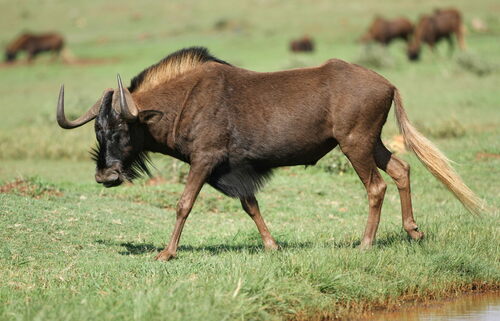
Closely related to the Black Wildebeest (Connochaetes gnou), which is smaller, has forward-curving horns, and a white tail; the Common Wildebeest is larger overall with backward-curving horns and lacks the white tail characteristic of its relative.
The Common Wildebeest and people
The Serengeti wildebeest migration is considered one of the greatest wildlife spectacles on Earth, involving synchronized movement of over a million animals; wildebeest can run at speeds up to 80 km/h to escape predators; their Afrikaans name 'wildebees' means 'wild ox' or 'wild cattle'.
Where and how to see it
Best observed during the Great Migration in the Serengeti (Tanzania) from December to July or the Maasai Mara (Kenya) from July to October, particularly during dramatic river crossings at the Mara River; early morning safari drives offer optimal viewing conditions.
Risks to humans
No notable risk to humans under normal circumstances, though wildebeest can act unpredictably if cornered or during rutting season; primary concern is disease transmission risk to livestock (malignant catarrhal fever) rather than direct danger to people.
Human uses
Historically and currently hunted for meat and hides by local communities; significant economic value through ecotourism, particularly safari tourism centered on the Great Migration spectacle in East Africa.
Myths and legends
In some East African cultures, the wildebeest migration is seen as a symbol of renewal and the eternal cycle of life tied to seasonal rains; the animal's odd, seemingly mismatched features have earned it nicknames like 'the ugliest animal in Africa' in popular safari lore.
Countries where the Common Wildebeest is recorded
The 8 countries named in the range description of its IUCN Red List assessment.
Questions about the Common Wildebeest
Where does the Common Wildebeest live?
The Common Wildebeest is recorded in Angola, Botswana, Kenya, Mozambique and Namibia, among 8 countries in total across Africa. These countries come from the range description of its IUCN Red List assessment, and they are what place the species on the interactive map.
Is the Common Wildebeest endangered?
The IUCN Red List assesses the Common Wildebeest as Least Concern. The species is widespread and abundant enough not to qualify for any threatened category. It does not mean the species is safe forever, only that nothing in the current data raises an alarm.
How many are left in the wild?
Approximately 1.5 to 2 million individuals total, with the Serengeti-Mara population alone estimated at 1.3 million; overall population trend is stable, though some subspecies like Cookson's Wildebeest have smaller, more vulnerable populations. This figure comes from the species assessment on the IUCN Red List; population estimates for wild mammals are ranges, not counts, and are revised at each assessment.
What habitat does the Common Wildebeest live in?
Open grasslands, savanna woodlands, and semi-arid plains; prefers areas with short grass for grazing and access to water sources.
What is the scientific name of the Common Wildebeest?
The Common Wildebeest is Connochaetes taurinus, in the family Bovidae, order Artiodactyla.
Other species in the genus Connochaetes
Other species in the family Bovidae
Species that share its range

Sources
Conservation status, range description and population estimate come from the IUCN Red List assessment for Connochaetes taurinus. Countries are derived from that range description, not from a mapped country list. Last refreshed on .
The distribution map is drawn from the IUCN Red List spatial data compiled in 2016. IUCN (International Union for Conservation of Nature)