
Black Wildebeest
Connochaetes gnou
Red List assessment
Least Concernon the IUCN Red List
- EXExtinct
- EWExtinct in the Wild
- CRCritically Endangered
- ENEndangered
- VUVulnerable
- NTNear Threatened
- LCLeast Concern
The Black Wildebeest is recorded in 4 countries across Africa. The IUCN Red List assesses the Black Wildebeest as Least Concern. Approximately 18,000-20,000 individuals, with a stable to increasing trend due to extensive management on private game farms.
- Family
- Bovidae
- Order
- Artiodactyla
- Genus
- Connochaetes
- Countries recorded
- 4
- Continents
- Africa
- Red List category
- Least Concern
- Data updated
- August 9, 2026
What is the Black Wildebeest?
The Black Wildebeest, also known as the white-tailed gnu, is a medium-sized antelope endemic to the grasslands of South Africa. It is easily recognized by its dark brown to black coat contrasted with a long white tail. Once nearly driven to extinction in the wild, it has recovered thanks to conservation on private and protected land. It is closely related to the more widespread Blue Wildebeest but is smaller and adapted to open highveld grasslands.
Where does the Black Wildebeest live?
South Africa, Lesotho, and Swaziland (Eswatini), primarily within fenced game reserves and private farmland
Endemic to southern Africa, mainly South Africa (Free State, Northern Cape, Eastern Cape), with smaller populations introduced into Lesotho, Swaziland, and Namibia.
Altitude and depth
1000-2000 m above sea level, typical of highveld plateau regions
Seasonal movements
No long-distance migration in modern fenced populations, but historically undertook seasonal movements following rainfall and grass growth patterns.
Habitat of the Black Wildebeest
Open grasslands, highveld plains, and karoo scrubland; prefers short grass plains for grazing and open terrain for predator detection.
Adaptations to its environment
Adapted to open grassland life with strong legs for running from predators, a thick coat for temperature extremes, and a specialized digestive system for grazing on short grasses. Its dark coloration may help with thermoregulation in sunny, exposed habitats.
Conservation status and numbers
Least Concern (LC) according to IUCN, as the species has recovered significantly from near-extinction in the 19th century through conservation and farming. Populations are stable and increasing on protected and private lands.
Estimated population
Approximately 18,000-20,000 individuals, with a stable to increasing trend due to extensive management on private game farms.
What threatens the Black Wildebeest?
Habitat loss due to agricultural expansion, hybridization with blue wildebeest in mixed enclosures, and localized poaching or disease outbreaks in unmanaged herds.
Diseases and parasites
Susceptible to anthrax, foot-and-mouth disease, and various tick-borne parasites; also affected by internal parasites such as nematodes.
What is being done to protect it?
Protected within numerous national parks and private reserves in South Africa; extensive game ranching has aided its recovery. Genetic management programs help prevent hybridization with blue wildebeest.
Recommended actions
Maintain genetic purity by preventing crossbreeding with blue wildebeest, ensure sufficient grassland habitat protection, and monitor disease transmission in dense farmed populations.
What the Black Wildebeest looks like
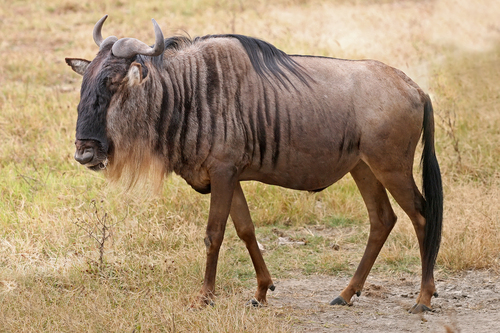
Dark brown to black coat with a long white or cream-colored tail resembling a horse's tail. The face is covered with a shaggy fringe of dark hair and both sexes have forward-curving horns.
Size
Shoulder height of 111-121 cm; body length around 170-220 cm, with a tail adding 40-60 cm.
Weight
Males typically weigh 140-160 kg; females weigh slightly less, around 110-140 kg.
Distinctive features
Distinguished from Blue Wildebeest by smaller size, darker coloration, distinctive white tail, and horns that curve forward and upward rather than outward and downward.
Differences between males and females
Males are generally larger and more robust than females, with thicker horns and a more prominent mane, though horn shape is similar in both sexes.
Behaviour and diet of the Black Wildebeest
Highly social, forming herds of females and young led by a dominant bull; bachelor groups of males also occur. Herd sizes vary from a few individuals to several hundred in favorable habitat.
When it is active
Primarily diurnal, with peak grazing activity in early morning and late afternoon to avoid the midday heat.
Diet
Herbivorous grazer feeding mainly on short grasses; will also consume herbs and shrubs when grass is scarce, especially during dry seasons.
Communication
Communicates through vocalizations such as grunts and snorts, as well as visual displays including head-tossing and stomping; scent marking via preorbital glands is also used to mark territory.
Interactions with other species
Predated upon by lions, spotted hyenas, and cheetahs; often coexists with other grazers such as zebra and blesbok, sharing grassland resources without direct competition due to different grazing preferences.
Role in its ecosystem
Plays an important role as a grazer that helps maintain grassland structure and supports predator populations; its grazing patterns influence plant community composition.
Reproduction and lifecycle
Breeding season (rut) occurs from February to April; gestation lasts about 8.5 months, with a single calf born typically between November and December.
Raising the young
Calves are cared for primarily by the mother, who nurses and protects them; calves can stand and move with the herd within hours of birth, providing predator avoidance benefits.
Maturity and lifespan
Sexual maturity is reached around 2-3 years of age; lifespan in the wild is typically 15-20 years, with slightly longer lifespans recorded in captivity.
Taxonomy and naming of the Black Wildebeest
Classification
Class Mammalia > Order Artiodactyla > Family Bovidae > Genus Connochaetes > Species Connochaetes gnou
Scientific synonyms
Bos gnou, Catoblepas gnou
What research says
Recent studies
Recent genetic research has examined hybridization between Black and Blue Wildebeest in mixed reserves, revealing the need for careful management to preserve genetic distinctiveness of C. gnou.
Genome and DNA
Diploid chromosome number of 2n=58; genetic studies have focused on distinguishing it from the Blue Wildebeest and monitoring hybridization risks.
Compared with similar species
Compared to the Blue Wildebeest (Connochaetes taurinus), the Black Wildebeest is smaller, darker, and has a distinctive white tail and different horn orientation; it also occupies a more restricted, temperate grassland range.
The Black Wildebeest and people
Black Wildebeest were once hunted almost to extinction for their hides and meat but have made a remarkable recovery through private conservation efforts. Their horse-like white tail gives them the nickname 'white-tailed gnu.' They can run at speeds up to 80 km/h when fleeing predators.
Where and how to see it
Best observed in South African reserves like Golden Gate Highlands National Park or private game farms in the Free State, especially during early morning or late afternoon grazing hours.
Risks to humans
No notable risk to humans under normal circumstances, though males can become aggressive during the rutting season if approached closely.
Human uses
Farmed for meat, hides, and trophy hunting on private game ranches; also a popular species for eco-tourism and wildlife photography in South Africa.
Myths and legends
In South African folklore, the wildebeest is sometimes associated with wild, untamed spirit of the plains and features in indigenous stories symbolizing endurance and resilience.
Countries where the Black Wildebeest is recorded
The 4 countries named in the range description of its IUCN Red List assessment.
Questions about the Black Wildebeest
Where does the Black Wildebeest live?
The Black Wildebeest is recorded in Eswatini, Lesotho, Namibia and South Africa across Africa. These countries come from the range description of its IUCN Red List assessment, and they are what place the species on the interactive map.
Is the Black Wildebeest endangered?
The IUCN Red List assesses the Black Wildebeest as Least Concern. The species is widespread and abundant enough not to qualify for any threatened category. It does not mean the species is safe forever, only that nothing in the current data raises an alarm.
How many are left in the wild?
Approximately 18,000-20,000 individuals, with a stable to increasing trend due to extensive management on private game farms. This figure comes from the species assessment on the IUCN Red List; population estimates for wild mammals are ranges, not counts, and are revised at each assessment.
What habitat does the Black Wildebeest live in?
Open grasslands, highveld plains, and karoo scrubland; prefers short grass plains for grazing and open terrain for predator detection.
What is the scientific name of the Black Wildebeest?
The Black Wildebeest is Connochaetes gnou, in the family Bovidae, order Artiodactyla.
Other species in the genus Connochaetes
Other species in the family Bovidae
Species that share its range
Sources
Conservation status, range description and population estimate come from the IUCN Red List assessment for Connochaetes gnou. Countries are derived from that range description, not from a mapped country list. Last refreshed on .
The distribution map is drawn from the IUCN Red List spatial data compiled in 2008. IUCN (International Union for Conservation of Nature)