
Cochabamba Grass Mouse
Akodon siberiae
Red List assessment
Near Threatenedon the IUCN Red List
- EXExtinct
- EWExtinct in the Wild
- CRCritically Endangered
- ENEndangered
- VUVulnerable
- NTNear Threatened
- LCLeast Concern
The Cochabamba Grass Mouse is recorded in 2 countries across Europe and South America. The IUCN Red List assesses the Cochabamba Grass Mouse as Near Threatened. No reliable global population estimate exists.
- Family
- Cricetidae
- Order
- Rodentia
- Genus
- Akodon
- Countries recorded
- 2
- Continents
- Europe and South America
- Red List category
- Near Threatened
- Data updated
- August 9, 2026
What is the Cochabamba Grass Mouse?
Akodon siberiae is a small cricetid rodent endemic to the Bolivian Andes, belonging to the highly speciose South American grass mouse genus Akodon. It was formally described by Myers in 1990, with the species name 'siberiae' referring to the type locality near the village of Siberia in the Cochabamba department of Bolivia. It inhabits humid montane forests and ecotones of the yungas cloud forest zone, an ecologically diverse and biodiverse transitional belt on the eastern Andean slopes. Like other Akodon grass mice, it is an opportunistic omnivore playing an important role in local ecosystem dynamics.
Where does the Cochabamba Grass Mouse live?
Endemic to Bolivia, primarily the Cochabamba department and possibly adjacent areas of La Paz department, on the eastern Andean slopes (yungas zone).
Akodon siberiae is endemic to Bolivia and has a highly restricted range centered on the Cochabamba department, particularly the yungas slopes of the eastern Andes. Its range may extend marginally into neighboring La Paz department. The type locality is near the settlement of Siberia, Cochabamba.
Altitude and depth
Typically found between approximately 2,000 and 3,500 meters above sea level, within the cloud forest and upper yungas zones of the Bolivian Andes.
Seasonal movements
No documented seasonal migrations. Activity levels may shift slightly with Andean seasonal rainfall patterns (wet season November–March, dry season May–September), potentially affecting reproductive timing and food availability.
Habitat of the Cochabamba Grass Mouse
The species primarily occupies humid montane forests (yungas) and adjacent high-altitude grasslands (puna) in the eastern Andes. It is typically found in dense herbaceous undergrowth, forest edges, and areas with abundant leaf litter that provide both cover and foraging opportunities. The yungas zone of Bolivia is characterized by high rainfall, cloud cover, and remarkable plant diversity.
Adaptations to its environment
Like other Akodon species, A. siberiae has dense, somewhat water-resistant fur suited to the cool, moist cloud forest environment. Its relatively broad molars are adapted for processing a mixed diet of seeds, plant material, and invertebrates. Small body size allows efficient thermoregulation and movement through dense ground-level vegetation.
Conservation status and numbers
Near Threatened (NT) on the IUCN Red List. The species narrowly avoids Vulnerable status due to its restricted geographic range (likely qualifying under criterion B), ongoing habitat degradation from agriculture and deforestation, and limited distributional knowledge. It does not currently meet quantitative thresholds for a threatened category but warrants close monitoring.
Estimated population
No reliable global population estimate exists. The population is considered small and likely declining due to ongoing habitat loss within its restricted range. Trend: declining.
What threatens the Cochabamba Grass Mouse?
The primary threats are deforestation and conversion of yungas forest to agricultural land (coca cultivation, subsistence farming), as well as overgrazing by livestock in high-altitude grassland margins. Climate change poses a longer-term threat by shifting the cloud forest zone upslope and reducing habitat area. The species' highly restricted range amplifies its vulnerability to any localized disturbance.
Diseases and parasites
No species-specific disease or parasite data published. Like other South American rodents, A. siberiae is potentially susceptible to hantaviruses, various ectoparasites (fleas, mites, ticks), and endoparasites (helminths, protozoans) common in the genus Akodon.
What is being done to protect it?
Parts of the species' range may fall within protected areas such as Carrasco National Park in Cochabamba, which offers some degree of habitat protection. Bolivia has national legislation protecting wildlife, but enforcement in remote yungas areas is limited. No species-specific conservation programs are known.
Recommended actions
Priority actions include systematic field surveys to better define the species' range and population size, assessment of its presence within existing protected areas, strengthening enforcement of deforestation controls in the yungas zone, and monitoring of population trends. Long-term habitat corridor maintenance between protected areas is also recommended.
What the Cochabamba Grass Mouse looks like
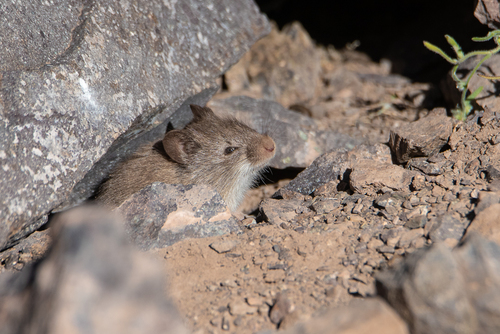
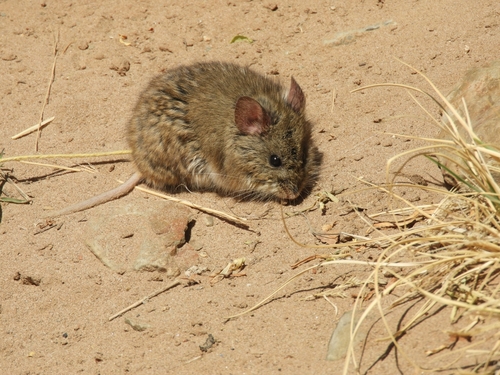
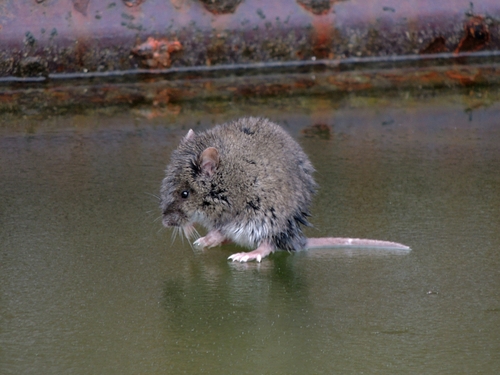
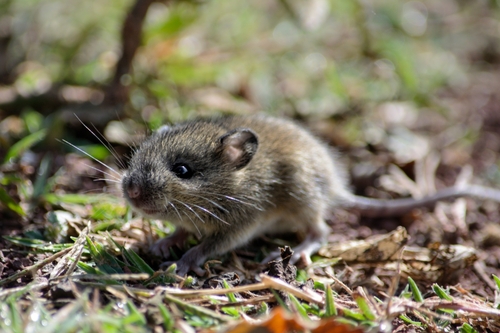
The dorsal fur is typically medium to dark brown or olive-brown, while the ventral surface is paler gray to buff. The fur is dense and moderately soft, adapted to cool montane conditions. The tail is relatively short compared to body length, sparsely haired, and bicolored (darker above, paler below). Ears are rounded and moderately sized.
Size
Body length (head-body): approximately 90–120 mm; tail length: approximately 65–95 mm. Total length roughly 155–215 mm. Typical for the genus Akodon.
Weight
Estimated 18–35 grams, consistent with similar Akodon species. No confirmed sex-specific weight data published for this species.
Distinctive features
Akodon siberiae can be distinguished from sympatric Akodon congeners by a combination of its specific cranial and dental morphology, geographic range, and karyotype (as established during its original description). Externally it closely resembles other members of the Akodon boliviensis species group and reliable identification often requires examination of skull characters.
Differences between males and females
Sexual dimorphism is minimal, as is typical for the genus Akodon. Males may be very slightly larger on average than females, but the difference is not pronounced.
Behaviour and diet of the Cochabamba Grass Mouse
Likely solitary or loosely social outside the breeding season, as is typical for Akodon grass mice. Individuals probably maintain small home ranges and may exhibit some territoriality, particularly among males during the breeding season.
When it is active
Primarily nocturnal and/or crepuscular, foraging mainly during the night and twilight hours. Daytime is spent sheltering in burrows, dense vegetation, or under logs and leaf litter.
Diet
Omnivorous, feeding on seeds, fruits, plant material, fungi, and invertebrates such as insects and earthworms. Like other Akodon species, it is an opportunistic forager whose diet varies seasonally with food availability.
How it feeds and hunts
Forages on the ground through leaf litter and dense vegetation, using olfaction and vibrissae to locate food items. Invertebrates are likely caught by active searching and pouncing rather than ambush.
Communication
Communication likely involves ultrasonic vocalizations (common in cricetid rodents), scent marking via urine and scent glands to establish territories and signal reproductive status, and tactile contact during social interactions.
Interactions with other species
Predators likely include Andean owls (e.g., Strix albitarsis), small felids, mustelids, and pit vipers. It competes with other small rodents sharing the yungas habitat. As a seed consumer and potential scatter-hoarder, it may play a modest role in seed dispersal for certain plant species.
Role in its ecosystem
Functions as a primary consumer and prey species within yungas food webs, channeling energy from plant material and invertebrates to predators. Its burrowing and foraging activity may contribute to soil aeration and nutrient cycling in the montane forest floor.
Reproduction and lifecycle
Breeding is likely seasonal, tied to the Andean wet season when food resources peak. Gestation in Akodon species is typically around 20–23 days. Litter size in the genus ranges from 2 to 6 pups (commonly 3–4). Multiple litters per year are possible under favorable conditions.
Raising the young
Maternal care is the primary parental investment, as is typical for cricetid rodents. The female nurses and protects the altricial young in a nest within a burrow or sheltered site. Weaning occurs at approximately 2–3 weeks of age.
Maturity and lifespan
Sexual maturity is likely reached at 2–3 months of age, consistent with other Akodon species. Wild lifespan is estimated at 1–2 years; captive individuals of related species may live up to 3 years.
Taxonomy and naming of the Cochabamba Grass Mouse
Classification
Mammalia > Rodentia > Cricetidae > Akodon > Akodon siberiae
What research says
Recent studies
Phylogenomic studies of the Akodon boliviensis species group have refined understanding of species boundaries and relationships within this complex. No major recent studies focused exclusively on A. siberiae are known, reflecting its status as a poorly studied endemic.
Genome and DNA
No published karyotype data specifically confirmed for A. siberiae at the time of writing. The broader Akodon genus is notable for extensive chromosomal variation (2n ranging from 10 to 44 across species), and karyotypic data were used to help distinguish A. siberiae from related taxa in the original description.
Compared with similar species
Akodon siberiae is closely related to Akodon boliviensis and other members of the A. boliviensis species group, from which it was distinguished primarily on the basis of morphological and karyotypic differences. It is smaller and more restricted in range than Akodon cursor, a more widespread congener from eastern Brazil.
The Cochabamba Grass Mouse and people
The species name 'siberiae' reflects not the Russian Siberia, but rather the Bolivian village of Siberia in Cochabamba — itself named by settlers who found the Andean cold reminiscent of the Russian wilderness. The genus Akodon is one of the most species-rich mammal genera in the Western Hemisphere, with over 40 described species. Despite their small size, Akodon grass mice are among the most ecologically dominant small mammals in Andean ecosystems, sometimes constituting the majority of small mammal captures in trapping surveys.
Where and how to see it
The best chance of observing this species is in the yungas cloud forests of Cochabamba department, Bolivia, particularly in and around Carrasco National Park. Sherman live traps set along forest edges and in dense herbaceous areas at night yield the highest capture rates. The dry season (May–September) may offer better access to remote field sites, though the wet season may yield higher activity.
Risks to humans
No notable risk to humans. As with all wild rodents, handling should be done with care due to the theoretical risk of hantavirus or other zoonotic diseases, but no specific outbreaks have been associated with this species.
Countries where the Cochabamba Grass Mouse is recorded
The 2 countries named in the range description of its IUCN Red List assessment.
Questions about the Cochabamba Grass Mouse
Where does the Cochabamba Grass Mouse live?
The Cochabamba Grass Mouse is recorded in Bolivia and Russia across Europe and South America. These countries come from the range description of its IUCN Red List assessment, and they are what place the species on the interactive map.
Is the Cochabamba Grass Mouse endangered?
The IUCN Red List assesses the Cochabamba Grass Mouse as Near Threatened. The species does not qualify as threatened today, but it is close to the thresholds and likely to cross them soon. It is the category that most often changes at the next assessment.
How many are left in the wild?
No reliable global population estimate exists. This figure comes from the species assessment on the IUCN Red List; population estimates for wild mammals are ranges, not counts, and are revised at each assessment.
What habitat does the Cochabamba Grass Mouse live in?
The species primarily occupies humid montane forests (yungas) and adjacent high-altitude grasslands (puna) in the eastern Andes.
What is the scientific name of the Cochabamba Grass Mouse?
The Cochabamba Grass Mouse is Akodon siberiae, in the family Cricetidae, order Rodentia.
Other species in the genus Akodon

Other species in the family Cricetidae
Sources
Conservation status, range description and population estimate come from the IUCN Red List assessment for Akodon siberiae. Countries are derived from that range description, not from a mapped country list. Last refreshed on .
The distribution map is drawn from the IUCN Red List spatial data compiled in 2017. IUCN SSC Small Mammal Specialist Group