
Cloud Forest Grass Mouse
Akodon torques
Red List assessment
Least Concernon the IUCN Red List
- EXExtinct
- EWExtinct in the Wild
- CRCritically Endangered
- ENEndangered
- VUVulnerable
- NTNear Threatened
- LCLeast Concern
The Cloud Forest Grass Mouse is recorded in one country, Peru across South America. The IUCN Red List assesses the Cloud Forest Grass Mouse as Least Concern. No precise global population estimate is available.
- Family
- Cricetidae
- Order
- Rodentia
- Genus
- Akodon
- Countries recorded
- 1
- Continents
- South America
- Red List category
- Least Concern
- Data updated
- August 9, 2026
What is the Cloud Forest Grass Mouse?
Akodon torques is a small, semi-fossorial rodent endemic to the cloud forests (yungas) of the Peruvian Andes. It belongs to one of the most speciose genera of South American rodents, characterized by a compact body, short tail, and dense fur adapted to cool, humid montane conditions. The species is remarkable as a representative of the extraordinary rodent radiation occurring in Andean cloud forests, one of the world's most biodiverse yet threatened ecosystems. Despite its relatively restricted range, it occupies a critical ecological niche as a small terrestrial consumer and prey species.
Where does the Cloud Forest Grass Mouse live?
Endemic to Peru, primarily found on the eastern slopes of the Andes (Yungas zone), in departments including Cusco, Puno, Ayacucho, and Junín.
Endemic to Peru, occurring along the eastern slopes of the central and southern Andes. Known records span departments including Cusco, Puno, Ayacucho, and Junín. Its range is largely confined to the narrow altitudinal band of Andean cloud forest on the western margin of the Amazon basin.
Altitude and depth
Typically found between approximately 1,800 and 3,500 meters above sea level, with the core of its distribution concentrated between 2,200 and 3,200 m, within the cloud forest and upper montane forest belts.
Seasonal movements
No documented long-distance seasonal migrations. Activity patterns and reproductive cycles may shift seasonally in response to rainfall regimes, with potentially higher breeding activity during or after the wet season (November–April) when plant food and invertebrate resources peak.
Habitat of the Cloud Forest Grass Mouse
Primary habitat is humid montane cloud forest (yungas), characterized by persistent fog, dense moss cover, and rich undergrowth. It also uses forest edges, scrubby vegetation near treeline, and grassland patches (jalca/puna transition zones) adjacent to cloud forest. The species favors areas with abundant leaf litter and dense herbaceous ground cover that provide both food and shelter.
Adaptations to its environment
Dense, soft fur provides insulation against the cold and damp conditions of cloud forest habitats. Relatively broad, robust forefeet are suited for digging and foraging through leaf litter and soil. Acute olfactory senses support food detection in low-light understorey conditions. Compact body size reduces heat loss in cool montane environments.
Conservation status and numbers
Listed as Least Concern (LC) by the IUCN. The species is considered to have a sufficiently large population and wide enough range within its habitat to not currently qualify for a threatened category, despite ongoing habitat pressures. Continued monitoring is advisable given the vulnerability of cloud forest ecosystems.
Estimated population
No precise global population estimate is available. The species is presumed to occur in moderate numbers within its range given the LC status, but population trend data are lacking. The overall trend is suspected to be slowly declining in line with cloud forest habitat loss.
What threatens the Cloud Forest Grass Mouse?
Deforestation and land conversion for agriculture (including coca cultivation and subsistence farming) on Andean slopes represent the primary threats. Climate change is a growing concern, as rising temperatures cause upward shifts in vegetation zones, effectively shrinking suitable cloud forest habitat. Introduced predators (cats, rats) may locally impact populations.
Diseases and parasites
Like other Akodon rodents, it is likely host to a range of ectoparasites (mites, fleas, ticks) and endoparasites (helminths, protozoans). Akodon species in South America have been documented as potential reservoirs for hantaviruses and other zoonotic pathogens, though specific data for A. torques are lacking.
What is being done to protect it?
The species benefits indirectly from protected areas within its range, including parts of Manu National Park and Megantoni National Sanctuary in Cusco region. Peru's broader national biodiversity conservation framework provides some legal protections for its habitat. No species-specific conservation program is known to exist.
Recommended actions
Expansion and enforcement of protected areas across Peruvian Andean cloud forests; systematic population surveys to establish baseline data; long-term monitoring programs to detect responses to climate change; community-based programs to reduce agricultural encroachment on montane forest slopes.
What the Cloud Forest Grass Mouse looks like
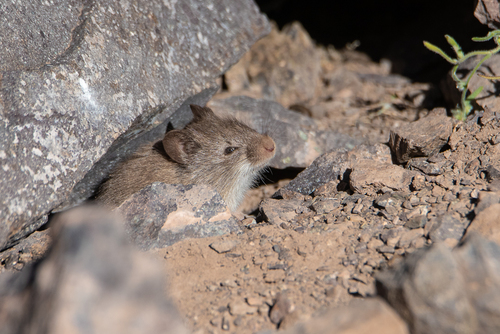
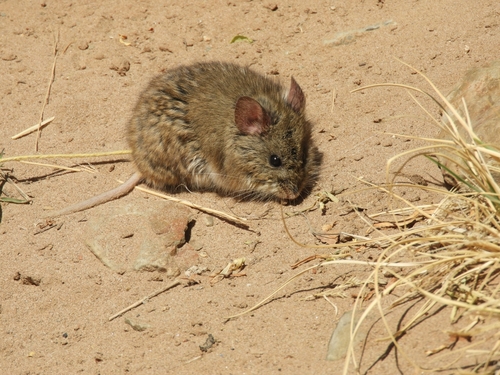
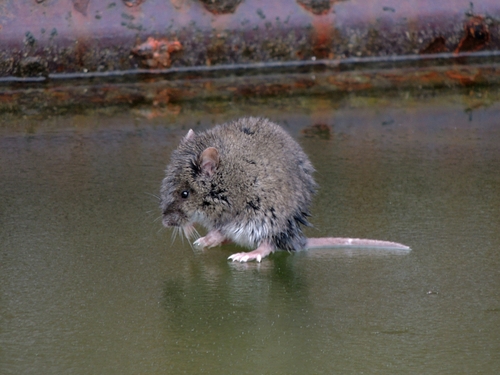
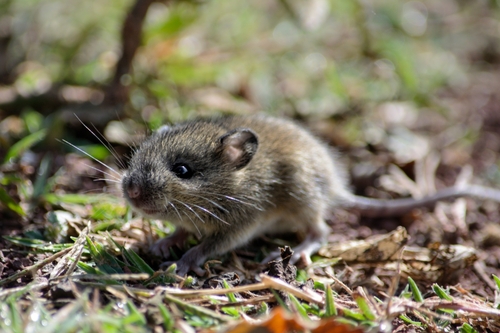
Dorsal pelage is medium to dark brownish-gray, often with an olivaceous tinge, providing camouflage among leaf litter and mossy ground. The ventral fur is paler, ranging from grayish-white to buff. The tail is bicolored (darker above, paler below), relatively short, and lightly haired. Eyes are small and rounded; ears are short and partially hidden in fur.
Size
Head-body length approximately 85–115 mm; tail length approximately 55–80 mm (notably shorter than head-body length). Total length roughly 140–195 mm.
Weight
Typically between 15 and 35 grams; sexual size dimorphism is minimal with males and females of similar mass.
Distinctive features
Distinguished from closely related Akodon species by its specific combination of fur coloration, shorter tail relative to body length, skull morphology (particularly molar structure and braincase shape), and its restricted cloud forest distribution. Genetic and karyotypic data are increasingly used to differentiate it from sympatric congeners.
Differences between males and females
Sexual dimorphism is minimal in this species. Males and females are very similar in size and coloration, though males may be marginally larger on average.
Behaviour and diet of the Cloud Forest Grass Mouse
Likely semi-solitary, as is typical for Akodon grass mice, with individuals maintaining overlapping or exclusive home ranges. Some degree of social tolerance may occur between individuals, particularly during the breeding season. No evidence of complex social hierarchies.
When it is active
Primarily nocturnal and crepuscular, with peak activity during the night hours. Daytime is spent resting in burrows, root cavities, or dense vegetation. Some limited diurnal foraging activity may occur in heavily overcast cloud forest conditions.
Diet
Omnivorous, with a diet consisting primarily of seeds, plant shoots, roots, fungi, and invertebrates (insects, worms, larvae). Like other Akodon species, it shifts dietary emphasis seasonally depending on resource availability, increasing invertebrate consumption when seeds are scarce.
How it feeds and hunts
Forages actively on and under the forest floor, using its sensitive vibrissae and olfaction to locate food items beneath leaf litter. Digs into soft soil for roots, tubers, and soil invertebrates. Opportunistic in its foraging strategy rather than employing specialized hunting techniques.
Communication
Communication likely involves ultrasonic vocalizations (particularly between mother and pups), scent marking through urine, feces, and specialized glands to delineate home ranges and signal reproductive status. Body postures and tactile contact are used during social interactions.
Interactions with other species
Serves as prey for Andean birds of prey (e.g., Andean hawk-eagle, owls), small carnivorous mammals (weasels, Andean colocolo), and snakes. Competes for resources with other small rodents of the yungas, including other Akodon species and Oligoryzomys. May contribute to seed dispersal and soil aeration through its burrowing activities.
Role in its ecosystem
Occupies an important role as a primary consumer and prey species within the Andean cloud forest food web. Its omnivory links plant, fungal, and invertebrate communities. By disturbing soil and dispersing seeds and fungal spores, it contributes to forest floor dynamics and nutrient cycling.
Reproduction and lifecycle
Likely breeds year-round with peaks during the wet season, as observed in related Akodon species. Gestation period is approximately 20–23 days. Litter size typically ranges from 2 to 5 pups. Females can experience postpartum estrus, enabling rapid successive litters.
Raising the young
Altricial young are born hairless and with closed eyes, entirely dependent on the mother. The female nurses and protects the pups in a concealed nest. Weaning occurs around 2–3 weeks of age, after which juveniles rapidly develop independence. Male parental investment is not well documented but is considered minimal.
Maturity and lifespan
Sexual maturity is likely reached at approximately 6–10 weeks of age, consistent with related Akodon species. Wild lifespan is estimated at 1–2 years due to high predation pressure; captive individuals of similar species may live 3–4 years under ideal conditions.
Taxonomy and naming of the Cloud Forest Grass Mouse
Classification
Mammalia > Rodentia > Cricetidae > Sigmodontinae > Akodon > Akodon torques
Scientific synonyms
Originally described by Oldfield Thomas in 1917. No widely recognized synonyms, though historically placed within broader Akodon boliviensis species group assemblages.
What research says
Recent studies
Recent molecular phylogenetic studies of Andean Akodon have helped better define the species boundaries of A. torques and its relationships within the boliviensis group. Ongoing biodiversity surveys in Peruvian yungas continue to refine our understanding of its distribution. Climate change vulnerability assessments for Andean small mammals have highlighted the species' potential susceptibility to habitat compression.
Genome and DNA
The genus Akodon is renowned for highly variable karyotypes, with diploid numbers ranging from 2n=10 to 2n=44 across the genus. The specific karyotype of A. torques has not been widely published; broader phylogenomic studies of Sigmodontinae have helped clarify its placement within the A. boliviensis group. Some Akodon species are notable for sex chromosome polymorphisms involving XY females.
Compared with similar species
Akodon torques is most closely related to other members of the Akodon boliviensis species group, including A. boliviensis and A. subfuscus, with which it can be difficult to distinguish morphologically. Compared to A. subfuscus, A. torques tends to be more restricted to dense cloud forest interiors. It is generally smaller and shorter-tailed than the widespread A. cursor of eastern Brazil.
The Cloud Forest Grass Mouse and people
The genus Akodon contains over 40 recognized species, making it one of the most species-rich mammal genera in the world — a product of explosive evolutionary diversification across the Andes. Some Akodon species famously produce XY females with a fully functional ovary, one of the most unusual sex-determination systems known in mammals. The cloud forests where A. torques lives are so perpetually misty that mosses, bromeliads, and orchids carpet every surface, creating a fairy-tale habitat that harbors extraordinary levels of endemism.
Where and how to see it
The best chances of encountering this species are in humid montane cloud forests of the Cusco and Puno regions of Peru, particularly in protected areas like Manu National Park. Sherman live-traps set along forest floor runways and near fallen logs at night are the standard method used by researchers. General wildlife tourism focused on yungas birding can incidentally offer glimpses of this and related small rodents at dawn and dusk.
Risks to humans
No notable direct risk to humans. As a potential reservoir for hantaviruses (consistent with other Akodon species), contact with wild individuals or their droppings should be avoided as a general precaution. Bites from cornered individuals are possible but minor.
Countries where the Cloud Forest Grass Mouse is recorded
The 1 countries named in the range description of its IUCN Red List assessment.
Questions about the Cloud Forest Grass Mouse
Where does the Cloud Forest Grass Mouse live?
The Cloud Forest Grass Mouse is recorded in Peru across South America. These countries come from the range description of its IUCN Red List assessment, and they are what place the species on the interactive map.
Is the Cloud Forest Grass Mouse endangered?
The IUCN Red List assesses the Cloud Forest Grass Mouse as Least Concern. The species is widespread and abundant enough not to qualify for any threatened category. It does not mean the species is safe forever, only that nothing in the current data raises an alarm.
How many are left in the wild?
No precise global population estimate is available. This figure comes from the species assessment on the IUCN Red List; population estimates for wild mammals are ranges, not counts, and are revised at each assessment.
What habitat does the Cloud Forest Grass Mouse live in?
Primary habitat is humid montane cloud forest (yungas), characterized by persistent fog, dense moss cover, and rich undergrowth.
What is the scientific name of the Cloud Forest Grass Mouse?
The Cloud Forest Grass Mouse is Akodon torques, in the family Cricetidae, order Rodentia.
Other species in the genus Akodon

Other species in the family Cricetidae
Sources
Conservation status, range description and population estimate come from the IUCN Red List assessment for Akodon torques. Countries are derived from that range description, not from a mapped country list. Last refreshed on .
The distribution map is drawn from the IUCN Red List spatial data compiled in 2008. IUCN (International Union for Conservation of Nature)