
Chaco Crimson-nosed Rat
Bibimys chacoensis
Red List assessment
Least Concernon the IUCN Red List
- EXExtinct
- EWExtinct in the Wild
- CRCritically Endangered
- ENEndangered
- VUVulnerable
- NTNear Threatened
- LCLeast Concern
The Chaco Crimson-nosed Rat is recorded in 3 countries across South America. The IUCN Red List assesses the Chaco Crimson-nosed Rat as Least Concern. No precise population estimate exists; the species is considered uncommon to rare in collections, with an unknown but likely declining trend due to habitat loss
- Family
- Cricetidae
- Order
- Rodentia
- Genus
- Bibimys
- Countries recorded
- 3
- Continents
- South America
- Red List category
- Least Concern
- Data updated
- August 9, 2026
What is the Chaco Crimson-nosed Rat?
Bibimys chacoensis is a small, secretive sigmodontine rodent endemic to the semi-arid Gran Chaco woodlands of South America. It belongs to a poorly studied genus of 'crimson-nosed rats' named for the reddish coloration around the snout in some species. Little is known about its ecology due to its cryptic, semi-fossorial lifestyle and low population density, making it a subject of ongoing taxonomic and ecological research.
Where does the Chaco Crimson-nosed Rat live?
Gran Chaco region of central South America, primarily northern Argentina, Paraguay, and possibly southeastern Bolivia
Found in the Gran Chaco biogeographic region spanning northern Argentina (Chaco, Formosa, Santiago del Estero provinces), Paraguay, and potentially bordering areas of Bolivia. Records are sparse and patchy due to limited trapping surveys in this region.
Altitude and depth
Lowland species, typically found at elevations between 100-500 meters above sea level
Seasonal movements
No documented long-distance migration; activity and breeding likely track seasonal rainfall patterns typical of the Chaco's wet and dry seasons
Habitat of the Chaco Crimson-nosed Rat
Inhabits dry Chaco forest, thorn scrub, and semi-arid grassland habitats, often near riparian zones or areas with looser, sandy soils suitable for burrowing. It appears to favor leaf litter and dense understory vegetation for cover.
Adaptations to its environment
Possesses reduced eyes and a somewhat elongated snout suited to a semi-fossorial, litter-dwelling lifestyle, along with strong forelimbs for digging shallow burrows. Its cryptic coloration provides camouflage in leaf litter and dry scrub habitats.
Conservation status and numbers
Listed as Least Concern by the IUCN due to a presumed relatively wide distribution across the Gran Chaco, despite limited population data; however, ongoing habitat loss could warrant future reassessment.
Estimated population
No precise population estimate exists; the species is considered uncommon to rare in collections, with an unknown but likely declining trend due to habitat loss
What threatens the Chaco Crimson-nosed Rat?
Primary threats include deforestation and habitat conversion for cattle ranching and soybean agriculture, which are rapidly reducing native Chaco forest cover. Fragmentation of remaining habitat patches also isolates populations.
Diseases and parasites
No specific diseases or parasites have been documented for this species, though it may host typical rodent ectoparasites such as mites and fleas
What is being done to protect it?
No species-specific conservation programs exist; some protection is afforded indirectly through Chaco forest reserves and protected areas in Argentina and Paraguay, such as national parks within its range.
Recommended actions
Increased field surveys to clarify distribution and population status, habitat protection within the Gran Chaco ecoregion, and inclusion in regional biodiversity monitoring programs targeting small mammals.
What the Chaco Crimson-nosed Rat looks like
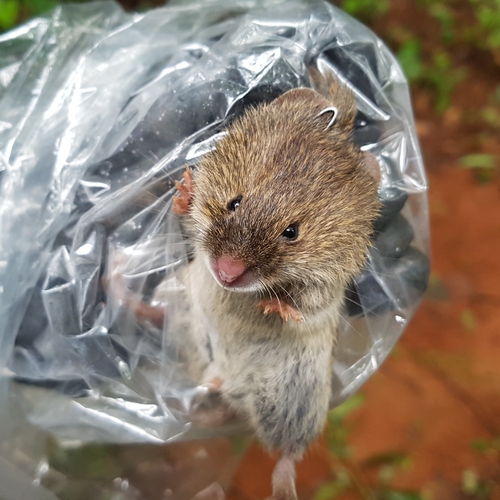
Small rodent with soft, grayish-brown to reddish-brown dorsal fur, paler ventral fur, and a somewhat pointed snout. Some individuals show a subtle reddish tinge around the nose, giving rise to the 'crimson-nosed' common name for the genus.
Size
Body length approximately 7-10 cm, with a tail of similar or slightly shorter length
Weight
Estimated body weight between 15-30 grams, typical for small sigmodontine rodents
Distinctive features
Distinguished from related Bibimys species and other Chaco rodents by subtle cranial and dental characteristics, as well as specific fur coloration patterns identified through morphological and molecular studies.
Differences between males and females
No significant sexual dimorphism has been documented; males and females are similar in size and coloration
Behaviour and diet of the Chaco Crimson-nosed Rat
Believed to be largely solitary, based on general knowledge of related semi-fossorial sigmodontine rodents, though social structure remains poorly studied
When it is active
Likely nocturnal or crepuscular, consistent with most small cricetid rodents, though direct behavioral observations are limited
Diet
Presumed omnivorous diet consisting of seeds, plant material, and invertebrates such as insects, based on dietary patterns of related Scapteromyini rodents
How it feeds and hunts
Likely forages by rooting through leaf litter and soil for invertebrates and seeds rather than active pursuit hunting
Communication
Likely relies on scent marking and ultrasonic vocalizations typical of small rodents, though no species-specific studies have documented communication behavior
Interactions with other species
Likely preyed upon by small carnivores, owls, and snakes native to the Chaco ecosystem; may compete with other small sympatric rodents for food and burrow space
Role in its ecosystem
Plays a role in seed dispersal and soil turnover through burrowing activity, and serves as a prey item within the Chaco food web, contributing to local biodiversity and ecosystem function
Reproduction and lifecycle
Reproductive biology is largely undocumented; related sigmodontine rodents typically have litters of 2-5 young after a gestation period of approximately 20-25 days
Raising the young
Presumed maternal care typical of cricetid rodents, with females nursing and protecting young in a nest until weaning, though specific data for this species is lacking
Maturity and lifespan
Specific data unavailable; related small sigmodontine rodents typically reach sexual maturity within 2-3 months and live 1-2 years in the wild
Taxonomy and naming of the Chaco Crimson-nosed Rat
Classification
Mammalia > Rodentia > Cricetidae > Bibimys > Bibimys chacoensis
Scientific synonyms
Formerly classified under Akodon or Scapteromys in older taxonomic treatments before Bibimys was established as a distinct genus
What research says
Recent studies
Recent taxonomic revisions using molecular data have helped clarify the relationships within the genus Bibimys and its placement relative to other Chaco rodents, though field ecology studies remain scarce
Genome and DNA
Molecular phylogenetic studies have been used to confirm its placement within the tribe Scapteromyini, but detailed genomic data such as chromosome number are not well documented
Compared with similar species
Similar in general appearance to other Bibimys species like B. labiosus and B. torresi, but distinguished by subtle morphological and genetic differences; also resembles other small Chaco sigmodontines such as Akodon species but differs in cranial morphology
The Chaco Crimson-nosed Rat and people
This species belongs to one of the least-studied rodent genera in South America, with only a handful of specimens ever collected. Its common name references the reddish nose coloration shared among Bibimys species, a distinctive but poorly understood trait.
Where and how to see it
Extremely difficult to observe due to its rarity, secretive nocturnal habits, and remote Chaco habitat; best chances would involve participating in scientific small-mammal trapping surveys in protected Chaco forest reserves in Argentina or Paraguay.
Risks to humans
No notable risk to humans
Countries where the Chaco Crimson-nosed Rat is recorded
The 3 countries named in the range description of its IUCN Red List assessment.
Questions about the Chaco Crimson-nosed Rat
Where does the Chaco Crimson-nosed Rat live?
The Chaco Crimson-nosed Rat is recorded in Argentina, Bolivia and Paraguay across South America. These countries come from the range description of its IUCN Red List assessment, and they are what place the species on the interactive map.
Is the Chaco Crimson-nosed Rat endangered?
The IUCN Red List assesses the Chaco Crimson-nosed Rat as Least Concern. The species is widespread and abundant enough not to qualify for any threatened category. It does not mean the species is safe forever, only that nothing in the current data raises an alarm.
How many are left in the wild?
No precise population estimate exists; the species is considered uncommon to rare in collections, with an unknown but likely declining trend due to habitat loss This figure comes from the species assessment on the IUCN Red List; population estimates for wild mammals are ranges, not counts, and are revised at each assessment.
What habitat does the Chaco Crimson-nosed Rat live in?
Inhabits dry Chaco forest, thorn scrub, and semi-arid grassland habitats, often near riparian zones or areas with looser, sandy soils suitable for burrowing.
What is the scientific name of the Chaco Crimson-nosed Rat?
The Chaco Crimson-nosed Rat is Bibimys chacoensis, in the family Cricetidae, order Rodentia.
Other species in the genus Bibimys
Other species in the family Cricetidae
Species that share its range
Sources
Conservation status, range description and population estimate come from the IUCN Red List assessment for Bibimys chacoensis. Countries are derived from that range description, not from a mapped country list. Last refreshed on .
The distribution map is drawn from the IUCN Red List spatial data compiled in 2008. IUCN (International Union for Conservation of Nature)