
Budin's Grass Mouse
Akodon budini
Red List assessment
Least Concernon the IUCN Red List
- EXExtinct
- EWExtinct in the Wild
- CRCritically Endangered
- ENEndangered
- VUVulnerable
- NTNear Threatened
- LCLeast Concern
The Budin's Grass Mouse is recorded in 2 countries across South America. The IUCN Red List assesses the Budin's Grass Mouse as Least Concern. No precise global population estimate is available.
- Family
- Cricetidae
- Order
- Rodentia
- Genus
- Akodon
- Countries recorded
- 2
- Continents
- South America
- Red List category
- Least Concern
- Data updated
- August 9, 2026
What is the Budin's Grass Mouse?
Budin's Grass Mouse is a small sigmodontine rodent endemic to the montane regions of northwestern Argentina. It inhabits the transition zones between Yungas subtropical cloud forests and high Andean grasslands (puna), making it an ecologically specialized species tied to Andean foothills. Named in honor of Emilio Budin, an Argentine naturalist and specimen collector active in the early 20th century. Like other members of the genus Akodon, it is a ground-dwelling generalist that plays an important role in Andean ecosystem nutrient cycling.
Where does the Budin's Grass Mouse live?
Northwestern Argentina (primarily Jujuy and Salta provinces), with possible extension into adjacent southern Bolivia
Restricted to the eastern Andean slopes of northwestern Argentina, particularly in Jujuy province and likely extending into parts of Salta province. Possibly marginally present in adjacent southern Bolivia. Its range is relatively narrow and tied to specific altitudinal zones along the Andes.
Altitude and depth
Typically found between approximately 1,500 and 3,500 meters above sea level, with highest densities likely around 2,000–3,000 m in the cloud forest–puna transition zone.
Seasonal movements
No well-documented seasonal migrations. Like most small Akodon rodents, it likely remains active year-round, with potential shifts in activity patterns or microhabitat use during the wet season (November–March) versus the dry season.
Habitat of the Budin's Grass Mouse
Primarily montane grasslands, shrublands, and the ecotone between Yungas cloud forest and Andean puna. It is typically found in areas with dense grass cover, rocky outcrops, and disturbed edges of humid montane forests. It favors humid to semi-humid microhabitats within the broader arid to semi-arid Andean landscape.
Adaptations to its environment
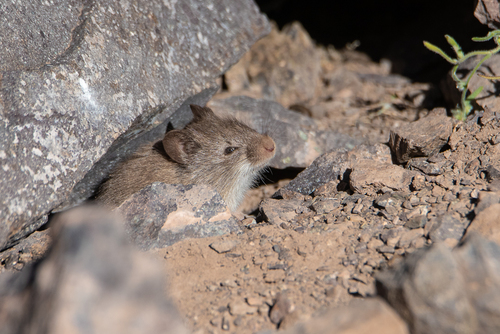
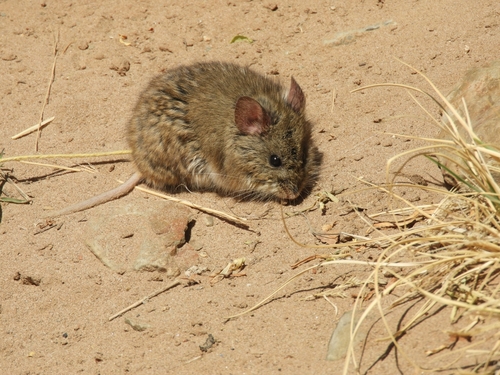
Compact body morphology helps conserve heat in cool montane environments. Dense, insulating fur provides protection against cold Andean nights and temperature fluctuations. Short limbs and robust build are typical of terrestrial burrowing or runway-using small rodents adapted to dense grass substrates.
Conservation status and numbers
Least Concern (LC) on the IUCN Red List. The species is assessed as not currently facing major threats sufficient to qualify for a threatened category; it is considered relatively stable within its range, though data remain limited due to its restricted distribution and infrequent study.
Estimated population
No precise global population estimate is available. The population is believed to be stable, though it may be naturally sparse given the species' narrow geographic and altitudinal range.
What threatens the Budin's Grass Mouse?
Habitat degradation through livestock overgrazing, agricultural encroachment into montane grasslands and Yungas forests, and deforestation at lower elevations represent the primary threats. Climate change-driven upward shifts in vegetation zones could compress its altitudinal range over time.
Diseases and parasites
As with other Akodon rodents, likely hosts a variety of internal parasites (nematodes, cestodes) and ectoparasites (fleas, mites, ticks). Potential reservoir for hantaviruses and other zoonotic agents, though no confirmed documented cases are recorded specifically for A. budini.
What is being done to protect it?
The species occurs within or near protected areas in Jujuy province, including Calilegua National Park (Yungas) and potentially other provincial reserves. Argentine national legislation provides general protection for native wildlife, though no species-specific conservation program is known for A. budini.
Recommended actions
Targeted field surveys to better define the species' range and population size; long-term monitoring in protected areas; reduction of livestock grazing pressure in key montane grassland habitats; inclusion in regional biodiversity assessments for the Yungas and puna transition zones.
What the Budin's Grass Mouse looks like
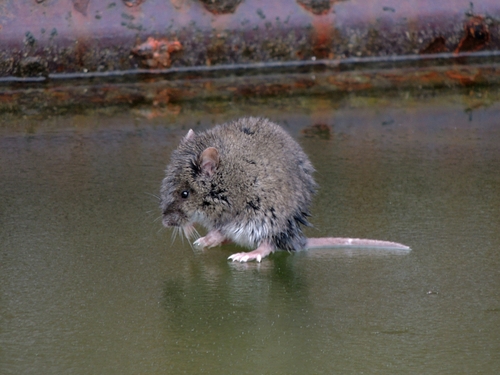
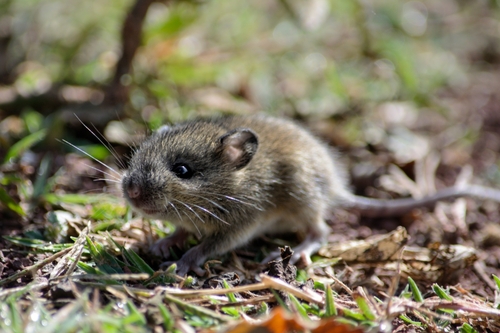
Dorsal fur is typically brownish to grayish-brown, often with darker mid-dorsal tones and a slightly grizzled appearance due to mixed dark and buffy hairs. The ventral surface is paler, grayish to whitish. The tail is bicolored, darker above and paler below, and moderately hairy. Eyes are small and ears are rounded and relatively short.
Size
Body length approximately 80–115 mm (head-body); tail length approximately 60–90 mm; total length roughly 140–200 mm. Hind foot approximately 19–23 mm.
Weight
Estimated body mass between 18 and 40 grams, typical for the genus Akodon; no significant documented dimorphism in size between sexes.
Distinctive features
Distinguished from closely related Akodon species by a combination of craniodental morphology (including specific features of the molars and skull proportions) and subtle pelage differences. Compared to A. boliviensis, it tends to be slightly smaller with somewhat different coloration; exact field identification often requires specimen examination.
Differences between males and females
Minimal external sexual dimorphism; males and females are similar in size and coloration, as is typical across the genus Akodon.
Behaviour and diet of the Budin's Grass Mouse
Presumed to be largely solitary or loosely asocial, as is typical for most Akodon species. Individuals maintain home ranges in dense grass and scrub cover; no evidence of complex social grouping.
When it is active
Primarily nocturnal to crepuscular, with peak activity after dusk. During the day, individuals likely shelter in grass runways, burrows, or beneath rocks and vegetation debris.
Diet
Omnivorous; diet likely consists of seeds, plant matter (grasses, forbs, roots), invertebrates (insects, arthropods), and possibly small amounts of fungal material. The balance of plant vs. animal matter may vary seasonally with prey availability.
How it feeds and hunts
Forages on the ground using olfactory and vibrissae-based sensory cues to locate seeds and invertebrate prey among leaf litter, grass stems, and soil surface. Does not pursue fast prey; primarily a gleaner and opportunistic hunter of slow-moving invertebrates.
Communication
Communication likely involves ultrasonic vocalizations, olfactory signals via urine and glandular secretions used for territory and mate recognition, and tactile contact during social interactions. Alarm squeaks may be used when threatened by predators.
Interactions with other species
Predated upon by Andean owls (e.g., Asio flammeus, Bubo virginianus), small Andean foxes (Lycalopex culpaeus), and snakes. Competes with other small rodents (other Akodon species, Phyllotis, Oxymycterus) for seeds and invertebrate resources. May serve as an intermediate host for certain internal parasites.
Role in its ecosystem
Functions as a secondary consumer and seed predator/disperser within Andean montane ecosystems. As prey, it is an important energy conduit to higher trophic levels (raptors, carnivores). Its burrowing and runway activity may contribute to soil aeration and seed redistribution.
Reproduction and lifecycle
Breeding biology is not well-documented specifically for this species. Based on related Akodon, breeding likely peaks during the austral spring and summer (October–March), coinciding with higher food availability. Gestation is approximately 21–23 days; litter size typically 3–6 pups.
Raising the young
Maternal care is predominant, as in most sigmodontine rodents. The female nurses and shelters pups in a nest; young are altricial at birth (hairless, eyes closed) and are weaned at approximately 14–21 days. Males likely play little direct role in parental care.
Maturity and lifespan
Sexual maturity is likely reached at approximately 6–10 weeks of age, consistent with other Akodon species. Lifespan in the wild is probably 1–2 years; captive individuals of related species may live up to 3 years under optimal conditions.
Taxonomy and naming of the Budin's Grass Mouse
Classification
Mammalia > Rodentia > Cricetidae (subfamily Sigmodontinae) > Akodon > Akodon budini
Scientific synonyms
Originally described by Oldfield Thomas in 1918; sometimes treated as a subspecies or close relative of other Akodon species in older literature, but currently recognized as a distinct species.
What research says
Recent studies
Taxonomic revisions within the genus Akodon using molecular phylogenetics have periodically re-evaluated the status of A. budini. Studies on Akodon species complexes in the central Andes have helped clarify its distinctiveness, though it remains one of the less-studied members of the genus.
Genome and DNA
Chromosome number not precisely confirmed for A. budini in available literature; related Akodon species typically have diploid numbers ranging from 2n=10 to 2n=44 with notable karyotypic diversity. No genome-wide study is known specifically for this species.
Compared with similar species
Most closely related to other Andean Akodon species such as A. boliviensis and A. albiventer. Compared to A. boliviensis, A. budini is generally considered more associated with higher-elevation Yungas transition habitats. All three species share the characteristic short-tailed, robust body plan of highland Akodon, differing mainly in skull dimensions and pelage tones.
The Budin's Grass Mouse and people
The genus Akodon is one of the most species-rich rodent genera in South America, with over 40 recognized species — and new cryptic species are still being discovered using genetics. Despite its small size, Budin's Grass Mouse can survive nighttime temperatures near or below freezing at its high Andean elevations. It was named after Emilio Budin, a prolific collector of Argentine natural history specimens in the early 1900s whose field work in the Andes yielded numerous species new to science.
Where and how to see it
Best observed using live-trapping techniques (Sherman traps) in montane grasslands and forest edges in Jujuy province, Argentina, particularly around Calilegua National Park and surrounding foothills. Evening hours offer the best chance of encountering active individuals. Professional permits are required for mammal trapping in Argentina.
Risks to humans
No notable direct risk to humans. As a potential rodent reservoir for hantavirus and other zoonotic pathogens common in the genus, basic hygiene precautions are recommended when handling live or dead specimens.
Countries where the Budin's Grass Mouse is recorded
The 2 countries named in the range description of its IUCN Red List assessment.
Questions about the Budin's Grass Mouse
Where does the Budin's Grass Mouse live?
The Budin's Grass Mouse is recorded in Argentina and Bolivia across South America. These countries come from the range description of its IUCN Red List assessment, and they are what place the species on the interactive map.
Is the Budin's Grass Mouse endangered?
The IUCN Red List assesses the Budin's Grass Mouse as Least Concern. The species is widespread and abundant enough not to qualify for any threatened category. It does not mean the species is safe forever, only that nothing in the current data raises an alarm.
How many are left in the wild?
No precise global population estimate is available. This figure comes from the species assessment on the IUCN Red List; population estimates for wild mammals are ranges, not counts, and are revised at each assessment.
What habitat does the Budin's Grass Mouse live in?
Primarily montane grasslands, shrublands, and the ecotone between Yungas cloud forest and Andean puna.
What is the scientific name of the Budin's Grass Mouse?
The Budin's Grass Mouse is Akodon budini, in the family Cricetidae, order Rodentia.
Other species in the genus Akodon

Other species in the family Cricetidae
Sources
Conservation status, range description and population estimate come from the IUCN Red List assessment for Akodon budini. Countries are derived from that range description, not from a mapped country list. Last refreshed on .
The distribution map is drawn from the IUCN Red List spatial data compiled in 2008. IUCN (International Union for Conservation of Nature)