
Herb Field Mouse
Apodemus uralensis
Red List assessment
Least Concernon the IUCN Red List
- EXExtinct
- EWExtinct in the Wild
- CRCritically Endangered
- ENEndangered
- VUVulnerable
- NTNear Threatened
- LCLeast Concern
The Herb Field Mouse is recorded in 6 countries across Asia and Europe. The IUCN Red List assesses the Herb Field Mouse as Least Concern. No precise global population estimate is available.
- Family
- Muridae
- Order
- Rodentia
- Genus
- Apodemus
- Countries recorded
- 6
- Continents
- Asia and Europe
- Red List category
- Least Concern
- Data updated
- August 9, 2026
What is the Herb Field Mouse?
The Herb Field Mouse is a small, cryptic rodent belonging to the genus Apodemus, the Old World field mice. It inhabits open grassy habitats, forest edges, and meadows across a vast Eurasian range stretching from Scandinavia and Eastern Europe to the Ural Mountains and western Siberia. It is notable for its preference for herbaceous vegetation and for being one of the smaller Apodemus species, occupying a distinct ecological niche from the more woodland-associated Yellow-necked or Wood Mice. Its wide distribution and adaptability to disturbed agricultural landscapes contribute to its Least Concern conservation status.
Where does the Herb Field Mouse live?
Eastern Europe and northern Asia: Russia, Ukraine, Belarus, Finland, Baltic states, Kazakhstan, western Siberia
The species ranges from Scandinavia (southern Finland) and the Baltic states southward through Poland, Ukraine, and Belarus, across Russia west of the Urals, and extends eastward into western Siberia and northern Kazakhstan. The core of its distribution lies in the temperate zone of Eastern Europe and the Ural region.
Altitude and depth
Primarily a lowland species occurring from near sea level up to approximately 1,500 m in montane meadow zones at the southern edges of its range. Most populations are found below 800 m.
Seasonal movements
Does not hibernate. Activity continues year-round, though surface activity decreases during cold winter months when animals may rely heavily on cached food stores and subnivean (under-snow) tunnels. Breeding ceases in winter and resumes in early spring.
Habitat of the Herb Field Mouse
Primarily found in open grassy habitats including meadows, steppes, forest-steppe ecotones, hedgerows, and agricultural field margins. It shows a strong affinity for herbaceous ground cover with dense vegetation providing shelter. It occasionally colonizes forest edges and shrubby areas but rarely penetrates dense woodland interiors.
Adaptations to its environment
Its relatively small body size allows it to exploit dense herbaceous cover inaccessible to larger rodents. Its generalist diet enables it to shift between seeds, insects, and plant material depending on seasonal availability. Its high reproductive rate allows rapid population recovery after winter mortality.
Conservation status and numbers
Least Concern (LC) on the IUCN Red List. The species has a large range, is locally common throughout much of it, and no major population-level declines have been documented. The population is considered stable overall.
Estimated population
No precise global population estimate is available. The species is considered locally common across much of its range, with population trends regarded as stable.
What threatens the Herb Field Mouse?
Intensification of agriculture (loss of field margins and hedgerows), pesticide use reducing invertebrate prey, and habitat conversion of natural grasslands and steppes. Local populations may be impacted by predator pressure and disease cycles.
Diseases and parasites
Known to host ectoparasites including ticks (Ixodes ricinus), mites, and fleas. Endoparasites include nematodes and cestodes. Can carry and act as a reservoir host for pathogens including hantaviruses and Borrelia (Lyme disease spirochetes), with implications for zoonotic disease ecology.
What is being done to protect it?
No specific conservation programs target this species given its Least Concern status. It benefits indirectly from agri-environment schemes in Europe that preserve field margins and reduce pesticide use, as well as from the protection of steppe and meadow habitats in Russia and Ukraine.
Recommended actions
Maintenance of field margins and uncultivated strips in agricultural landscapes; reduction of broad-spectrum pesticide use; continued monitoring of populations in the context of climate-driven habitat shifts; taxonomic and genetic studies to clarify population structure.
What the Herb Field Mouse looks like
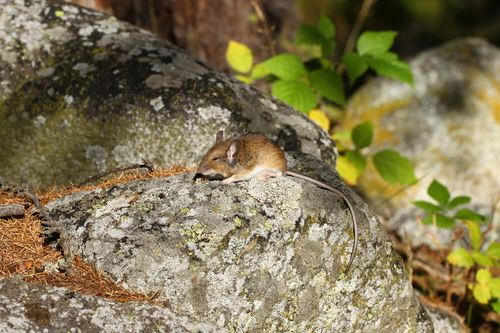
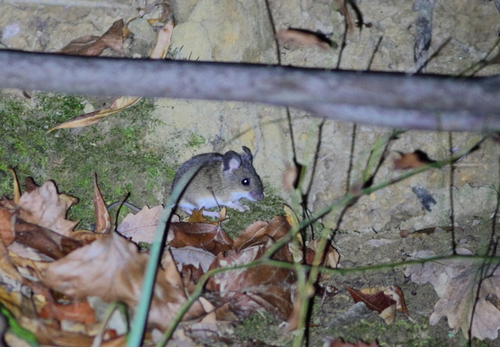
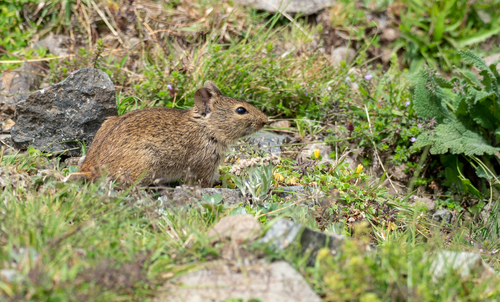
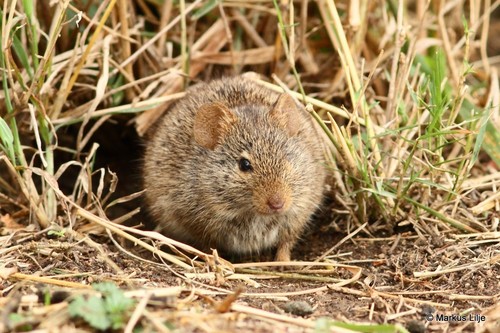
Dorsal fur is brownish-gray to ochre-brown, often with a slightly darker midline. The flanks are paler and the ventral side is white to light gray. The ears are moderately large and rounded, and the eyes are conspicuous and dark. The tail is bicolored, darker above and paler below.
Size
Body length: 65–105 mm; tail length: 60–95 mm (tail is typically slightly shorter than body length). No significant limb specializations.
Weight
Typically 12–25 g. Adults in good body condition before winter may reach the upper end of this range.
Distinctive features
Distinguished from the closely related Wood Mouse (Apodemus sylvaticus) by its smaller size, shorter tail relative to body length, and less rich rufous coloration. Compared to Apodemus microps (Pygmy Field Mouse), differentiation is subtle and historically required karyotypic or molecular confirmation. Lacks the yellow-orange chest patch seen in A. flavicollis.
Differences between males and females
Sexual dimorphism is minimal. Males and females are similar in size and coloration, though adult males may be marginally heavier during the breeding season.
Behaviour and diet of the Herb Field Mouse
Predominantly solitary outside the breeding season. Home ranges may overlap, particularly between males. No complex social hierarchy has been documented. During winter, loose aggregations in shared nesting sites may occur for thermoregulation.
When it is active
Primarily nocturnal, with peak activity occurring in the first few hours after dusk and again before dawn. Some crepuscular activity has been recorded. During breeding season, daytime activity may increase.
Diet
Omnivorous. The diet consists mainly of seeds (grass seeds, weed seeds, cereal grains), green plant parts, roots, and berries, supplemented by invertebrates such as insects, larvae, and earthworms, especially in spring and summer when protein demand is high. Food caching behavior has been reported.
How it feeds and hunts
Forages by actively searching through leaf litter, grass bases, and soil surface using vibrissae (whiskers) and olfaction to locate food items. Invertebrates are captured opportunistically. No specialized pursuit hunting.
Communication
Communicates using ultrasonic vocalizations, particularly during social interactions and mating. Scent marking via urine and specialized glands plays a role in territory signaling. Body postures and vibrissae orientation are used in close-range encounters.
Interactions with other species
Preyed upon by a wide range of predators including owls (Barn Owl, Tawny Owl), mustelids (weasels, stoats), foxes, and domestic cats. Competes for food resources with other small rodents such as voles (Microtus spp.) and other Apodemus species. May act as a seed disperser for certain plant species through caching behavior.
Role in its ecosystem
Functions as an important intermediate consumer in grassland and agricultural ecosystems, linking primary producers (seeds, vegetation) to higher predators. Its seed-caching behavior contributes to plant dispersal. It is also a host for various ectoparasites and endoparasites, playing a role in disease ecology.
Reproduction and lifecycle
Breeding season runs from March or April through October, with multiple litters possible per year (2–4 litters). Gestation lasts approximately 19–21 days. Litter size ranges from 3 to 8 pups, with an average of 5–6.
Raising the young
The female provides all direct parental care. Pups are born blind, naked, and altricial. They are nursed in a grass-lined nest for approximately 18–21 days until weaning. Males do not participate in pup rearing.
Maturity and lifespan
Sexual maturity is reached at approximately 2–3 months of age. Wild lifespan is typically 12–18 months due to high predation and overwinter mortality. In captivity, individuals may survive up to 2–3 years.
Taxonomy and naming of the Herb Field Mouse
Classification
Mammalia > Rodentia > Muridae > Apodemus > Apodemus uralensis
Subspecies
No widely recognized subspecies are currently validated; populations across the broad range show some morphological variation but subspecific taxonomy remains unresolved.
Scientific synonyms
Originally described as Mus uralensis Pallas, 1811. Has been variously synonymized or confused with Apodemus microps in older literature.
What research says
Recent studies
Recent phylogeographic studies using mitochondrial and nuclear markers have clarified the evolutionary history and colonization routes of A. uralensis across Eastern Europe and Siberia. Studies on zoonotic disease ecology have highlighted its role as a reservoir host in Eurasian disease systems.
Genome and DNA
The diploid chromosome number is 2n = 48, consistent with many other Apodemus species. Molecular phylogenetic studies have helped clarify its distinctness from closely related taxa such as A. microps and have informed current species-level taxonomy within the genus.
Compared with similar species
Most closely related to the Pygmy Field Mouse (Apodemus microps) of Central Europe, from which it was sometimes not distinguished historically. A. uralensis tends to have a more easterly and northerly distribution. It is smaller and less rufous than the Wood Mouse (A. sylvaticus) and lacks the distinctive yellow collar of the Yellow-necked Mouse (A. flavicollis).
The Herb Field Mouse and people
Despite its small size, the Herb Field Mouse can cache enough seeds to sustain itself through weeks of harsh winter conditions. It produces ultrasonic calls inaudible to humans that are used during courtship. Its broad eastward range means some populations live in climates as cold as the sub-Siberian steppe, making it one of the hardiest members of its genus.
Where and how to see it
Best observed at night in open meadows and agricultural field margins across Russia and Eastern Europe using small live traps or UV-reflective spotlighting methods. Spring and early autumn, when breeding activity is highest, offer the best chances of encounter. Areas around Moscow and the Ural foothills are within the core of its range.
Risks to humans
Can carry ectoparasites (ticks) that transmit Lyme disease and may act as a reservoir for hantaviruses. Direct risk from bites is minimal. Standard precautions when handling wild rodents or working in infested habitats are recommended.
Human uses
Used as a model organism in some ecological and parasitological research. No significant commercial, agricultural, or traditional medicinal uses documented. Occasionally considered a minor pest in stored grain facilities within its range.
Countries where the Herb Field Mouse is recorded
The 6 countries named in the range description of its IUCN Red List assessment.
Questions about the Herb Field Mouse
Where does the Herb Field Mouse live?
The Herb Field Mouse is recorded in Belarus, Finland, Kazakhstan, Poland and Russia, among 6 countries in total across Asia and Europe. These countries come from the range description of its IUCN Red List assessment, and they are what place the species on the interactive map.
Is the Herb Field Mouse endangered?
The IUCN Red List assesses the Herb Field Mouse as Least Concern. The species is widespread and abundant enough not to qualify for any threatened category. It does not mean the species is safe forever, only that nothing in the current data raises an alarm.
How many are left in the wild?
No precise global population estimate is available. This figure comes from the species assessment on the IUCN Red List; population estimates for wild mammals are ranges, not counts, and are revised at each assessment.
What habitat does the Herb Field Mouse live in?
Primarily found in open grassy habitats including meadows, steppes, forest-steppe ecotones, hedgerows, and agricultural field margins.
What is the scientific name of the Herb Field Mouse?
The Herb Field Mouse is Apodemus uralensis, in the family Muridae, order Rodentia.
Other species in the genus Apodemus
Other species in the family Muridae
Sources
Conservation status, range description and population estimate come from the IUCN Red List assessment for Apodemus uralensis. Countries are derived from that range description, not from a mapped country list. Last refreshed on .
The distribution map is drawn from the IUCN Red List spatial data compiled in 2008. IUCN (International Union for Conservation of Nature)