
Western European Hedgehog
Erinaceus europaeus
Red List assessment
Near Threatenedon the IUCN Red List
- EXExtinct
- EWExtinct in the Wild
- CRCritically Endangered
- ENEndangered
- VUVulnerable
- NTNear Threatened
- LCLeast Concern
The Western European Hedgehog is recorded in 5 countries across Europe and Oceania. The IUCN Red List assesses the Western European Hedgehog as Near Threatened. UK population estimated to have declined from around 30 million in the 1950s to under 1 million today; overall European population trend is considered declining though precise continental figures are uncertain.
- Family
- Erinaceidae
- Order
- Eulipotyphla
- Genus
- Erinaceus
- Countries recorded
- 5
- Continents
- Europe and Oceania
- Red List category
- Near Threatened
- Data updated
- August 9, 2026
What is the Western European Hedgehog?
The Western European Hedgehog is a small, spiny insectivorous mammal instantly recognizable by its coat of sharp spines used for defense. It is widespread across Europe, thriving in gardens, hedgerows, farmland, and woodland edges, making it one of the continent's most familiar wild mammals. Nocturnal and solitary, it plays an important role in controlling insect and slug populations. Despite being widespread, populations have declined sharply in recent decades due to habitat loss and human infrastructure.
Where does the Western European Hedgehog live?
Western, Central and Northern Europe, including the British Isles, France, Germany, Scandinavia, and Italy
Found throughout most of Western and Central Europe, from the British Isles and Ireland eastward through France, the Benelux countries, Germany, Scandinavia (southern parts), Italy, and into parts of Eastern Europe; introduced populations exist in New Zealand.
Altitude and depth
Typically found from sea level up to around 2000m in mountainous regions such as the Alps, though most populations occur below 1000m.
Seasonal movements
Hedgehogs hibernate in temperate regions from around October/November to March/April, entering torpor in nests of leaves and grass to survive cold winters when food is scarce.
Habitat of the Western European Hedgehog
Prefers mosaic habitats including deciduous woodland edges, hedgerows, grasslands, farmland, parks and suburban gardens; it avoids dense coniferous forests, wetlands, and very open exposed terrain. Urban and suburban gardens have become increasingly important refuges as rural habitat is lost.
Adaptations to its environment
The dense coat of keratin spines provides defense against predators via a rolling-into-a-ball behavior controlled by a specialized panniculus carnosus muscle. Hibernation and fat storage allow survival through winters with reduced insect prey availability, while a strong sense of smell and hearing compensate for poor eyesight during nocturnal foraging.
Conservation status and numbers
Classified as Near Threatened by IUCN due to significant population declines particularly in the UK and parts of Western Europe over recent decades, driven by habitat fragmentation and agricultural intensification.
Estimated population
UK population estimated to have declined from around 30 million in the 1950s to under 1 million today; overall European population trend is considered declining though precise continental figures are uncertain.
What threatens the Western European Hedgehog?
Major threats include habitat loss from agricultural intensification and hedgerow removal, road mortality, garden fencing restricting movement, pesticide use reducing invertebrate prey, and predation by badgers in some regions.
Diseases and parasites
Commonly affected by ticks, fleas, mites (causing mange), lungworm, and ringworm; can also carry Salmonella and ectoparasites transmissible in rare cases to pets.
What is being done to protect it?
Conservation efforts include hedgehog-friendly garden initiatives, 'hedgehog highways' (gaps in fences), wildlife rehabilitation centers, national monitoring schemes like the UK's Hedgehog Street campaign, and legal protection in several countries.
Recommended actions
Priority actions include preserving and restoring hedgerows and field margins, creating wildlife corridors between gardens, reducing pesticide use, mitigating road mortality, and continued population monitoring across Europe.
What the Western European Hedgehog looks like
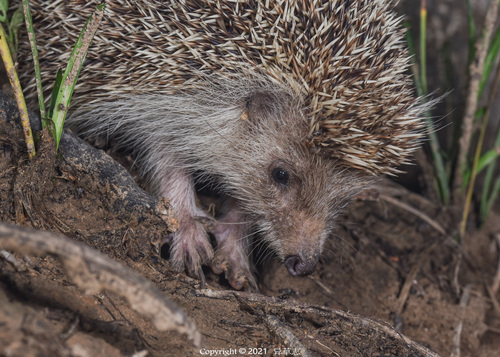
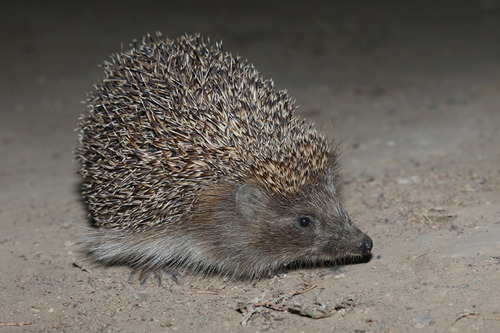
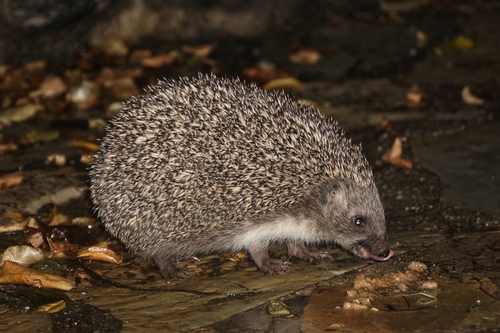
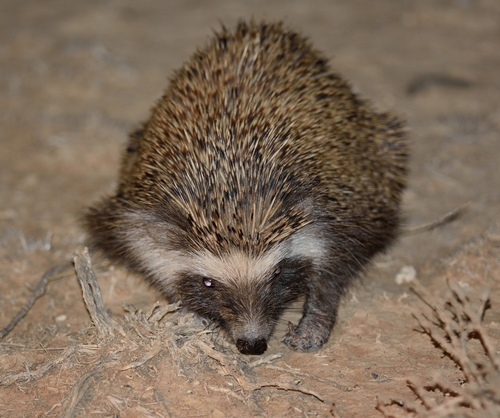
The upperparts are covered in thousands of brown-and-white banded spines, while the face, legs, and underside are covered in coarse grayish-brown fur. The face is pointed with a dark, moist nose and small black eyes.
Size
Body length typically 20-30 cm, with a very short tail of about 1-2 cm.
Weight
Adults typically weigh between 400-1200g, with significant seasonal variation as they fatten up before hibernation.
Distinctive features
Distinguished from other hedgehog species (like the Eastern European hedgehog Erinaceus roumanicus) by subtle differences in skull shape, fur coloration on the chest, and genetic markers rather than obvious external features.
Differences between males and females
Minimal sexual dimorphism; males and females are similar in size and appearance, though males may be slightly larger on average.
Behaviour and diet of the Western European Hedgehog
Solitary and largely non-territorial, hedgehogs interact mainly during the breeding season and otherwise forage and rest independently, with home ranges that may overlap between individuals.
When it is active
Strictly nocturnal, emerging at dusk to forage and returning to nests before dawn; activity ceases entirely during winter hibernation.
Diet
Omnivorous, primarily feeding on invertebrates such as beetles, earthworms, slugs, caterpillars, and earwigs, supplemented occasionally with bird eggs, carrion, and fallen fruit.
How it feeds and hunts
Forages by slowly walking and snuffling through leaf litter and grass, using acute smell and hearing to detect prey, then digging or pouncing to capture invertebrates.
Communication
Communicates primarily through scent marking and body posture; vocalizations include grunts, snorts, and squeals, particularly during mating encounters or distress.
Interactions with other species
Natural predators include badgers, foxes, and birds of prey such as eagle owls; hedgehogs may avoid areas with high badger density due to competition and predation pressure.
Role in its ecosystem
Functions as an important mid-level predator of invertebrates, helping regulate populations of garden and agricultural pests such as slugs and beetles, while also serving as prey for larger carnivores.
Reproduction and lifecycle
Breeding occurs from April to September, with a gestation period of about 31-35 days; females typically give birth to litters of 3-7 young called hoglets, sometimes producing two litters per year in favorable conditions.
Raising the young
Only the female cares for the young, nursing them in a nest for around 4-6 weeks until weaning, after which juveniles become independent and disperse.
Maturity and lifespan
Reach sexual maturity around 1 year of age; average lifespan in the wild is 2-3 years, though they can live up to 8-10 years in captivity or protected environments.
Taxonomy and naming of the Western European Hedgehog
Classification
Class Mammalia > Order Eulipotyphla > Family Erinaceidae > Genus Erinaceus > Species Erinaceus europaeus
Subspecies
Several subspecies have been proposed historically (e.g., E. e. europaeus, E. e. hispanicus) but most modern authorities consider the species largely monotypic across its core range, with clinal variation rather than distinct subspecies.
Scientific synonyms
Erinaceus vulgaris (older synonym used in some 19th century texts)
What research says
Recent studies
Recent GPS-tracking studies have revealed detailed information on urban hedgehog movement patterns and the effectiveness of garden corridors, informing conservation strategies in the UK and Europe.
Genome and DNA
The hedgehog genome has been sequenced as part of comparative mammalian genomics studies, revealing insights into immune adaptations related to spine development and hibernation physiology.
Compared with similar species
Similar to the Eastern European hedgehog (Erinaceus roumanicus), with which its range overlaps in parts of Central Europe; the two species are distinguished mainly through genetic and cranial analysis rather than visible traits.
The Western European Hedgehog and people
Hedgehogs can have up to 5,000-7,000 spines on their bodies; they are largely immune to many snake venoms due to specialized blood proteins; and they can run surprisingly fast, up to 2-3 mph, when startled.
Where and how to see it
Best observed at dusk in gardens, hedgerows, and woodland edges during warmer months (May-September); using red-filtered torches minimizes disturbance while allowing visibility of nocturnal activity.
Risks to humans
No notable risk to humans beyond minor ectoparasite transmission risk (such as ringworm) through direct handling; bites are rare and not dangerous.
Human uses
Historically hunted for meat in some regions and occasionally used in folk medicine, though today they are primarily valued as garden allies for natural pest control and as a beloved symbol of wildlife-friendly gardening.
Myths and legends
In European folklore, hedgehogs have been associated with cunning and protection, and in some traditions were believed to steal milk from cows' udders at night, a myth without factual basis.
Countries where the Western European Hedgehog is recorded
The 5 countries named in the range description of its IUCN Red List assessment.
Questions about the Western European Hedgehog
Where does the Western European Hedgehog live?
The Western European Hedgehog is recorded in France, Germany, Ireland, Italy and New Zealand across Europe and Oceania. These countries come from the range description of its IUCN Red List assessment, and they are what place the species on the interactive map.
Is the Western European Hedgehog endangered?
The IUCN Red List assesses the Western European Hedgehog as Near Threatened. The species does not qualify as threatened today, but it is close to the thresholds and likely to cross them soon. It is the category that most often changes at the next assessment.
How many are left in the wild?
UK population estimated to have declined from around 30 million in the 1950s to under 1 million today; overall European population trend is considered declining though precise continental figures are uncertain. This figure comes from the species assessment on the IUCN Red List; population estimates for wild mammals are ranges, not counts, and are revised at each assessment.
What habitat does the Western European Hedgehog live in?
Prefers mosaic habitats including deciduous woodland edges, hedgerows, grasslands, farmland, parks and suburban gardens; it avoids dense coniferous forests, wetlands, and very open exposed terrain.
What is the scientific name of the Western European Hedgehog?
The Western European Hedgehog is Erinaceus europaeus, in the family Erinaceidae, order Eulipotyphla.
Other species in the genus Erinaceus
Other species in the family Erinaceidae
Species that share its range


Sources
Conservation status, range description and population estimate come from the IUCN Red List assessment for Erinaceus europaeus. Countries are derived from that range description, not from a mapped country list. Last refreshed on .
The distribution map is drawn from the IUCN Red List spatial data compiled in 2023. IUCN SSC Small Mammal Specialist Group