
Southern African Hedgehog
Atelerix frontalis
Red List assessment
Least Concernon the IUCN Red List
- EXExtinct
- EWExtinct in the Wild
- CRCritically Endangered
- ENEndangered
- VUVulnerable
- NTNear Threatened
- LCLeast Concern
The Southern African Hedgehog is recorded in 9 countries across Africa. The IUCN Red List assesses the Southern African Hedgehog as Least Concern. No precise global population estimate has been published.
- Family
- Erinaceidae
- Order
- Eulipotyphla
- Genus
- Atelerix
- Countries recorded
- 9
- Continents
- Africa
- Red List category
- Least Concern
- Data updated
- August 9, 2026
What is the Southern African Hedgehog?
The Southern African Hedgehog is a small, spiny, insectivorous mammal native to the savannas and grasslands of southern and central Africa. It is one of four species in the African genus Atelerix and is readily identified by its distinctive white frontal band across the forehead. Remarkably, it possesses partial resistance to the venom of some venomous snakes, including the puff adder. As a nocturnal forager, it plays a useful role in controlling invertebrate populations in its ecosystem and has adapted well to suburban and agricultural environments.
Where does the Southern African Hedgehog live?
South Africa, Zimbabwe, Botswana, Namibia (eastern), Mozambique, Malawi, Zambia, and southern Angola
Ranges across southern and central Africa: throughout much of South Africa (especially Gauteng, KwaZulu-Natal, Limpopo, Northern Cape), northward into Zimbabwe, eastern Botswana, eastern Namibia, Mozambique, Malawi, Zambia, and southern Angola. Absent from the Congo Basin and West Africa.
Altitude and depth
Typically found from sea level to approximately 2,000 m above sea level, with records from highland grasslands in South Africa and Zimbabwe. Most common at moderate elevations in bushveld and savanna zones.
Seasonal movements
In the colder and drier parts of its range (e.g., Highveld of South Africa), individuals may enter prolonged periods of torpor during winter (May–August) to conserve energy. This is not true hibernation but can last several weeks. Activity peaks during spring and summer (September–February) coinciding with breeding and peak invertebrate availability.
Habitat of the Southern African Hedgehog
Primarily inhabits savanna, bushveld, dry grasslands, and scrublands with sufficient ground cover. Also tolerates montane grasslands, agricultural margins, and suburban gardens. Key microhabitat requirements include leaf litter, rocks, brush piles, and loose soil for nesting and foraging.
Adaptations to its environment
Bears approximately 5,000–7,000 hollow, keratin-based spines that provide a formidable passive defense; rolls into a tight ball when threatened, concealing all soft body parts. Capable of entering winter torpor to survive food shortages and cold. Exhibits 'self-anointing' behavior—producing foamy saliva mixed with novel scents and spreading it over the spines—whose function remains scientifically debated. Nocturnal lifestyle minimizes exposure to daytime heat and visual predators.
Conservation status and numbers
Listed as Least Concern (LC) by the IUCN Red List. The species maintains a wide distribution and is locally common in suitable habitat. However, localized population declines are suspected in urban and agricultural zones due to road mortality and habitat loss, and the overall population trend may be slowly declining.
Estimated population
No precise global population estimate has been published. The species is considered locally common across much of its range, but population trend is suspected to be slowly declining in areas of high human pressure. No quantitative census data currently exist.
What threatens the Southern African Hedgehog?
Primary threats include road traffic mortality (a major cause of death in urbanized areas), habitat loss and fragmentation from agricultural expansion and urban development, use in traditional medicine (muti trade), persecution based on superstition, predation by domestic dogs and cats, and collection for the illegal exotic pet trade.
Diseases and parasites
Hosts diverse ectoparasites including ticks (Ixodes and Haemaphysalis species), fleas, and mites. Dermatophyte fungal infections (ringworm) are common and transmissible to humans. Can carry Salmonella and potentially other zoonotic bacteria. Captive-held individuals are susceptible to 'Wobbly Hedgehog Syndrome,' a fatal progressive neurological condition of uncertain etiology also documented in African species.
What is being done to protect it?
The species is protected under South Africa's National Environmental Management: Biodiversity Act (NEMBA), requiring permits for keeping or trading. It occurs in numerous protected areas including Kruger National Park, Pilanesberg, and Hwange National Park (Zimbabwe). Wildlife rehabilitation centers across South Africa regularly treat road-injured individuals.
Recommended actions
Priority actions include implementing wildlife-friendly road design (underpasses, road signage) to reduce roadkill; strengthening enforcement against the muti trade and illegal pet keeping; conducting systematic population monitoring; promoting awareness of the species' ecological value among urban residents; and restoring native grassland and bushveld habitats.
What the Southern African Hedgehog looks like
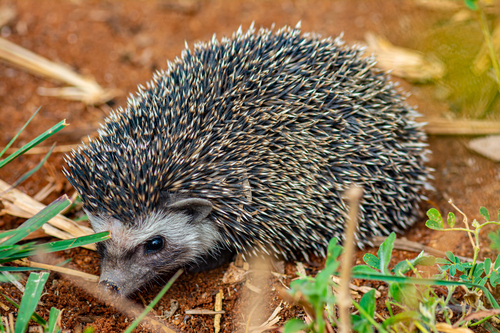
The back is densely covered in banded spines: white at the base, with a dark brown to black mid-band, and a white tip, giving a speckled appearance. The face, underside, and limbs are covered in soft fur that is predominantly white to creamy white or pale brown. A distinctive white frontal band runs across the forehead. The snout is pointed and the eyes are small and dark.
Size
Body length: 15–30 cm (typically 18–22 cm); tail length: 1–4 cm. Limbs are short and sturdy; the snout is elongated and highly mobile.
Weight
Typically 250–600 g; individuals accumulating fat reserves before winter torpor may approach the upper limit. Females tend to be marginally smaller than males on average.
Distinctive features
Distinguished from the closely related Four-toed Hedgehog (Atelerix albiventris) by its more southerly distribution, slightly larger average size, and the prominent white frontal band on the forehead. Like all Atelerix species, it has four (not five) toes on its hind feet, separating it from European Erinaceus hedgehogs. The white face contrasting with the banded dorsal spines is the most reliable field mark.
Differences between males and females
Sexual dimorphism is minimal; males and females are nearly identical in external appearance and size. Males may be marginally heavier on average. The sexes are reliably distinguished only by examination of the anogenital distance or direct observation of genitalia.
Behaviour and diet of the Southern African Hedgehog
Predominantly solitary outside the breeding season. Individuals maintain overlapping home ranges without strong territorial aggression. Males actively seek out females during the breeding season but provide no subsequent parental investment. No social hierarchy or permanent grouping has been observed.
When it is active
Strictly nocturnal, becoming active shortly after dusk and returning to a nest before dawn. During the day it sleeps in a nest of dry leaves and grass concealed under rocks, fallen logs, brush piles, or in a shallow burrow. Active periods and foraging distances increase markedly during spring and summer.
Diet
Omnivorous, with a strong preference for invertebrates. Diet includes beetles, earthworms, millipedes, caterpillars, grasshoppers, termites, snails, and slugs. Also takes small vertebrates (frogs, small lizards), bird eggs, carrion, fungi, and fallen fruit. Considered ecologically and agriculturally beneficial due to high consumption of garden and crop pests.
How it feeds and hunts
Forages by rooting actively through leaf litter, loose soil, and debris with its sensitive, mobile snout, detecting prey primarily by smell and hearing. Investigates crevices, holes, and the underside of objects. Prey is usually seized and eaten directly; larger invertebrates may be shaken to disable them. Hedgehogs show partial resistance to certain invertebrate irritants, enabling consumption of stinging arthropods.
Communication
Communicates through a range of vocalizations including snuffling, grunting, chirping (young), hissing, and loud screaming when highly stressed or threatened. Scent communication via urine, feces, and possibly flank gland secretions likely plays a role in reproductive signaling. The enigmatic self-anointing behavior may serve functions related to chemical camouflage, mate attraction, or parasite deterrence.
Interactions with other species
Natural predators include large owls (e.g., Verreaux's eagle-owl), African wildcats, honey badgers, black-backed jackals, and large snakes such as the puff adder. Hedgehogs possess partial serum-based resistance to viper venom, making them less vulnerable to snake predation than most similar-sized mammals, but they are not fully immune. They compete with other small insectivores (shrews, elephant shrews) for invertebrate prey resources.
Role in its ecosystem
Occupies a mid-trophic position as an opportunistic omnivore in savanna and grassland food webs. Helps regulate invertebrate populations, including agricultural pest species. Serves as prey for larger carnivores and raptors. Provides limited seed dispersal through consumption and subsequent deposition of small fruits. Contributes to soil aeration through rooting behavior.
Reproduction and lifecycle
Breeding season extends mainly from September to January in the Southern Hemisphere (spring and summer). Gestation lasts approximately 34–37 days. Litter size ranges from 1 to 9 young (typically 3–5). Newborns are altricial—born blind and hairless—but soft baby spines are covered by a fluid-filled skin membrane that retracts within hours of birth, rapidly exposing the initial spine coat.
Raising the young
Exclusively maternal parental care; males play no role in rearing. The female nurses the young in a concealed nest for 4–6 weeks. Juveniles begin accompanying their mother on foraging trips at 3–4 weeks old and are weaned and fully independent by approximately 6–8 weeks. The mother defends the nest aggressively if disturbed.
Maturity and lifespan
Females reach sexual maturity as early as 2 months of age but typically do not breed until their first spring. Males mature somewhat later. Estimated lifespan in the wild is 2–5 years; captive individuals can survive up to 8–10 years with proper care.
Taxonomy and naming of the Southern African Hedgehog
Classification
Mammalia > Eulipotyphla > Erinaceidae > Atelerix > Atelerix frontalis
Subspecies
Two subspecies are tentatively recognized: Atelerix frontalis frontalis (South Africa, Botswana, Zimbabwe) and Atelerix frontalis angolae (Angola, Zambia, Malawi), though their validity is debated.
Scientific synonyms
Originally described as Erinaceus frontalis by A. Smith in 1831; later placed in genus Atelerix. Also formerly referred to under the synonyms Erinaceus namaquensis and Atelerix namaquensis in older literature.
What research says
Recent studies
Recent studies in South Africa have quantified road mortality as a critical threat in urbanized landscapes, particularly around Johannesburg and Pretoria. Phylogeographic analyses have refined species boundaries within African Atelerix hedgehogs. Growing research focuses on the species' urban ecology and adaptability to human-modified environments. Studies on venom resistance mechanisms in Atelerix have contributed to broader understanding of toxin immunity in small mammals.
Genome and DNA
The diploid chromosome number for Atelerix species is reported as 2n = 48. Molecular phylogenetic studies have confirmed the separation of the genus Atelerix from the European genus Erinaceus and supported the recognition of distinct African species. Full genome sequencing for A. frontalis has not been widely published.
Compared with similar species
Most closely related to the Four-toed (African Pygmy) Hedgehog (Atelerix albiventris), which is more northerly in distribution and widely kept as a pet globally. A. frontalis is generally slightly larger and more cold-tolerant. Compared to European hedgehogs (Erinaceus europaeus), it is smaller, inhabits tropical/subtropical biomes, and has four rather than five hind toes. The North African hedgehog (Atelerix algirus) is more desert-adapted and geographically distant.
The Southern African Hedgehog and people
1) The self-anointing behavior—where a hedgehog chews a novel-smelling substance, produces copious foamy saliva, and contorts to spread it all over its spines—remains one of the most bizarre and still poorly explained behaviors in all of mammalogy. 2) Due to partial serum-based resistance to snake venom, Southern African Hedgehogs can withstand puff adder bites that would be lethal to animals of comparable size. 3) Each spine is a modified hollow hair made of keratin; hedgehogs shed and regrow spines throughout their life in a process called 'quilling,' which can be painful for juveniles.
Where and how to see it
Best observed on warm, windless nights in open bushveld or grassland, especially near water sources, from September to February. Private game reserves and national parks in Limpopo, Mpumalanga, and KwaZulu-Natal (e.g., Kruger, Pilanesberg, Hluhluwe-iMfolozi) offer good opportunities. Slow spotlight drives along dirt roads after dark often reveal individuals foraging or crossing. Use a dim red-light torch to minimize disturbance; avoid handling wild individuals.
Risks to humans
Generally low risk to humans. May bite if handled improperly or provoked, causing minor puncture wounds. Spines can puncture skin if grasped carelessly. Can transmit ringworm (dermatophyte fungi) through contact with spines or skin. Potential carrier of Salmonella and tick-borne pathogens; basic hygiene precautions are advised after any contact with wild individuals.
Human uses
Used in traditional medicine (muti) across parts of southern Africa, with spines, fat, and other body parts traded for purported medicinal and protective purposes. Occasionally kept illegally as exotic pets; a permit is required in South Africa. Naturally valuable as informal pest controllers in gardens and farms due to high consumption of insects, slugs, and other invertebrates. Increasingly featured in urban biodiversity and wildlife-friendly gardening initiatives.
Myths and legends
In several southern African traditional belief systems, hedgehog body parts (spines, fat) are used as ingredients in muti (traditional medicine) and are believed to confer protective or curative properties, unfortunately driving persecution of the species. In some Nguni cultural contexts the hedgehog is associated with tenacity and self-protection due to its defensive behavior. In modern South African popular culture, hedgehogs have gained an affectionate public image as charming garden visitors.
Countries where the Southern African Hedgehog is recorded
The 9 countries named in the range description of its IUCN Red List assessment.
Questions about the Southern African Hedgehog
Where does the Southern African Hedgehog live?
The Southern African Hedgehog is recorded in Angola, Botswana, Democratic Republic of the Congo, Malawi and Mozambique, among 9 countries in total across Africa. These countries come from the range description of its IUCN Red List assessment, and they are what place the species on the interactive map.
Is the Southern African Hedgehog endangered?
The IUCN Red List assesses the Southern African Hedgehog as Least Concern. The species is widespread and abundant enough not to qualify for any threatened category. It does not mean the species is safe forever, only that nothing in the current data raises an alarm.
How many are left in the wild?
No precise global population estimate has been published. This figure comes from the species assessment on the IUCN Red List; population estimates for wild mammals are ranges, not counts, and are revised at each assessment.
What habitat does the Southern African Hedgehog live in?
Primarily inhabits savanna, bushveld, dry grasslands, and scrublands with sufficient ground cover.
What is the scientific name of the Southern African Hedgehog?
The Southern African Hedgehog is Atelerix frontalis, in the family Erinaceidae, order Eulipotyphla.
Other species in the genus Atelerix
Other species in the family Erinaceidae
Species that share its range

Sources
Conservation status, range description and population estimate come from the IUCN Red List assessment for Atelerix frontalis. Countries are derived from that range description, not from a mapped country list. Last refreshed on .
The distribution map is drawn from the IUCN Red List spatial data compiled in 2008. IUCN (International Union for Conservation of Nature)