
Tien Shan Red-backed Vole
Clethrionomys centralis
Red List assessment
Least Concernon the IUCN Red List
- EXExtinct
- EWExtinct in the Wild
- CRCritically Endangered
- ENEndangered
- VUVulnerable
- NTNear Threatened
- LCLeast Concern
The Tien Shan Red-backed Vole is recorded in 5 countries across Asia. The IUCN Red List assesses the Tien Shan Red-backed Vole as Least Concern. No precise global population estimate exists, but the species is considered common within suitable habitat; population trend is presumed stable.
- Family
- Cricetidae
- Order
- Rodentia
- Genus
- Craseomys
- Countries recorded
- 5
- Continents
- Asia
- Red List category
- Least Concern
- Data updated
- August 9, 2026
What is the Tien Shan Red-backed Vole?
The Tien Shan Red-backed Vole is a small rodent endemic to the mountainous regions of Central Asia, particularly the Tien Shan range. It inhabits forested and shrubby mountain slopes at moderate to high elevations. This species is notable for its adaptation to cold, high-altitude environments and its role in mountain ecosystem food webs as both seed disperser and prey species.
Where does the Tien Shan Red-backed Vole live?
Central Asia, primarily in the Tien Shan mountain range spanning Kyrgyzstan, Kazakhstan, Tajikistan, Uzbekistan, and western China (Xinjiang).
Found in the Tien Shan mountain system across Kyrgyzstan, southeastern Kazakhstan, Tajikistan, Uzbekistan, and extending into the Xinjiang region of northwestern China. Its range is restricted to montane habitats within this mountain system.
Altitude and depth
Typically found between 1500-3500 meters elevation, with highest densities in mid-elevation forest zones.
Seasonal movements
Does not hibernate but shows reduced activity during harsh winter months; breeding is seasonal, concentrated in spring and summer when food resources are abundant.
Habitat of the Tien Shan Red-backed Vole
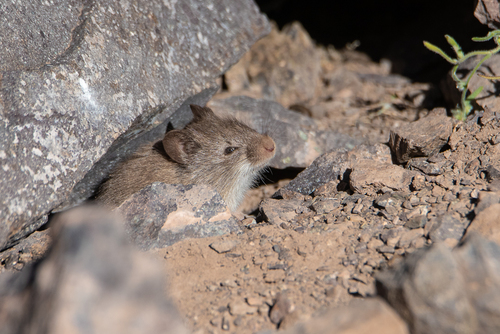
Prefers coniferous and mixed forests, shrubby thickets, and subalpine meadows with dense ground cover. Often found near streams or in areas with moss and leaf litter that provide cover and nesting material.
Adaptations to its environment
Possesses dense fur for insulation against cold mountain temperatures and burrowing behavior to escape extreme weather. Its small body size and efficient metabolism help conserve energy in resource-limited high-altitude environments.
Conservation status and numbers
Listed as Least Concern (LC) by IUCN due to its relatively wide distribution across suitable mountain habitats and presumed stable population, despite localized habitat pressures.
Estimated population
No precise global population estimate exists, but the species is considered common within suitable habitat; population trend is presumed stable.
What threatens the Tien Shan Red-backed Vole?
Habitat degradation from deforestation, overgrazing by livestock, and climate change affecting montane forest ecosystems are the primary threats, though none are currently severe enough to threaten overall population viability.
Diseases and parasites
Susceptible to various ectoparasites including fleas, mites, and ticks, as well as internal parasites such as helminths; may also serve as a reservoir for certain zoonotic pathogens common to voles.
What is being done to protect it?
No species-specific conservation programs exist; general protection is afforded through Tien Shan mountain nature reserves and national parks in Kyrgyzstan and Kazakhstan that preserve forest habitat.
Recommended actions
Continued monitoring of population trends, protection of montane forest habitats from overgrazing and logging, and further taxonomic research to clarify subspecies status and range boundaries.
What the Tien Shan Red-backed Vole looks like
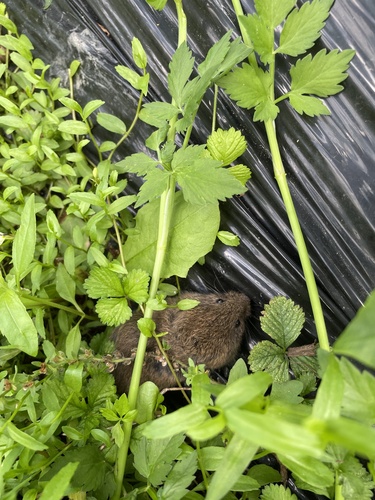
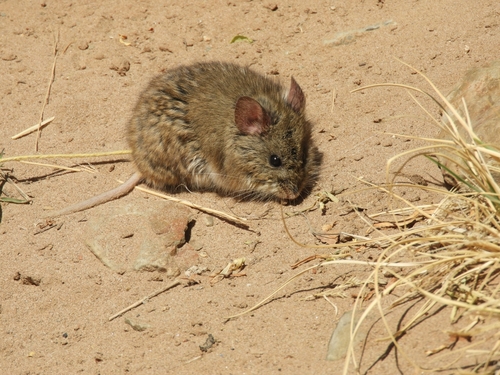
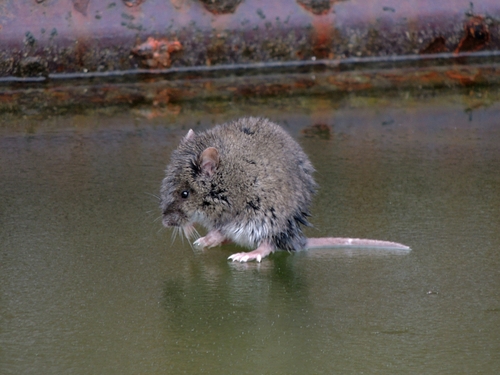
Has a reddish-brown to chestnut dorsal stripe running along the back, contrasting with greyish-brown flanks and a lighter, greyish-white underside. The fur is soft and dense, suited to cold mountain climates.
Size
Body length typically ranges from 9-12 cm, with a tail length of 4-6 cm.
Weight
Adults typically weigh between 15-30 grams.
Distinctive features
Distinguished from related red-backed voles by subtle differences in skull morphology, tail length proportions, and the specific coloration pattern of its dorsal stripe, though field identification can be challenging without genetic or detailed morphological analysis.
Differences between males and females
Minimal sexual dimorphism; males and females are similar in size and coloration.
Behaviour and diet of the Tien Shan Red-backed Vole
Generally solitary or living in loose family groups, with some overlap in home ranges between individuals, particularly during breeding season.
When it is active
Primarily nocturnal and crepuscular, though some daytime activity occurs, especially in cooler months when temperatures are more moderate.
Diet
Herbivorous, feeding primarily on seeds, berries, green vegetation, fungi, and occasionally bark or roots, particularly during winter when other food is scarce.
Communication
Communicates primarily through scent marking using glandular secretions and urine to establish territory and reproductive status; also uses vocalizations and physical contact within social interactions.
Interactions with other species
Serves as prey for various mountain predators including owls, weasels, foxes, and small carnivorous mammals; competes with other small rodents for similar food resources and habitat niches.
Role in its ecosystem
Plays an important ecological role as a seed disperser for forest plants and as a key prey species supporting populations of mountain predators, contributing to nutrient cycling in montane ecosystems.
Reproduction and lifecycle
Breeding occurs from spring through late summer, with females capable of producing multiple litters per season. Gestation lasts approximately 18-20 days, with litter sizes typically ranging from 4-8 pups.
Raising the young
Females provide sole parental care, nursing and protecting young in nests until weaning at approximately 3 weeks of age, after which juveniles become independent.
Maturity and lifespan
Reaches sexual maturity at approximately 2-3 months of age; typical lifespan in the wild is short, around 1-1.5 years, due to high predation pressure and environmental stress.
Taxonomy and naming of the Tien Shan Red-backed Vole
Classification
Mammalia > Rodentia > Cricetidae > Craseomys (formerly Clethrionomys) > centralis
Subspecies
Several subspecies have been described across its Central Asian range, though taxonomy remains debated; some authorities consider it closely related to or synonymous with populations of Craseomys rufocanus in parts of its range.
Scientific synonyms
Myodes centralis; Clethrionomys rufocanus centralis (in some classifications treating it as a subspecies of the grey red-backed vole).
What research says
Recent studies
Recent taxonomic studies using molecular data have sought to clarify the relationship between C. centralis and other red-backed vole species in Central Asia, though comprehensive genetic surveys remain limited.
Genome and DNA
Specific genomic studies on this species are limited, though it belongs to a genus with well-documented chromosomal variation among related vole species.
Compared with similar species
Closely resembles other red-backed voles such as Craseomys rufocanus and Myodes glareolus, differing mainly in geographic range, subtle coloration, and skull characteristics rather than overall body plan or behavior.
The Tien Shan Red-backed Vole and people
Despite living in harsh, high-altitude environments, this vole remains active year-round without true hibernation. It is one of several vole species found at the edge of habitable elevation zones in Central Asian mountain ranges, showcasing remarkable cold adaptation for such a small mammal.
Where and how to see it
Best observed in forested mountain habitats of the Tien Shan range during dawn or dusk in spring and summer months, using patience and quiet observation near ground cover, logs, or forest edges.
Risks to humans
No notable risk to humans; however, as with many rodents, there is a low potential for disease transmission through contact with droppings or ectoparasites.
Countries where the Tien Shan Red-backed Vole is recorded
The 5 countries named in the range description of its IUCN Red List assessment.
Questions about the Tien Shan Red-backed Vole
Where does the Tien Shan Red-backed Vole live?
The Tien Shan Red-backed Vole is recorded in China, Kazakhstan, Kyrgyzstan, Tajikistan and Uzbekistan across Asia. These countries come from the range description of its IUCN Red List assessment, and they are what place the species on the interactive map.
Is the Tien Shan Red-backed Vole endangered?
The IUCN Red List assesses the Tien Shan Red-backed Vole as Least Concern. The species is widespread and abundant enough not to qualify for any threatened category. It does not mean the species is safe forever, only that nothing in the current data raises an alarm.
How many are left in the wild?
No precise global population estimate exists, but the species is considered common within suitable habitat; population trend is presumed stable. This figure comes from the species assessment on the IUCN Red List; population estimates for wild mammals are ranges, not counts, and are revised at each assessment.
What habitat does the Tien Shan Red-backed Vole live in?
Prefers coniferous and mixed forests, shrubby thickets, and subalpine meadows with dense ground cover.
What is the scientific name of the Tien Shan Red-backed Vole?
The Tien Shan Red-backed Vole is Clethrionomys centralis, in the family Cricetidae, order Rodentia.
Other species in the genus Craseomys
Other species in the family Cricetidae
Sources
Conservation status, range description and population estimate come from the IUCN Red List assessment for Clethrionomys centralis. Countries are derived from that range description, not from a mapped country list. Last refreshed on .
The distribution map is drawn from the IUCN Red List spatial data compiled in 2008. IUCN (International Union for Conservation of Nature)