
Grey Red-backed Vole
Craseomys rufocanus
Red List assessment
Least Concernon the IUCN Red List
- EXExtinct
- EWExtinct in the Wild
- CRCritically Endangered
- ENEndangered
- VUVulnerable
- NTNear Threatened
- LCLeast Concern
The Grey Red-backed Vole is recorded in 4 countries across Asia and Europe. The IUCN Red List assesses the Grey Red-backed Vole as Least Concern. No precise global population estimate exists, but the species is considered abundant and widespread, with populations undergoing natural multi-year density cycles rather than long-term decline.
- Family
- Cricetidae
- Order
- Rodentia
- Genus
- Craseomys
- Countries recorded
- 4
- Continents
- Asia and Europe
- Red List category
- Least Concern
- Data updated
- August 9, 2026
What is the Grey Red-backed Vole?
The Grey Red-backed Vole is a small rodent native to the boreal and subarctic zones of northern Eurasia, ranging from Scandinavia to Japan. It is notable for its grayish dorsal fur with a reddish tinge and its ecological importance as a key prey species in taiga and tundra food webs. This species belongs to the recently revised genus Craseomys, separated from Myodes based on molecular phylogenetic studies. It shows dramatic population cycles that influence predator populations across its range.
Where does the Grey Red-backed Vole live?
Northern Eurasia, including Scandinavia, Russia (Siberia and the Far East), Mongolia, northeastern China, Korea, and Japan (Hokkaido)
Found across a wide swath of northern Eurasia including Fennoscandia, Russia (Siberia, Ural Mountains, Russian Far East, Kamchatka), Mongolia, northeastern China, the Korean Peninsula, and the Japanese island of Hokkaido.
Altitude and depth
Occurs from sea level up to approximately 2000-2500 meters in mountainous regions, particularly in alpine tundra zones of Japan and Siberia.
Seasonal movements
Does not hibernate; remains active year-round, including under snow cover during winter using subnivean tunnels. Breeding is seasonal, occurring primarily from spring through early autumn with a pause during the coldest winter months.
Habitat of the Grey Red-backed Vole
Primarily inhabits boreal coniferous and mixed forests (taiga), subalpine meadows, shrub tundra, and rocky alpine habitats. It favors areas with dense ground cover, moss, and leaf litter that provide shelter and food resources.
Adaptations to its environment
Possesses a thick, dense fur coat for insulation against cold climates and burrows extensively to create nests and food storage chambers. It also exhibits communal nesting behavior in winter to conserve heat and caches food such as seeds and lichens for use during snow-covered periods.
Conservation status and numbers
Listed as Least Concern (LC) by the IUCN due to its wide geographic distribution, large population size, and lack of significant range-wide decline. Populations naturally fluctuate in multi-year cycles but remain abundant overall.
Estimated population
No precise global population estimate exists, but the species is considered abundant and widespread, with populations undergoing natural multi-year density cycles rather than long-term decline.
What threatens the Grey Red-backed Vole?
Localized threats include habitat degradation from logging, agricultural expansion, and land conversion in parts of its range. Climate change may also affect snow cover patterns critical for winter survival in northern populations.
Diseases and parasites
Known to host various ectoparasites including fleas, ticks, and mites, and serves as a reservoir species for hantaviruses in parts of its range, particularly studied in Japan and Russia.
What is being done to protect it?
No species-specific conservation programs exist due to its stable status, though it benefits indirectly from forest and tundra habitat protections in nature reserves across Russia, Japan, and Scandinavia.
Recommended actions
Continued monitoring of population cycles and habitat quality in the context of climate change and forestry practices is recommended, along with maintaining protected boreal forest areas.
What the Grey Red-backed Vole looks like
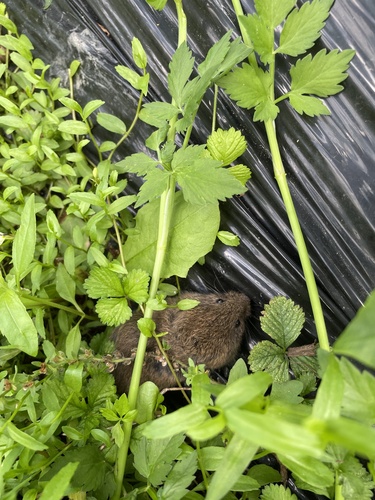
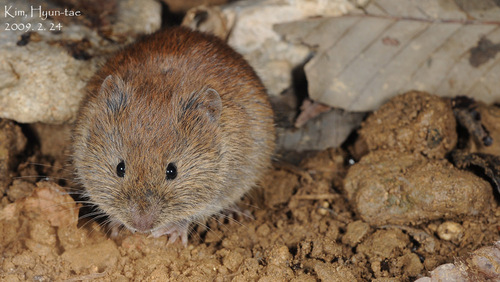
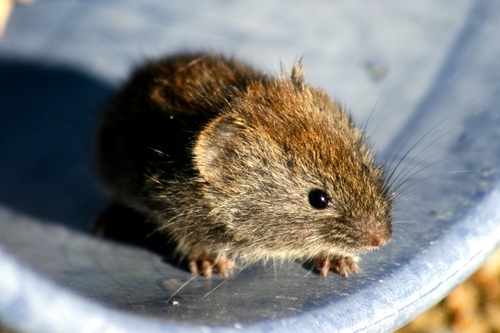
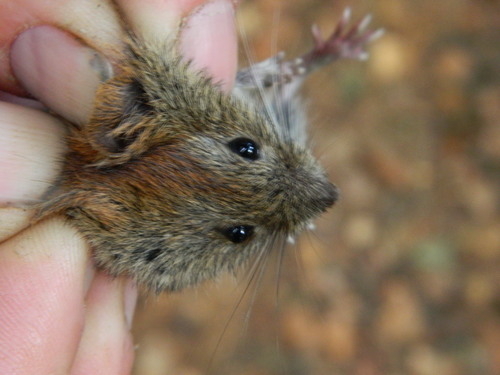
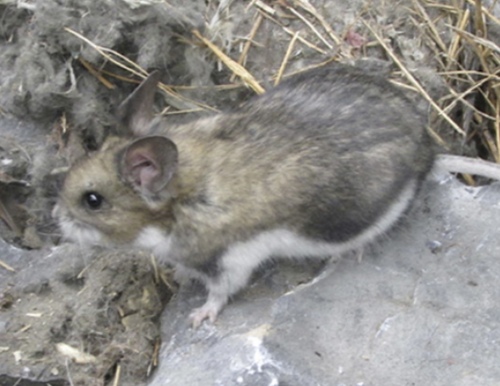
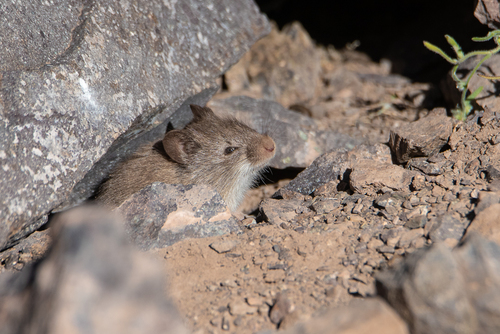
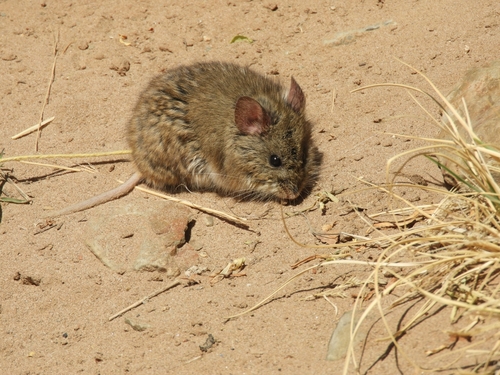
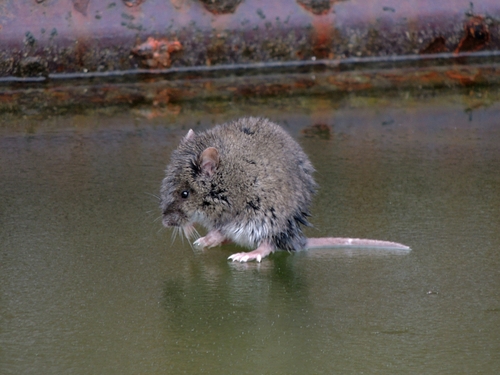
The dorsal fur is grayish-brown to reddish-brown, often with a distinct reddish stripe along the back, while the flanks are gray and the underparts are whitish to pale gray. The tail is short and bicolored, and the body is compact with small rounded ears.
Size
Body length typically ranges from 9 to 13 cm, with a tail length of about 3 to 5 cm.
Weight
Adults typically weigh between 15 and 45 grams, with slight seasonal variation in body mass.
Distinctive features
Distinguished from closely related bank voles (Myodes glareolus) by its larger size, grayer overall coloration, and less vivid reddish dorsal stripe. Skull and dental characteristics, along with genetic data, support its placement in the separate genus Craseomys.
Differences between males and females
Sexual dimorphism is minimal; females may be marginally larger than males, particularly during breeding season, but coloration and general morphology are similar between sexes.
Behaviour and diet of the Grey Red-backed Vole
Generally solitary outside of breeding season, though individuals may share burrow systems and nests communally during winter to conserve warmth. Population density and social interactions increase during peak cycle years.
When it is active
Primarily nocturnal and crepuscular, though activity can occur throughout the day, especially under snow cover in winter when protected from surface predators.
Diet
Herbivorous diet consisting mainly of grasses, mosses, seeds, berries, fungi, and tree bark or buds, particularly important during winter months when other food is scarce.
Communication
Communication includes scent marking via urine and glandular secretions for territory and reproductive signaling, along with ultrasonic vocalizations between mothers and pups and tactile interactions during social encounters.
Interactions with other species
Serves as an important prey species for owls, weasels, foxes, and other mustelids, and competes with sympatric rodent species such as bank voles and shrews for food and habitat resources.
Role in its ecosystem
Plays a crucial ecological role as a primary prey item supporting predator populations in boreal ecosystems, while also contributing to seed dispersal, soil aeration through burrowing, and nutrient cycling in forest floor habitats.
Reproduction and lifecycle
Breeding occurs primarily from April to October, with females producing multiple litters per year after a gestation period of about 18-20 days. Litter size typically ranges from 3 to 8 pups.
Raising the young
Females provide sole parental care, nursing and protecting altricial young in a nest until weaning, which occurs at approximately 2-3 weeks of age. Young become independent shortly after weaning and can reproduce within their first year.
Maturity and lifespan
Sexual maturity is reached at approximately 1 to 2 months of age. Lifespan in the wild is typically 1 to 2 years due to predation and environmental pressures, though captive individuals may live slightly longer.
Taxonomy and naming of the Grey Red-backed Vole
Classification
Mammalia > Rodentia > Cricetidae > Craseomys > Craseomys rufocanus
Subspecies
Several subspecies recognized, including C. r. rufocanus (mainland Siberia/Russia), C. r. bedfordiae (Hokkaido, Japan), C. r. latastei and C. r. jochelsoni (Kamchatka and Far East Russia), differing slightly in coloration and size across their range.
Scientific synonyms
Myodes rufocanus, Clethrionomys rufocanus, Evotomys rufocanus
What research says
Recent studies
Recent taxonomic revisions based on genetic analyses (circa 2010s) clarified the phylogenetic position of this species, resulting in its placement in the newly recognized genus Craseomys separate from Myodes and Clethrionomys.
Genome and DNA
Molecular phylogenetic studies using mitochondrial and nuclear DNA led to the reclassification of this species from Myodes to the distinct genus Craseomys, reflecting deeper evolutionary divergence from other red-backed voles.
Compared with similar species
Compared to the bank vole (Myodes glareolus), the Grey Red-backed Vole is generally larger and grayer with a less pronounced reddish dorsal stripe. It is also similar in ecology to the northern red-backed vole (Myodes rutilus) but occupies a more southern and montane distribution in parts of its range.
The Grey Red-backed Vole and people
This species undergoes dramatic population cycles roughly every 3-4 years, dramatically influencing predator abundance in its ecosystem. It was only recently reclassified into its own genus, Craseomys, based on genetic evidence separating it from other red-backed voles.
Where and how to see it
Best observed in boreal forests of Hokkaido, Japan, or the taiga regions of Siberia during dawn or dusk using small live traps for research purposes, as the species is small and cryptic in the wild. Winter tracking of subnivean tunnel systems can also reveal signs of activity.
Risks to humans
Poses a minor risk to humans as a known reservoir for hantaviruses, which can be transmitted through contact with rodent excreta or bites in certain regions.
Human uses
Not commercially utilized by humans, though it serves as an important study species in ecological and epidemiological research, particularly regarding population cycles and hantavirus transmission.
Countries where the Grey Red-backed Vole is recorded
The 4 countries named in the range description of its IUCN Red List assessment.
Questions about the Grey Red-backed Vole
Where does the Grey Red-backed Vole live?
The Grey Red-backed Vole is recorded in China, Japan, Mongolia and Russia across Asia and Europe. These countries come from the range description of its IUCN Red List assessment, and they are what place the species on the interactive map.
Is the Grey Red-backed Vole endangered?
The IUCN Red List assesses the Grey Red-backed Vole as Least Concern. The species is widespread and abundant enough not to qualify for any threatened category. It does not mean the species is safe forever, only that nothing in the current data raises an alarm.
How many are left in the wild?
No precise global population estimate exists, but the species is considered abundant and widespread, with populations undergoing natural multi-year density cycles rather than long-term decline. This figure comes from the species assessment on the IUCN Red List; population estimates for wild mammals are ranges, not counts, and are revised at each assessment.
What habitat does the Grey Red-backed Vole live in?
Primarily inhabits boreal coniferous and mixed forests (taiga), subalpine meadows, shrub tundra, and rocky alpine habitats.
What is the scientific name of the Grey Red-backed Vole?
The Grey Red-backed Vole is Craseomys rufocanus, in the family Cricetidae, order Rodentia.
Other species in the genus Craseomys
Other species in the family Cricetidae
Sources
Conservation status, range description and population estimate come from the IUCN Red List assessment for Craseomys rufocanus. Countries are derived from that range description, not from a mapped country list. Last refreshed on .
The distribution map is drawn from the IUCN Red List spatial data compiled in 2012. IUCN (International Union for Conservation of Nature)