
Striped Hyaena
Hyaena hyaena
Red List assessment
Near Threatenedon the IUCN Red List
- EXExtinct
- EWExtinct in the Wild
- CRCritically Endangered
- ENEndangered
- VUVulnerable
- NTNear Threatened
- LCLeast Concern
The Striped Hyaena is recorded in 14 countries across Africa and Asia. The IUCN Red List assesses the Striped Hyaena as Near Threatened. Global population estimated at less than 10,000 mature individuals, with populations generally declining across most range countries, though some stable pockets exist in protected areas.
- Family
- Hyaenidae
- Order
- Carnivora
- Genus
- Hyaena
- Countries recorded
- 14
- Continents
- Africa and Asia
- Red List category
- Near Threatened
- Data updated
- August 9, 2026
What is the Striped Hyaena?
The striped hyaena is a medium-sized carnivore known for its distinctive sloping back, mane of long hair along its spine, and vertical black stripes on a grayish-brown coat. It ranges across arid and semi-arid regions from North Africa through the Middle East to South Asia, making it the most widely distributed hyaena species. Remarkable for its powerful jaws capable of crushing bone, it plays a crucial ecological role as a scavenger, cleaning carcasses and preventing disease spread.
Where does the Striped Hyaena live?
North and East Africa, Middle East, and South Asia including India
Ranges from Morocco and Senegal across North Africa through Egypt, the Middle East (Israel, Jordan, Saudi Arabia, Iran, Iraq), into Central Asia, and eastward through Pakistan to India. Notably present in the Horn of Africa (Ethiopia, Somalia, Kenya, Tanzania).
Altitude and depth
0-3300 meters above sea level, typically found in lowland arid regions but capable of ranging into mountainous terrain.
Seasonal movements
No true migration or hibernation; some populations show increased nocturnal activity during hot summer months and may shift denning behavior seasonally based on food availability and breeding cycles.
Habitat of the Striped Hyaena
Inhabits arid and semi-arid environments including deserts, semi-deserts, savannas, scrublands, and dry woodlands. Also found in rocky hills, wadis, and agricultural edges near human settlements. Avoids dense forests and extremely wet habitats.
Adaptations to its environment
Possesses highly efficient water conservation mechanisms allowing survival with minimal drinking water, obtaining moisture from food. Strong jaw muscles and specialized teeth allow consumption of bones and tough hide that other scavengers cannot process, maximizing nutritional extraction from carcasses.
Conservation status and numbers
Near Threatened (NT) according to IUCN, with populations declining across much of its range due to habitat loss, persecution, and declining prey base. Some regional populations, particularly in North Africa and parts of the Middle East, face more severe declines approaching Vulnerable status.
Estimated population
Global population estimated at less than 10,000 mature individuals, with populations generally declining across most range countries, though some stable pockets exist in protected areas.
What threatens the Striped Hyaena?
Habitat loss and fragmentation from agricultural expansion and urbanization, persecution by farmers due to livestock predation fears (despite being primarily scavengers), road mortality, and declining wild prey populations forcing reliance on human-associated food sources leading to conflict.
Diseases and parasites
Susceptible to rabies, canine distemper, and various endoparasites including tapeworms and roundworms; can also carry ectoparasites like ticks and fleas that affect population health in some regions.
What is being done to protect it?
Protected under national wildlife laws in most range countries; listed on CITES Appendix III in some nations. Conservation efforts include protected area management in India, Iran, and Israel, along with research and monitoring programs, though dedicated species-specific conservation programs remain limited.
Recommended actions
Enhanced habitat protection and connectivity between fragmented populations, community education programs to reduce persecution, better waste management near human settlements to reduce conflict, and expanded population monitoring across the range to establish accurate baseline data.
What the Striped Hyaena looks like
Coarse grayish-brown to sandy coat marked with distinct vertical black stripes on the body and horizontal stripes on the legs. Features a prominent erectile mane running from the neck to tail that can be raised to appear larger when threatened, along with a bushy tail and large pointed ears.
Size
Body length 85-130 cm, with shoulder height of 60-80 cm; tail length adds 25-40 cm.
Weight
Weight ranges from 25-55 kg, with males typically slightly larger than females though the difference is not dramatic.
Distinctive features
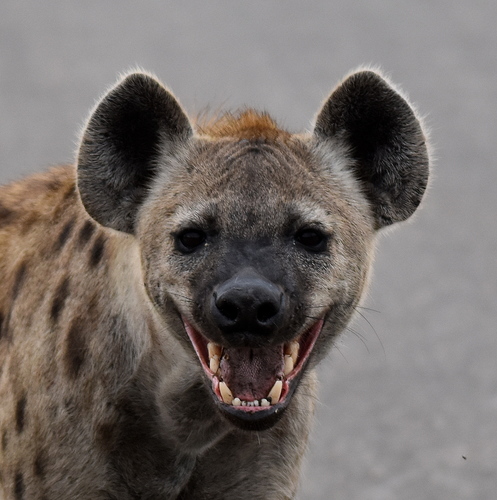
Distinguished from spotted hyaenas by its stripe pattern (versus spots), smaller size, more pointed ears, and less pronounced sexual dimorphism. Its sloping back profile with longer front legs than hind legs is more pronounced than in other hyaena species.
Differences between males and females
Minimal sexual dimorphism; males and females are similar in size and appearance, unlike the more pronounced dimorphism seen in spotted hyaenas. Females lack the pseudo-penis characteristic that distinguishes female spotted hyaenas.
Behaviour and diet of the Striped Hyaena
Primarily solitary or found in monogamous pairs, though some social flexibility exists with small family groups sharing dens. Less socially complex than spotted hyaenas, with limited group hunting or communal denning behavior.
When it is active
Primarily nocturnal and crepuscular, becoming active at dusk and remaining active through the night, retreating to dens, caves, or dense vegetation during daylight hours to avoid heat and human contact.
Diet
Omnivorous scavenger feeding primarily on carrion, but also consuming insects, fruits, small vertebrates, and occasionally hunting small live prey. Known to cache food and can travel long distances searching for carcasses using keen sense of smell.
How it feeds and hunts
Primarily scavenges using excellent olfactory senses to locate carcasses over long distances; opportunistically hunts small mammals, birds, and reptiles using stalking and pouncing techniques rather than pursuit hunting.
Communication
Uses a variety of vocalizations including groans, growls, and a distinctive laugh-like call, though less vocal than spotted hyaenas. Scent marking through anal gland secretions on vegetation and communal latrines serves for territory marking and social communication.
Interactions with other species
Competes with other scavengers including vultures, jackals, and occasionally larger predators like lions or spotted hyaenas for carcass access. Generally avoids direct confrontation with larger carnivores, yielding to more dominant scavengers.
Role in its ecosystem
Serves a vital ecological role as a scavenger, helping to clean ecosystems of carcasses and thereby reducing disease transmission risk. This scavenging behavior also recycles nutrients back into the ecosystem more efficiently than decomposition alone.
Reproduction and lifecycle
Breeding can occur year-round in most regions though peaks may vary geographically; gestation lasts approximately 90-91 days, producing litters of 1-6 cubs (typically 2-4) born in underground dens.
Raising the young
Both parents may contribute to cub-rearing, with cubs remaining in natal dens for several months before beginning to accompany adults. Weaning occurs around 8-12 months, with young reaching independence by 12-18 months of age.
Maturity and lifespan
Reaches sexual maturity around 2-3 years of age; lifespan in the wild is approximately 10-12 years, while captive individuals can live up to 20-24 years with proper care.
Taxonomy and naming of the Striped Hyaena
Classification
Class Mammalia > Order Carnivora > Family Hyaenidae > Genus Hyaena > Species Hyaena hyaena
Subspecies
Several subspecies recognized including H. h. hyaena (North Africa, Middle East), H. h. sultana (Arabian Peninsula), H. h. syriaca (Levant), H. h. barbara (North Africa), H. h. dubbah (Northeast Africa/Horn of Africa), and H. h. satunini (Central Asia) - though subspecies taxonomy is debated.
Scientific synonyms
Canis hyaena (Linnaeus, 1758 original combination); Hyaena vulgaris (older synonym)
What research says
Recent studies
Recent camera trap and GPS collar studies have revealed larger home ranges than previously thought and provided new insights into den site selection and movement patterns in fragmented habitats across Israel and India.
Genome and DNA
Diploid chromosome number of 2n=40; genetic studies have revealed distinct phylogeographic structuring across its range, useful for understanding subspecies boundaries and conservation units.
Compared with similar species
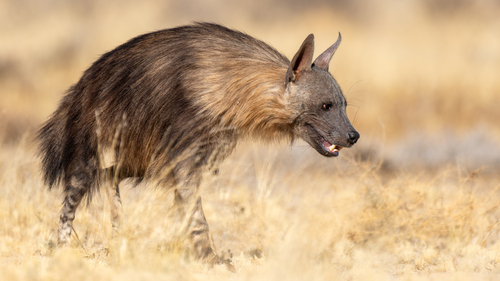
Smaller and less socially complex than the spotted hyaena (Crocuta crocuta), with striped rather than spotted coat pattern and reduced sexual dimorphism. Shares scavenging ecology with the brown hyaena (Parahyaena brunnea) of southern Africa but occupies a much broader geographic range.
The Striped Hyaena and people
Striped hyaenas can consume and digest bones almost entirely due to extremely strong stomach acid and jaw pressure exceeding 800 psi. Despite their fearsome reputation, they are generally shy and avoid human contact, with attacks on humans being extremely rare.
Where and how to see it
Best observed at dusk or through night safaris in protected areas of India (such as Gir National Park), Israel's Negev Desert, or parts of Ethiopia; camera traps near known den sites offer higher success rates than direct observation due to the species' shy, nocturnal nature.
Risks to humans
Generally poses no significant risk to humans as they are shy and avoid confrontation; extremely rare instances of livestock predation or defensive bites have been documented but attacks are not common.
Human uses
Historically hunted for body parts used in traditional medicine and folk remedies in parts of North Africa and the Middle East; occasionally kept in captivity for zoos and wildlife education programs, though not domesticated or farmed.
Myths and legends
Featured prominently in Middle Eastern and North African folklore, often associated with dark magic, graverobbing, and shape-shifting abilities in various cultural traditions. In some regions, body parts were traditionally used in folk medicine or believed to possess magical protective properties.
Countries where the Striped Hyaena is recorded
The 14 countries named in the range description of its IUCN Red List assessment.
Questions about the Striped Hyaena
Where does the Striped Hyaena live?
The Striped Hyaena is recorded in Egypt, Ethiopia, India, Iran and Iraq, among 14 countries in total across Africa and Asia. These countries come from the range description of its IUCN Red List assessment, and they are what place the species on the interactive map.
Is the Striped Hyaena endangered?
The IUCN Red List assesses the Striped Hyaena as Near Threatened. The species does not qualify as threatened today, but it is close to the thresholds and likely to cross them soon. It is the category that most often changes at the next assessment.
How many are left in the wild?
Global population estimated at less than 10,000 mature individuals, with populations generally declining across most range countries, though some stable pockets exist in protected areas. This figure comes from the species assessment on the IUCN Red List; population estimates for wild mammals are ranges, not counts, and are revised at each assessment.
What habitat does the Striped Hyaena live in?
Inhabits arid and semi-arid environments including deserts, semi-deserts, savannas, scrublands, and dry woodlands.
What is the scientific name of the Striped Hyaena?
The Striped Hyaena is Hyaena hyaena, in the family Hyaenidae, order Carnivora.
Other species in the family Hyaenidae
Species that share its range
Sources
Conservation status, range description and population estimate come from the IUCN Red List assessment for Hyaena hyaena. Countries are derived from that range description, not from a mapped country list. Last refreshed on .
The distribution map is drawn from the IUCN Red List spatial data compiled in 2015. IUCN (International Union for Conservation of Nature)