
Spotted Hyaena
Crocuta crocuta
Red List assessment
Least Concernon the IUCN Red List
- EXExtinct
- EWExtinct in the Wild
- CRCritically Endangered
- ENEndangered
- VUVulnerable
- NTNear Threatened
- LCLeast Concern
The Spotted Hyaena is recorded in 6 countries across Africa. The IUCN Red List assesses the Spotted Hyaena as Least Concern. Estimated 27,000-47,000 individuals across Africa, with overall population trend considered stable to slightly declining, though many local populations outside protected areas are decreasing.
- Family
- Hyaenidae
- Order
- Carnivora
- Genus
- Crocuta
- Countries recorded
- 6
- Continents
- Africa
- Red List category
- Least Concern
- Data updated
- August 9, 2026
What is the Spotted Hyaena?
The Spotted Hyaena is Africa's most common large carnivore and the largest member of the Hyaenidae family. Known for its distinctive laughing vocalization and complex matriarchal social structure, it is a highly successful apex predator and scavenger found across sub-Saharan Africa. Often misunderstood as purely a scavenger, it is actually an accomplished hunter responsible for the majority of its own kills.
Where does the Spotted Hyaena live?
Sub-Saharan Africa, primarily in savanna, grassland, and woodland regions from Senegal to Somalia and south to South Africa
Found throughout sub-Saharan Africa from Senegal and Mauritania in the west, across the Sahel to Somalia and Ethiopia in the east, and south through East and Southern Africa to South Africa. Notably absent from the Congo Basin rainforest and extreme desert regions.
Altitude and depth
Sea level to approximately 4000m, with most populations concentrated in lowland savanna ecosystems between 0-2000m
Seasonal movements
No true migration or hibernation, but clan territories and ranging patterns shift seasonally in response to prey migrations, particularly in ecosystems like the Serengeti-Mara.
Habitat of the Spotted Hyaena
Highly adaptable species inhabiting savannas, grasslands, woodlands, semi-arid areas, and even mountainous regions up to 4000m. Avoids only dense tropical rainforest and true desert interiors, showing remarkable ecological flexibility.
Adaptations to its environment
Possesses extremely powerful jaws and digestive system capable of consuming and digesting bone, including stomach acid strong enough to dissolve calcium. Excellent thermoregulation and endurance allow hunting in extreme heat, while acute senses of smell, hearing, and night vision aid both hunting and scavenging.
Conservation status and numbers
Least Concern (LC) according to IUCN, though populations are fragmented and declining in many areas outside protected zones due to human-wildlife conflict and habitat loss.
Estimated population
Estimated 27,000-47,000 individuals across Africa, with overall population trend considered stable to slightly declining, though many local populations outside protected areas are decreasing.
What threatens the Spotted Hyaena?
Habitat loss and fragmentation, human-wildlife conflict including retaliatory killing for livestock predation, poaching for body parts used in traditional medicine, and prey base depletion due to bushmeat hunting.
Diseases and parasites
Susceptible to canine distemper virus, rabies, anthrax, and various tick-borne diseases. Also hosts numerous internal and external parasites including tapeworms, roundworms, and ticks.
What is being done to protect it?
Protected within numerous national parks and reserves across Africa including Serengeti, Kruger, and Maasai Mara ecosystems. Various NGOs conduct human-wildlife conflict mitigation programs, and CITES does not currently restrict trade as heavily as for other large carnivores.
Recommended actions
Strengthen human-wildlife conflict mitigation through livestock protection measures, maintain and expand protected area connectivity, combat poaching for traditional medicine trade, and conduct further population monitoring in unprotected areas.
What the Spotted Hyaena looks like
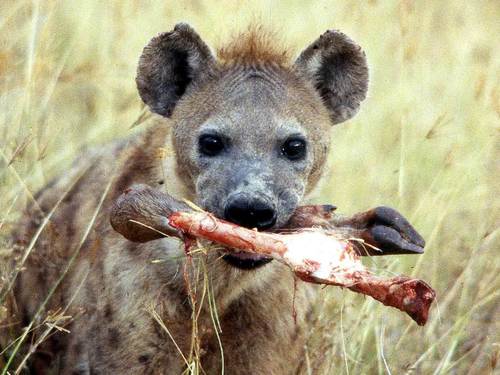
Coarse, sandy to reddish-brown coat covered in irregular dark spots that fade with age, with a distinctive sloping back due to longer front legs than hind legs. Large rounded ears, powerful neck and shoulders, and a mane-like ridge of hair along the back.
Size
Body length 95-165cm, shoulder height 70-91cm, with a relatively short tail of 25-36cm
Weight
Females typically weigh 44-63.9kg, slightly larger than males who weigh 40.5-55kg on average, though weight can vary significantly by region
Distinctive features
Distinguished from other hyaena species by its spotted coat pattern, larger size, more robust build, and rounded rather than pointed ears. The pseudo-penis of females (enlarged clitoris) is a unique anatomical feature among mammals.
Differences between males and females
Females are typically 10-20% larger and more muscular than males, unusual among mammals. Females also possess a pseudo-penis (enlarged, erectile clitoris) that makes external sex determination difficult without close examination.
Behaviour and diet of the Spotted Hyaena
Lives in complex matriarchal clans of up to 80 individuals in some regions, though typical clan size is 10-20 members. Society is structured around strict female-dominated hierarchies where even the lowest-ranking female outranks all males.
When it is active
Primarily nocturnal and crepuscular, with peak activity during dusk, dawn, and nighttime hours, though can be active during cooler daylight periods, especially in protected areas with less human disturbance.
Diet
Opportunistic carnivore consuming a wide range of prey from small rodents to large ungulates like wildebeest and zebra, plus significant scavenging of carrion. Diet varies by region and includes birds, reptiles, insects, and occasionally fruit.
How it feeds and hunts
Hunts both solitarily and in coordinated groups, using exceptional stamina to chase prey over long distances (up to 5km) at speeds reaching 60km/h. Employs cooperative hunting strategies for large prey and uses powerful jaws capable of exerting 4500 psi of bite force.
Communication
Highly vocal species with over 10 distinct calls including the famous 'laugh' (produced during excitement or submission), whoops for long-distance communication, and groans, growls, and giggles for social interaction. Also uses scent marking via anal gland secretions and elaborate greeting ceremonies involving genital inspection.
Interactions with other species
Major competitor and occasional predator conflict with lions, often engaging in kleptoparasitism (stealing kills) in both directions. Also interacts with African wild dogs, cheetahs, and various scavenger birds, frequently displacing smaller predators from kills through numerical superiority.
Role in its ecosystem
Functions as both apex predator and important scavenger, playing crucial roles in nutrient cycling and disease control by consuming carrion. Helps regulate ungulate populations and its scavenging behavior reduces disease transmission risk in ecosystems.
Reproduction and lifecycle
Breeding occurs year-round with no strict seasonality, though births may peak during certain periods depending on region. Gestation lasts approximately 110 days, typically producing litters of 1-4 cubs (usually 2), born in isolated dens.
Raising the young
Cubs are raised primarily by the mother with nursing continuing for 12-18 months, unusually long for a carnivore. Cubs are born with open eyes and erupted teeth, exhibit intense sibling rivalry that can be fatal, and remain dependent on maternal care and clan protection for 1-2 years.
Maturity and lifespan
Sexual maturity reached around 2-3 years of age. Lifespan averages 12 years in the wild but can reach 20-25 years in captivity under optimal conditions.
Taxonomy and naming of the Spotted Hyaena
Classification
Class Mammalia > Order Carnivora > Family Hyaenidae > Genus Crocuta > Species Crocuta crocuta
Subspecies
Several subspecies have been proposed based on regional morphology, including C. c. crocuta (Southern Africa), C. c. germinans (West Africa), and C. c. fortis (East Africa), though genetic studies suggest limited support for distinct subspecies status.
Scientific synonyms
Hyaena crocuta (original Erxleben 1777 classification)
What research says
Recent studies
Recent research has focused on the genetic and hormonal basis of female masculinization, cognitive abilities comparable to primates in problem-solving tasks, and complex vocal communication systems that may encode individual identity information.
Genome and DNA
Diploid chromosome number of 2n=40. Genetic studies have revealed the species' matriarchal social structure correlates with unique hormonal profiles, including elevated androgen levels in females linked to their masculinized genitalia and aggressive behavior.
Compared with similar species
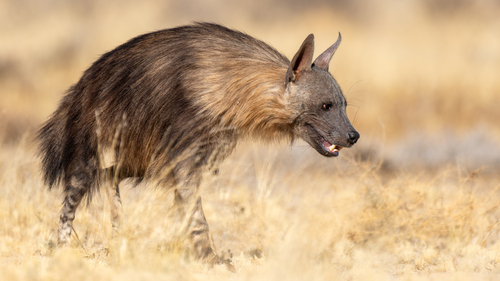
Distinguished from the Striped Hyaena (Hyaena hyaena) by its spotted pattern versus stripes, larger size, and more social behavior. Differs from the Brown Hyaena (Parahyaena brunnea) through habitat preference and more robust build, while the Aardwolf (Proteles cristatus) is much smaller and specializes in insect consumption.
The Spotted Hyaena and people
Female Spotted Hyaenas give birth through their pseudo-penis, a process that is both physically challenging and can be fatal for first-time mothers. They possess one of the most powerful bite forces relative to body size among mammals, capable of crushing bone. Their complex 'clan' societies and problem-solving abilities rival those of some primates.
Where and how to see it
Best observed in East African parks like Serengeti National Park and Maasai Mara during dawn or dusk game drives, or in Southern Africa's Kruger National Park. Night drives in well-managed reserves offer excellent viewing opportunities as hyaenas are most active during these hours.
Risks to humans
Can pose danger to humans through occasional attacks, particularly on livestock or in areas of human-wildlife conflict, though unprovoked attacks on humans are rare. Bites carry risk of disease transmission and require immediate medical attention.
Human uses
Body parts are used in some traditional medicine practices across parts of Africa, believed to confer various properties including protection or strength. Limited ecotourism value as a charismatic species for wildlife viewing, though historically persecuted rather than utilized economically.
Myths and legends
Widely featured in African folklore as symbols of greed, gluttony, or witchcraft, often associated with negative or sinister connotations in various cultures. Some traditional beliefs associate hyaenas with sorcery and shapeshifting, while their scavenging behavior has historically led to cultural taboos and fear.
Countries where the Spotted Hyaena is recorded
The 6 countries named in the range description of its IUCN Red List assessment.
Questions about the Spotted Hyaena
Where does the Spotted Hyaena live?
The Spotted Hyaena is recorded in Democratic Republic of the Congo, Ethiopia, Mauritania, Senegal and Somalia, among 6 countries in total across Africa. These countries come from the range description of its IUCN Red List assessment, and they are what place the species on the interactive map.
Is the Spotted Hyaena endangered?
The IUCN Red List assesses the Spotted Hyaena as Least Concern. The species is widespread and abundant enough not to qualify for any threatened category. It does not mean the species is safe forever, only that nothing in the current data raises an alarm.
How many are left in the wild?
Estimated 27,000-47,000 individuals across Africa, with overall population trend considered stable to slightly declining, though many local populations outside protected areas are decreasing. This figure comes from the species assessment on the IUCN Red List; population estimates for wild mammals are ranges, not counts, and are revised at each assessment.
What habitat does the Spotted Hyaena live in?
Highly adaptable species inhabiting savannas, grasslands, woodlands, semi-arid areas, and even mountainous regions up to 4000m.
What is the scientific name of the Spotted Hyaena?
The Spotted Hyaena is Crocuta crocuta, in the family Hyaenidae, order Carnivora.
Other species in the family Hyaenidae
Species that share its range

Sources
Conservation status, range description and population estimate come from the IUCN Red List assessment for Crocuta crocuta. Countries are derived from that range description, not from a mapped country list. Last refreshed on .
The distribution map is drawn from the IUCN Red List spatial data compiled in 2015. IUCN (International Union for Conservation of Nature)