
Brown Hyaena
Parahyaena brunnea
Red List assessment
Near Threatenedon the IUCN Red List
- EXExtinct
- EWExtinct in the Wild
- CRCritically Endangered
- ENEndangered
- VUVulnerable
- NTNear Threatened
- LCLeast Concern
The Brown Hyaena is recorded in 7 countries across Africa. The IUCN Red List assesses the Brown Hyaena as Near Threatened. Estimated at around 4,000-10,000 mature individuals globally, with the population considered stable to slightly declining outside of well-protected reserves.
- Family
- Hyaenidae
- Order
- Carnivora
- Genus
- Parahyaena
- Countries recorded
- 7
- Continents
- Africa
- Red List category
- Near Threatened
- Data updated
- August 9, 2026
What is the Brown Hyaena?
The Brown Hyaena is a medium-sized, shaggy-coated carnivore endemic to southern Africa, notable for being primarily a scavenger rather than an active hunter. It is well adapted to arid and semi-arid environments, including the Namib and Kalahari deserts. Highly social yet solitary foragers, they live in clans but forage alone, covering large distances nightly in search of food. It is the rarest of the extant hyaena species.
Where does the Brown Hyaena live?
Southern Africa, primarily Namibia, Botswana, South Africa, and Zimbabwe, with smaller populations in Mozambique, Angola, and Zambia
Found mainly in Namibia, Botswana, South Africa (including the Kalahari and Karoo regions), and parts of Zimbabwe; smaller, more fragmented populations occur in southern Angola, Mozambique, and Zambia.
Altitude and depth
Typically found from sea level up to about 2000m, with most populations concentrated in lowland arid and semi-arid plains.
Seasonal movements
No true migration or hibernation; however, ranging patterns and foraging distances can shift seasonally in response to prey availability and water scarcity, particularly in desert regions.
Habitat of the Brown Hyaena
Occupies a wide range of habitats including arid savanna, desert and semi-desert regions, coastal areas, and open scrubland; also found in some agricultural and peri-urban areas at the fringes of protected zones.
Adaptations to its environment
Possesses a thick, shaggy coat that insulates against extreme temperature fluctuations in deserts, and long powerful jaws capable of crushing bone to access marrow. Its excellent sense of smell allows it to locate carrion over vast distances, and it can survive extended periods with minimal water intake, obtaining moisture from prey.
Conservation status and numbers
Listed as Near Threatened by the IUCN due to ongoing habitat fragmentation and persecution by farmers, though the population is considered relatively stable in protected areas. The species does not qualify for a threatened category but is close to meeting the criteria due to localized declines.
Estimated population
Estimated at around 4,000-10,000 mature individuals globally, with the population considered stable to slightly declining outside of well-protected reserves.
What threatens the Brown Hyaena?
Persecution and lethal control by livestock farmers who mistakenly blame them for stock losses, habitat loss and fragmentation from agricultural expansion, road mortality, and indirect poisoning from carcasses baited for other predators.
Diseases and parasites
Susceptible to canine distemper virus, rabies, and various tick-borne diseases; also hosts internal parasites such as tapeworms acquired through scavenging.
What is being done to protect it?
Protected in numerous reserves and national parks across its range including Kgalagadi Transfrontier Park, Etosha National Park, and various private game reserves; conservation education programs aim to reduce human-wildlife conflict with farmers.
Recommended actions
Expand community-based conservation programs to reduce retaliatory killings, promote non-lethal livestock protection methods, maintain habitat connectivity between protected areas, and continue population monitoring across its range.
What the Brown Hyaena looks like
Has a long, shaggy dark brown to black coat, particularly thick around the neck and shoulders forming a mane-like ruff, with a lighter, yellowish-brown neck and distinctive horizontal stripes on the legs. The head is broad with large rounded ears, and the back slopes down toward the hindquarters similar to other hyaena species.
Size
Shoulder height of approximately 66-88 cm, with body length ranging from 110-136 cm excluding the tail, which adds another 19-27 cm.
Weight
Males typically weigh 40-48 kg, while females are slightly smaller at 37-43 kg.
Distinctive features
Distinguished from the Spotted Hyaena by its shaggy, striped coat (rather than spotted), smaller size, and pointed ears; distinguished from the Striped Hyaena by its darker coloration and more localized southern African range.
Differences between males and females
Minimal sexual dimorphism; males and females are similar in appearance, though males tend to be marginally larger and heavier than females.
Behaviour and diet of the Brown Hyaena
Lives in clans of typically 4-14 individuals that defend a communal territory, but forages solitarily; clans have a matriarchal-influenced structure with a dominant breeding female, and non-related males may join clans as subordinate members.
When it is active
Primarily nocturnal and crepuscular, becoming active around dusk and foraging through the night, resting in dens or shaded areas during the heat of the day.
Diet
Predominantly a scavenger, feeding on carrion from carcasses left by large predators such as lions; supplements diet with small mammals, birds, reptiles, insects, eggs, fruit, and occasionally marine resources like stranded seals or fish along coastal habitats.
How it feeds and hunts
Primarily forages solitarily over long nightly distances (up to 30+ km) using an acute sense of smell to locate carcasses; opportunistically hunts small, easy prey rather than pursuing large live game through active hunting.
Communication
Uses scent marking extensively through a distinctive 'pasting' behavior involving anal gland secretions on grass stalks to mark territory; also communicates through vocalizations like low growls and grunts, plus body language and grooming within the clan.
Interactions with other species
Competes with and can be displaced from carcasses by lions, spotted hyaenas, and large vulture flocks; occasionally preyed upon by lions, and cubs may be vulnerable to other predators like leopards.
Role in its ecosystem
Functions as an important scavenger within its ecosystem, helping to recycle nutrients from carcasses and reduce disease spread by consuming decaying carrion, thus playing a key role in ecosystem sanitation.
Reproduction and lifecycle
Breeding occurs year-round without a strict seasonal pattern; gestation lasts approximately 90 days, and litters typically consist of 1-4 cubs born in a den.
Raising the young
Cubs are raised communally within the clan, with the dominant female and sometimes other clan members, including unrelated males, contributing to feeding and guarding cubs; cubs are weaned around 12 months but remain dependent on the clan for food provisioning for over a year.
Maturity and lifespan
Reaches sexual maturity at around 2-3 years of age; typical lifespan in the wild is 12-15 years, while captive individuals may live up to 20 years.
Taxonomy and naming of the Brown Hyaena
Classification
Class Mammalia > Order Carnivora > Family Hyaenidae > Genus Parahyaena > Species Parahyaena brunnea
Scientific synonyms
Hyaena brunnea (former genus placement)
What research says
Recent studies
Recent research using GPS collar tracking has revealed extensive home ranges (sometimes exceeding 200-500 km²) and complex social dynamics including male dispersal patterns between clans.
Genome and DNA
Diploid chromosome number is 2n=40; genetic studies have highlighted relatively low genetic diversity in some isolated populations, raising conservation concerns for long-term viability.
Compared with similar species
Compared to the Spotted Hyaena, the Brown Hyaena is smaller, less aggressive, and relies almost entirely on scavenging rather than active hunting; compared to the Striped Hyaena of North Africa and Asia, it has a darker coat and inhabits a distinctly separate southern African range.
The Brown Hyaena and people
Brown Hyaenas can travel over 30 km in a single night searching for food; they are sometimes called 'strandwolves' in Namibia due to their habit of scavenging along coastal beaches for marine carrion.
Where and how to see it
Best observed in Namibia's Namib Desert coastal areas or in the Kalahari region such as Kgalagadi Transfrontier Park, particularly at dusk or during night drives with spotlights, as they are shy and mostly nocturnal.
Risks to humans
No notable risk to humans; Brown Hyaenas are shy, avoid confrontation, and rarely attack people, though they may occasionally raid livestock or scavenge near human settlements.
Human uses
Historically persecuted rather than utilized, though in some regions their pelts have been used traditionally; increasingly valued today for ecotourism in reserves across their range.
Myths and legends
In some southern African folklore, hyaenas are associated with witchcraft and are seen as omens or symbols of greed and cunning, though the Brown Hyaena specifically has fewer distinct legends compared to the Spotted Hyaena.
Countries where the Brown Hyaena is recorded
The 7 countries named in the range description of its IUCN Red List assessment.
Questions about the Brown Hyaena
Where does the Brown Hyaena live?
The Brown Hyaena is recorded in Angola, Botswana, Mozambique, Namibia and South Africa, among 7 countries in total across Africa. These countries come from the range description of its IUCN Red List assessment, and they are what place the species on the interactive map.
Is the Brown Hyaena endangered?
The IUCN Red List assesses the Brown Hyaena as Near Threatened. The species does not qualify as threatened today, but it is close to the thresholds and likely to cross them soon. It is the category that most often changes at the next assessment.
How many are left in the wild?
Estimated at around 4,000-10,000 mature individuals globally, with the population considered stable to slightly declining outside of well-protected reserves. This figure comes from the species assessment on the IUCN Red List; population estimates for wild mammals are ranges, not counts, and are revised at each assessment.
What habitat does the Brown Hyaena live in?
Occupies a wide range of habitats including arid savanna, desert and semi-desert regions, coastal areas, and open scrubland; also found in some agricultural and peri-urban areas at the fringes of protected zones.
What is the scientific name of the Brown Hyaena?
The Brown Hyaena is Parahyaena brunnea, in the family Hyaenidae, order Carnivora.
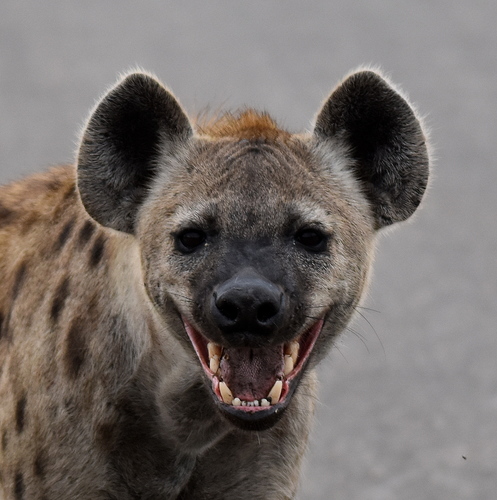
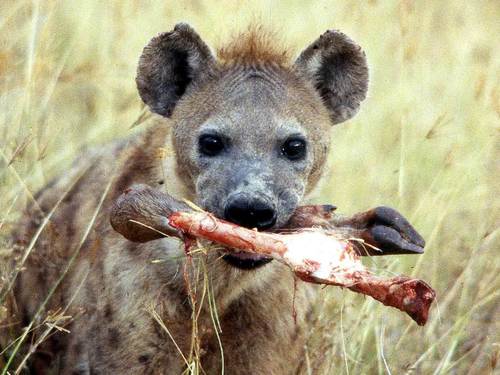
Other species in the family Hyaenidae
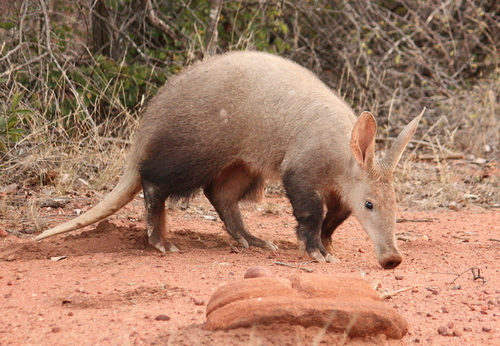
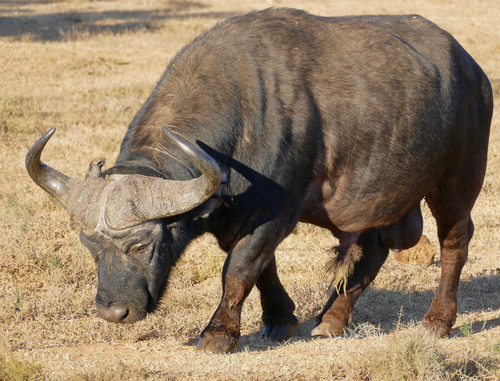
Species that share its range
Sources
Conservation status, range description and population estimate come from the IUCN Red List assessment for Parahyaena brunnea. Countries are derived from that range description, not from a mapped country list. Last refreshed on .
The distribution map is drawn from the IUCN Red List spatial data compiled in 2015. International Union for the Conservation of Nature