
Serval
Leptailurus serval
Red List assessment
Least Concernon the IUCN Red List
- EXExtinct
- EWExtinct in the Wild
- CRCritically Endangered
- ENEndangered
- VUVulnerable
- NTNear Threatened
- LCLeast Concern
The Serval is recorded in 5 countries across Africa. The IUCN Red List assesses the Serval as Least Concern. No precise global population estimate exists, but the species is considered common in suitable habitat across much of sub-Saharan Africa; overall population trend is believed to be stable to slightly declining in some regions due to habitat degradation.
- Family
- Felidae
- Order
- Carnivora
- Genus
- Leptailurus
- Countries recorded
- 5
- Continents
- Africa
- Red List category
- Least Concern
- Data updated
- August 9, 2026
What is the Serval?
The serval is a medium-sized wild cat native to Africa, characterized by its remarkably long legs, large ears, and slender build adapted for hunting in tall grass. It is the tallest of Africa's small cats relative to body size and is renowned for its exceptional leaping ability and acute hearing. Found predominantly in savanna wetlands and grasslands, the serval plays an important role as a mesopredator controlling rodent populations across its range.
Where does the Serval live?
Sub-Saharan Africa, primarily in savanna and grassland regions from Senegal to Ethiopia and south to South Africa
Widely distributed across sub-Saharan Africa, from Senegal and Mauritania in the west, through the Sahel and East Africa, down to South Africa. Absent from the Congo Basin rainforest core and extremely arid desert regions like the central Sahara and Namib.
Altitude and depth
0-3,800 meters above sea level, with populations recorded in highland grasslands of Ethiopia and Kenya as well as lowland savannas.
Habitat of the Serval
Servals prefer well-watered savannas, grasslands near wetlands, marshes, and reed beds with tall grass cover. They avoid dense rainforest and arid deserts, requiring habitats that support high rodent prey density and adequate cover for stalking.
Adaptations to its environment
The serval's unusually long legs and neck allow it to see over tall grass and pounce with precision, while its large concave ears provide exceptional hearing to detect prey movement underground or in vegetation. Its coat pattern of black spots and stripes on tawny fur provides effective camouflage in grassland habitats.
Conservation status and numbers
Listed as Least Concern by the IUCN due to its wide distribution and adaptability, though some regional populations, particularly in North Africa and West Africa, have experienced significant declines and local extirpations.
Estimated population
No precise global population estimate exists, but the species is considered common in suitable habitat across much of sub-Saharan Africa; overall population trend is believed to be stable to slightly declining in some regions due to habitat degradation.
What threatens the Serval?
Habitat loss due to agricultural expansion and wetland drainage, hunting for fur and bushmeat, human-wildlife conflict from perceived livestock predation, and road mortality are the primary threats to serval populations.
Diseases and parasites
Servals can be affected by feline diseases such as feline immunodeficiency virus (FIV) and various internal and external parasites including ticks, fleas, and intestinal worms, though comprehensive disease studies in wild populations remain limited.
What is being done to protect it?
Servals are protected under CITES Appendix II, limiting international trade, and occur in numerous protected areas including national parks and game reserves throughout their range. Some countries have implemented hunting regulations and habitat protection measures for wetland ecosystems.
Recommended actions
Priority actions include protecting and restoring wetland and grassland habitats, mitigating human-wildlife conflict through community education, enforcing anti-poaching laws, and conducting further population surveys in poorly studied regions like West and Central Africa.
What the Serval looks like
The serval has a slender, long-legged body with tawny-gold fur marked with bold black spots and stripes, a small head with very large rounded ears, and a relatively short black-ringed tail with a black tip.
Size
Head-body length of 59-92 cm with a relatively short tail of 20-38 cm; shoulder height ranges from 54-62 cm, making it proportionally the tallest of Africa's small cats.
Weight
Adults typically weigh between 9-18 kg, with males generally larger than females, averaging around 12 kg for females and up to 18 kg for males.
Distinctive features
Distinguished from other African cats by its extremely long legs relative to body size, oversized ears, and distinctive spotted coat pattern; it is often confused with a small cheetah but has a much shorter tail and different ear shape.
Differences between males and females
Males are generally larger and heavier than females, though color patterns and markings are similar between sexes with no notable difference in coat coloration.
Behaviour and diet of the Serval
Servals are primarily solitary animals, with individuals maintaining home ranges that may overlap between sexes but rarely between same-sex individuals; they come together mainly for mating.
When it is active
Servals are primarily crepuscular and nocturnal, though they may also be active during daylight hours in areas with minimal human disturbance or during cooler seasons.
Diet
Servals are obligate carnivores with a diet dominated by small rodents, particularly vlei rats and other grass-dwelling rodents, supplemented by birds, reptiles, frogs, and insects.
How it feeds and hunts
Servals employ a distinctive 'mousing' technique, using their acute hearing to locate prey in grass before leaping high into the air and pouncing down with their front paws to pin prey; they can leap up to 3 meters horizontally and 1.5 meters vertically to catch birds in flight.
Communication
Servals communicate through vocalizations including a high-pitched chirping call, hisses, growls, and purrs, as well as scent marking via urine spraying and cheek rubbing to establish territory boundaries.
Interactions with other species
Servals face predation risk from larger carnivores such as leopards, hyenas, and African wild dogs, and compete for prey resources with caracals and other mesopredators; they generally avoid direct confrontation with larger predators.
Role in its ecosystem
As a mesopredator, the serval plays a crucial ecological role in controlling rodent populations, which helps regulate grassland ecosystem dynamics and indirectly benefits agricultural areas by reducing crop pest numbers.
Reproduction and lifecycle
Breeding can occur year-round in favorable conditions but often peaks with rainy seasons; gestation lasts approximately 65-75 days, resulting in litters of 1-4 kittens, with weaning occurring around 3-4 months of age.
Raising the young
Female servals raise kittens alone in secluded dens within dense vegetation, moving the litter periodically to avoid predators; kittens become independent at around 6-12 months and reach full independence by their first year.
Maturity and lifespan
Sexual maturity is reached at approximately 12-24 months of age; wild servals typically live 10-12 years, while captive individuals can live up to 20 years or more with proper care.
Taxonomy and naming of the Serval
Classification
Class Mammalia > Order Carnivora > Family Felidae > Genus Leptailurus > Species Leptailurus serval
Subspecies
Up to 18 subspecies have been proposed based on geographic variation, including L. s. serval (South Africa), L. s. constantina (North Africa, now likely extinct), and L. s. lipostictus (East Africa), though modern taxonomy often treats these as clinal variation rather than distinct subspecies.
Scientific synonyms
Felis serval (original classification by Schreber, 1776); also historically placed in genus Caracal by some authors.
What research says
Recent studies
Recent research has focused on serval genetics related to the popular Savannah cat hybrid breed, as well as studies examining serval habitat use and movement patterns using GPS collar technology in various African ecosystems.
Genome and DNA
The serval has a diploid chromosome number of 2n=38, consistent with most other Felidae species; genetic studies have contributed to understanding hybridization potential with domestic cats in the creation of Savannah cat breeds.
Compared with similar species
Compared to the caracal, servals have longer legs and a spotted rather than solid coat; compared to the cheetah, servals are much smaller with proportionally shorter tails and rounder heads, despite superficial similarities in body proportions.
The Serval and people
Servals have the largest ears relative to body size of any cat species, giving them hearing so acute they can detect prey moving underground. They also have one of the highest hunting success rates among cats, succeeding in over 50% of attempts, and can jump higher relative to their body size than almost any other cat.
Where and how to see it
Best observed during dawn or dusk in wetland-adjacent savanna habitats within East African reserves such as the Serengeti, Maasai Mara, or Ngorongoro Crater, particularly during the dry season when vegetation is shorter and visibility improves.
Risks to humans
No notable risk to humans; servals are shy and avoid human contact, with no significant recorded incidents of unprovoked attacks on people.
Human uses
Servals have been hunted historically for their pelts, and live individuals are sometimes captured for the exotic pet trade or used in breeding programs to create Savannah cat hybrids with domestic cats.
Myths and legends
In some African cultures, serval pelts have historically been used in traditional ceremonial dress and regalia, symbolizing status or spiritual significance, though specific mythological narratives about the species are less documented compared to larger predators like lions.
Countries where the Serval is recorded
The 5 countries named in the range description of its IUCN Red List assessment.
Questions about the Serval
Where does the Serval live?
The Serval is recorded in Democratic Republic of the Congo, Ethiopia, Mauritania, Senegal and South Africa across Africa. These countries come from the range description of its IUCN Red List assessment, and they are what place the species on the interactive map.
Is the Serval endangered?
The IUCN Red List assesses the Serval as Least Concern. The species is widespread and abundant enough not to qualify for any threatened category. It does not mean the species is safe forever, only that nothing in the current data raises an alarm.
How many are left in the wild?
No precise global population estimate exists, but the species is considered common in suitable habitat across much of sub-Saharan Africa; overall population trend is believed to be stable to slightly declining in some regions due to habitat degradation. This figure comes from the species assessment on the IUCN Red List; population estimates for wild mammals are ranges, not counts, and are revised at each assessment.
What habitat does the Serval live in?
Servals prefer well-watered savannas, grasslands near wetlands, marshes, and reed beds with tall grass cover.
What is the scientific name of the Serval?
The Serval is Leptailurus serval, in the family Felidae, order Carnivora.
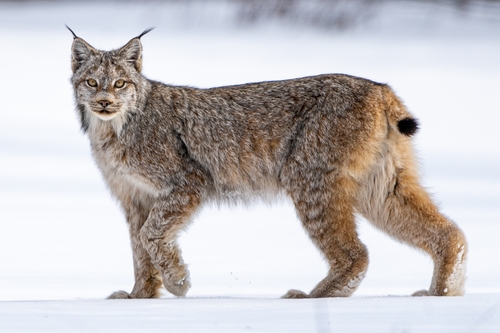
Other species in the family Felidae
Species that share its range

Sources
Conservation status, range description and population estimate come from the IUCN Red List assessment for Leptailurus serval. Countries are derived from that range description, not from a mapped country list. Last refreshed on .
The distribution map is drawn from the IUCN Red List spatial data compiled in 2015. IUCN (International Union for Conservation of Nature)