
Santa Marta White-fronted Capuchin
Cebus malitiosus
Red List assessment
Endangeredon the IUCN Red List
- EXExtinct
- EWExtinct in the Wild
- CRCritically Endangered
- ENEndangered
- VUVulnerable
- NTNear Threatened
- LCLeast Concern
The Santa Marta White-fronted Capuchin is recorded in one country, Colombia across South America. The IUCN Red List assesses the Santa Marta White-fronted Capuchin as Endangered. Population size is not precisely known but is believed to be small and declining due to continued habitat degradation across its restricted range.
- Family
- Cebidae
- Order
- Primates
- Genus
- Cebus
- Countries recorded
- 1
- Continents
- South America
- Red List category
- Endangered
- Data updated
- August 9, 2026
What is the Santa Marta White-fronted Capuchin?
The Santa Marta White-fronted Capuchin is a medium-sized New World monkey endemic to the isolated Sierra Nevada de Santa Marta massif in northern Colombia. It is notable for being restricted to one of the most biologically unique and threatened mountain ranges in the world, an isolated coastal massif with extremely high endemism. This species is highly intelligent, using tools and complex foraging strategies typical of capuchins. Its extremely limited range makes it especially vulnerable to habitat loss.
Where does the Santa Marta White-fronted Capuchin live?
Colombia, restricted to the Sierra Nevada de Santa Marta region
Endemic to the Sierra Nevada de Santa Marta in northern Colombia, an isolated coastal mountain range near the Caribbean Sea, disjunct from the Andes.
Altitude and depth
Approximately 0-1500 meters above sea level
Seasonal movements
No true migration; may show shifts in ranging patterns and feeding behavior between wet and dry seasons tied to fruit availability.
Habitat of the Santa Marta White-fronted Capuchin
Inhabits humid tropical and subtropical forests, including lowland and montane rainforest, as well as forest edges and secondary growth within the Sierra Nevada de Santa Marta.
Adaptations to its environment
Prehensile tail and strong grasping hands allow arboreal locomotion and foraging across forest strata. High cognitive ability and tool use (e.g., cracking nuts or seeds) aid in exploiting varied food resources in a patchy, isolated habitat.
Conservation status and numbers
Endangered (EN) according to IUCN, primarily due to a small and fragmented range coupled with ongoing habitat loss from deforestation and agricultural expansion within the Sierra Nevada de Santa Marta.
Estimated population
Population size is not precisely known but is believed to be small and declining due to continued habitat degradation across its restricted range.
What threatens the Santa Marta White-fronted Capuchin?
Deforestation for agriculture (coffee, coca cultivation), logging, habitat fragmentation, and illegal hunting or capture for the pet trade.
Diseases and parasites
Susceptible to typical primate parasites such as intestinal helminths and ectoparasites; specific disease studies for this species are limited.
What is being done to protect it?
Some populations occur within protected areas such as Sierra Nevada de Santa Marta National Natural Park; conservation efforts include habitat protection initiatives and research by Colombian conservation organizations.
Recommended actions
Expand and enforce protected area coverage, curb illegal logging and agricultural encroachment, conduct population surveys, and engage local indigenous communities in conservation stewardship.
What the Santa Marta White-fronted Capuchin looks like
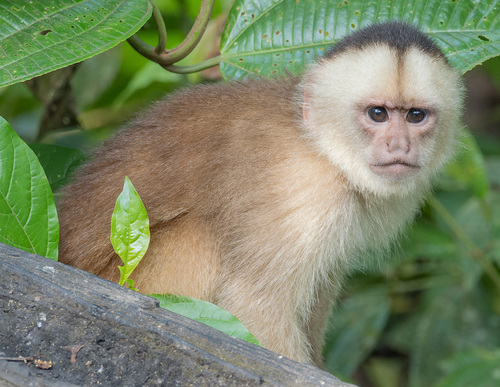
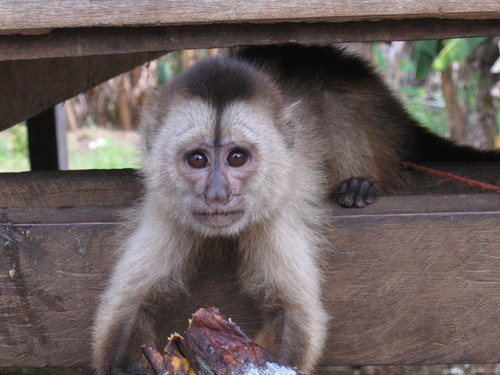
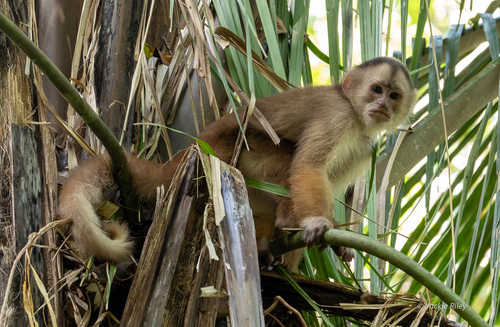
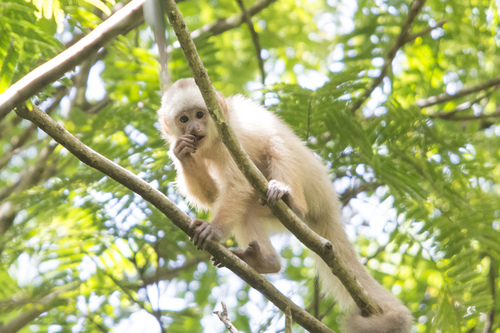
Has a cream to pale yellowish face and forehead contrasting with darker brown to blackish body fur; the crown often shows a distinctive dark cap.
Size
Body length approximately 35-45 cm, with a tail of similar or greater length (40-55 cm) used for balance and grasping.
Weight
Adults typically weigh between 2.5 and 3.5 kg, with males generally slightly larger than females.
Distinctive features
Distinguished from other Cebus/white-fronted capuchins by subtle differences in facial coloration and cranial morphology, along with its isolated geographic range in the Santa Marta massif.
Differences between males and females
Modest sexual dimorphism, with males slightly larger in body size and canine teeth compared to females.
Behaviour and diet of the Santa Marta White-fronted Capuchin
Lives in social groups of variable size, typically ranging from a few individuals to around 15-20, with a mix of males and females organized in a loose dominance hierarchy.
When it is active
Diurnal, active during daylight hours foraging, resting, and socializing before nesting in trees at night.
Diet
Omnivorous diet including a wide variety of fruits, seeds, insects, small vertebrates, and occasionally bird eggs.
How it feeds and hunts
Forages opportunistically, using manual dexterity to extract insects from bark, crack open nuts with tools or by pounding on branches, and search leaf litter and tree cavities for prey.
Communication
Communicates through a range of vocalizations (alarm calls, contact calls), facial expressions, body postures, and scent marking to maintain group cohesion and signal danger.
Interactions with other species
Faces predation from raptors and possibly wild cats; competes with other frugivorous mammals and birds for fruit resources; may associate loosely with other primate or bird species while foraging.
Role in its ecosystem
Plays an important ecological role as a seed disperser, contributing to forest regeneration and plant diversity within its restricted habitat.
Reproduction and lifecycle
Breeding is not strictly seasonal; gestation lasts approximately 5-6 months, typically resulting in a single offspring per birth.
Raising the young
Mothers provide primary care, carrying and nursing infants for several months; other group members, including juveniles, may assist in alloparental care.
Maturity and lifespan
Sexual maturity is generally reached around 4-6 years of age; lifespan in the wild is estimated at 15-25 years, potentially longer in captivity.
Taxonomy and naming of the Santa Marta White-fronted Capuchin
Classification
Mammalia > Primates > Cebidae > Cebus > Cebus malitiosus
Scientific synonyms
Formerly considered a subspecies of Cebus albifrons (Cebus albifrons malitiosus)
What research says
Recent studies
Recent taxonomic revisions using morphological and molecular data have helped clarify its status as a distinct species separate from Cebus albifrons.
Compared with similar species
Closely related to other white-fronted capuchins (Cebus albifrons complex) found throughout northern South America, but distinguished by its isolated range and subtle morphological differences.
The Santa Marta White-fronted Capuchin and people
This capuchin lives in one of the most biologically isolated mountain ranges on Earth, the Sierra Nevada de Santa Marta, which harbors many species found nowhere else. Like other capuchins, it is known for remarkable problem-solving skills and tool use in the wild.
Where and how to see it
Best observed in early morning within protected forest areas of the Sierra Nevada de Santa Marta National Natural Park, where guided ecotourism tours may offer sightings of foraging groups.
Risks to humans
No notable risk to humans; wild individuals are generally shy and avoid direct contact.
Human uses
Not significantly used by humans, though illegal capture for the pet trade has been documented in some parts of its range.
Countries where the Santa Marta White-fronted Capuchin is recorded
The 1 countries named in the range description of its IUCN Red List assessment.
Questions about the Santa Marta White-fronted Capuchin
Where does the Santa Marta White-fronted Capuchin live?
The Santa Marta White-fronted Capuchin is recorded in Colombia across South America. These countries come from the range description of its IUCN Red List assessment, and they are what place the species on the interactive map.
Is the Santa Marta White-fronted Capuchin endangered?
Yes. The IUCN Red List assesses the Santa Marta White-fronted Capuchin as Endangered, one of the three threatened categories. The species faces a very high risk of extinction in the wild — a step below Critically Endangered, but still on a trajectory that ends badly without intervention.
How many are left in the wild?
Population size is not precisely known but is believed to be small and declining due to continued habitat degradation across its restricted range. This figure comes from the species assessment on the IUCN Red List; population estimates for wild mammals are ranges, not counts, and are revised at each assessment.
What habitat does the Santa Marta White-fronted Capuchin live in?
Inhabits humid tropical and subtropical forests, including lowland and montane rainforest, as well as forest edges and secondary growth within the Sierra Nevada de Santa Marta.
What is the scientific name of the Santa Marta White-fronted Capuchin?
The Santa Marta White-fronted Capuchin is Cebus malitiosus, in the family Cebidae, order Primates.
Other species in the genus Cebus
Other species in the family Cebidae
Species that share its range

Sources
Conservation status, range description and population estimate come from the IUCN Red List assessment for Cebus malitiosus. Countries are derived from that range description, not from a mapped country list. Last refreshed on .
The distribution map is drawn from the IUCN Red List spatial data compiled in 2020. IUCN (International Union for Conservation of Nature)