
Buff-headed Capuchin
Sapajus xanthosternos
Red List assessment
Critically Endangeredon the IUCN Red List
- EXExtinct
- EWExtinct in the Wild
- CRCritically Endangered
- ENEndangered
- VUVulnerable
- NTNear Threatened
- LCLeast Concern
The Buff-headed Capuchin is recorded in one country, Brazil across South America. The IUCN Red List assesses the Buff-headed Capuchin as Critically Endangered. Fewer than 180 mature individuals believed to remain in the wild, with a continuing declining trend.
- Family
- Cebidae
- Order
- Primates
- Genus
- Sapajus
- Countries recorded
- 1
- Continents
- South America
- Red List category
- Critically Endangered
- Data updated
- August 9, 2026
What is the Buff-headed Capuchin?
The buff-headed capuchin is a critically endangered New World monkey endemic to the highly fragmented Atlantic Forest of Bahia, Brazil. It is easily recognized by its golden-yellow underparts and distinctive reddish-orange crown patch. This species is remarkable for being one of the most threatened primates in the Americas, with a tiny remaining range due to extensive deforestation. It is a highly intelligent, tool-using primate known for its adaptability in fragmented habitats.
Where does the Buff-headed Capuchin live?
Eastern Brazil, restricted to the Atlantic Forest region of Bahia state
Endemic to eastern Brazil, restricted to a small portion of southern Bahia state within the Atlantic Forest biome, historically ranging further but now confined to isolated forest patches.
Altitude and depth
0-800m above sea level
Seasonal movements
No migration or hibernation; some seasonal shifts in diet and ranging behavior correlate with fruit availability during wet and dry seasons.
Habitat of the Buff-headed Capuchin
Primarily lowland and submontane tropical Atlantic rainforest, including semi-deciduous and evergreen forest types; also found in degraded secondary forest and forest fragments surrounded by agricultural land.
Adaptations to its environment
Strong prehensile-like tail (though not fully prehensile) aids in arboreal locomotion; robust jaw and teeth allow processing of hard nuts and seeds; manual dexterity enables tool use for cracking palm nuts, an adaptation to exploit fallback foods when preferred fruit is scarce.
Conservation status and numbers
Critically Endangered (IUCN); population has declined by over 80% over the past three generations due to severe habitat loss, fragmentation, and historical hunting pressure, with remaining subpopulations small and isolated.
Estimated population
Fewer than 180 mature individuals believed to remain in the wild, with a continuing declining trend.
What threatens the Buff-headed Capuchin?
Massive deforestation for agriculture (cacao, cattle, sugarcane), habitat fragmentation isolating small populations, hunting, illegal pet trade, and genetic isolation reducing viability of remaining groups.
Diseases and parasites
Susceptible to various endoparasites (nematodes, protozoa) and can be affected by yellow fever outbreaks, which have caused significant mortality in some New World primate populations.
What is being done to protect it?
Protected under Brazilian law; conservation programs including captive breeding at institutions like CPB (Centro de Primatologia do Rio de Janeiro), habitat protection in reserves such as Una Biological Reserve, and reforestation/corridor projects led by NGOs like IESB and Conservation International Brazil.
Recommended actions
Expand and connect protected forest fragments via corridors, strengthen anti-poaching and anti-trafficking enforcement, support community-based conservation and sustainable agroforestry (e.g., cacao agroforestry systems), and continue genetic management of captive populations for potential reintroduction.
What the Buff-headed Capuchin looks like
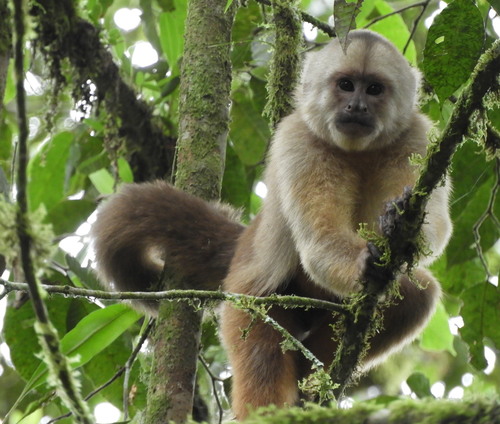
Distinctive golden-yellow to orange fur on the chest, belly, and inner limbs, contrasting with dark brown to blackish fur on the back, limbs, and tail; the face is pale with a dark cap, and a reddish-orange crown patch is often present.
Size
Body length approximately 35-48 cm, with a non-prehensile tail of similar or greater length (40-50 cm), used for balance.
Weight
Adults typically weigh 2.5-3.9 kg, with males generally slightly larger than females.
Distinctive features
The vivid golden-yellow underside and reddish crown distinguish it from other Sapajus species, which typically have more uniform brown or black coloring; it also has a relatively robust, muscular build for nut-cracking.
Differences between males and females
Males are slightly larger and more robust than females, though external color patterns are similar between sexes.
Behaviour and diet of the Buff-headed Capuchin
Lives in multi-male, multi-female social groups of typically 8-15 individuals with a clear dominance hierarchy; strong social bonds are maintained through grooming and cooperative behaviors.
When it is active
Diurnal, with peak activity in early morning and late afternoon; groups rest during the hottest midday hours.
Diet
Omnivorous diet including ripe fruits, seeds, nuts, insects, small vertebrates, bird eggs, and occasionally plant matter like leaves and flowers; palm nuts are an important fallback food.
How it feeds and hunts
Uses tools such as stones to crack open hard palm nuts on anvil surfaces; forages cooperatively and manipulates bark and foliage to extract insects and small prey.
Communication
Communicates through a variety of vocalizations including alarm calls, contact calls, and food-associated calls; also uses facial expressions, body postures, and scent marking with urine for social and territorial signaling.
Interactions with other species
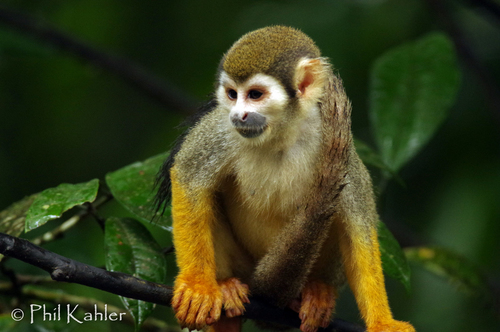
Natural predators include large raptors (harpy eagles), wild cats (ocelots, margays), and snakes; competes with other frugivorous mammals and birds for fruit resources; may form loose mixed-species associations with squirrel monkeys in some areas.
Role in its ecosystem
Plays an important ecological role as a seed disperser for many Atlantic Forest plant species, contributing to forest regeneration and maintenance of plant diversity.
Reproduction and lifecycle
Breeding is not strictly seasonal though may peak with fruit abundance; gestation lasts about 150-160 days, typically resulting in a single offspring, with interbirth intervals of around 2 years.
Raising the young
Mothers provide primary care, carrying infants on their backs for several months; other group members, including juveniles and sometimes males, may assist in alloparental care; weaning occurs around 9-12 months.
Maturity and lifespan
Sexual maturity is reached around 4-8 years of age; lifespan in the wild is approximately 15-25 years, while captive individuals can live up to 40 years.
Taxonomy and naming of the Buff-headed Capuchin
Classification
Class Mammalia > Order Primates > Family Cebidae > Genus Sapajus > Species Sapajus xanthosternos
Scientific synonyms
Cebus xanthosternos (former classification before genus Sapajus was split from Cebus)
What research says
Recent studies
Recent genetic and habitat viability studies have focused on assessing population connectivity and inbreeding risks in fragmented Bahia forests, informing corridor and reintroduction planning.
Genome and DNA
Diploid chromosome number is 2n=54, typical for Cebidae; genetic studies have highlighted low genetic diversity in remaining wild populations due to severe bottlenecks.
Compared with similar species
Similar in general body plan to other Sapajus species like the tufted capuchin (Sapajus apella), but distinguished by its striking golden ventral coloration; less robust and more restricted in range than the widespread tufted capuchin.
The Buff-headed Capuchin and people
This capuchin is sometimes called the 'golden-bellied capuchin' due to its brilliant coloring; it is one of the rarest primates in the world with a population smaller than many endangered great ape populations; some individuals have been observed using stone tools in the wild, a rare trait among non-human primates.
Where and how to see it
Best observed in protected reserves such as Una Biological Reserve or nearby private reserves in southern Bahia, ideally during early morning hours when groups are most active and foraging; guided ecotourism tours increase chances of sightings while minimizing disturbance.
Risks to humans
No notable risk to humans; wild individuals are generally shy and avoid direct contact, though captive or habituated individuals may bite if provoked.
Human uses
Historically captured for the illegal pet trade; currently the species has conservation and ecotourism value rather than economic exploitation, with some individuals maintained in accredited breeding programs for conservation purposes.
Countries where the Buff-headed Capuchin is recorded
The 1 countries named in the range description of its IUCN Red List assessment.
Questions about the Buff-headed Capuchin
Where does the Buff-headed Capuchin live?
The Buff-headed Capuchin is recorded in Brazil across South America. These countries come from the range description of its IUCN Red List assessment, and they are what place the species on the interactive map.
Is the Buff-headed Capuchin endangered?
Yes. The IUCN Red List assesses the Buff-headed Capuchin as Critically Endangered, one of the three threatened categories. The species faces an extremely high risk of extinction in the wild. This is the last category before extinction, and it is reached through a very small or steeply declining population, a tiny range, or both.
How many are left in the wild?
Fewer than 180 mature individuals believed to remain in the wild, with a continuing declining trend. This figure comes from the species assessment on the IUCN Red List; population estimates for wild mammals are ranges, not counts, and are revised at each assessment.
What habitat does the Buff-headed Capuchin live in?
Primarily lowland and submontane tropical Atlantic rainforest, including semi-deciduous and evergreen forest types; also found in degraded secondary forest and forest fragments surrounded by agricultural land.
What is the scientific name of the Buff-headed Capuchin?
The Buff-headed Capuchin is Sapajus xanthosternos, in the family Cebidae, order Primates.
Other species in the genus Sapajus
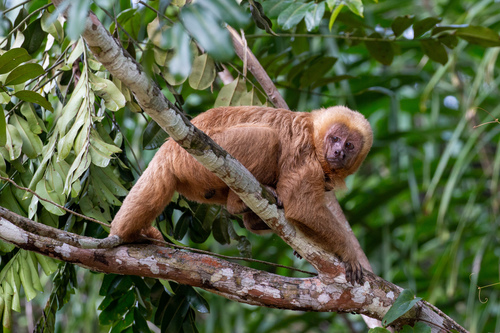
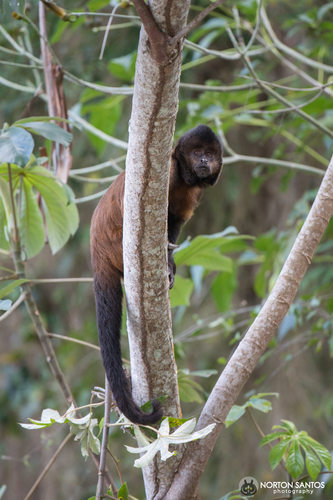
Other species in the family Cebidae
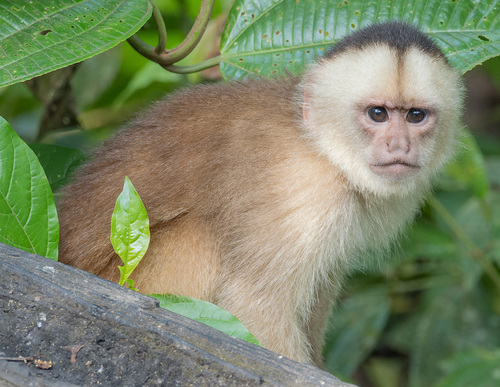
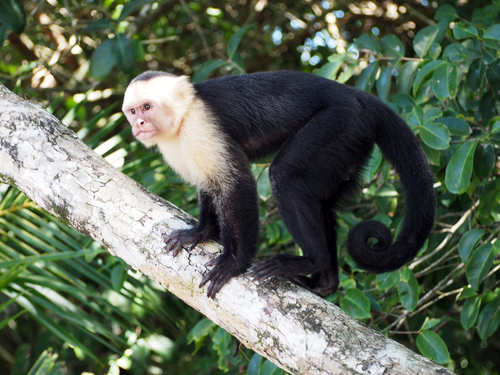
Sources
Conservation status, range description and population estimate come from the IUCN Red List assessment for Sapajus xanthosternos. Countries are derived from that range description, not from a mapped country list. Last refreshed on .
The distribution map is drawn from the IUCN Red List spatial data compiled in 2008. IUCN (International Union for Conservation of Nature)