
Guianan Squirrel Monkey
Saimiri sciureus
Red List assessment
Least Concernon the IUCN Red List
- EXExtinct
- EWExtinct in the Wild
- CRCritically Endangered
- ENEndangered
- VUVulnerable
- NTNear Threatened
- LCLeast Concern
The Guianan Squirrel Monkey is recorded in 4 countries across South America. The IUCN Red List assesses the Guianan Squirrel Monkey as Least Concern. No precise global population estimate exists, but the species is considered common and widespread within suitable habitat; populations are believed to be generally stable, though some local declines are reported due to habitat loss.
- Family
- Cebidae
- Order
- Primates
- Genus
- Saimiri
- Countries recorded
- 4
- Continents
- South America
- Red List category
- Least Concern
- Data updated
- August 9, 2026
What is the Guianan Squirrel Monkey?
The Guianan squirrel monkey is a small, highly active New World primate native to the forests of the Guiana Shield. It is known for its bright coloration, expressive face with a distinctive black muzzle, and its energetic, acrobatic movement through the forest canopy. Living in large, cohesive social groups, it is one of the most gregarious and vocal primates in its range. Its adaptability to varied forest habitats has helped it remain a species of Least Concern.
Where does the Guianan Squirrel Monkey live?
Northeastern South America, primarily the Guiana Shield region including French Guiana, Suriname, Guyana, and northern Brazil
Found in northeastern South America across French Guiana, Suriname, Guyana, and adjacent parts of northern Brazil (Amapá and northern Pará regions), largely within the Guiana Shield ecoregion.
Altitude and depth
Typically found from sea level up to around 500 meters elevation, mostly in lowland forest zones.
Seasonal movements
No migration or hibernation; however, birth timing is often synchronized with periods of high fruit and insect abundance during the wet season.
Habitat of the Guianan Squirrel Monkey
Primarily found in lowland tropical rainforest, including primary and secondary forest, gallery forest along rivers, and seasonally flooded forest. It shows a preference for dense understory and lower-to-mid canopy layers.
Adaptations to its environment
Possesses a long, non-prehensile tail used for balance during rapid arboreal locomotion, and excellent color vision to locate ripe fruit and camouflaged insects. Small body size and agility allow it to exploit thin terminal branches inaccessible to larger primates, reducing competition and predation risk.
Conservation status and numbers
Listed as Least Concern by the IUCN due to its relatively wide distribution and adaptability to forest disturbance, although local populations face pressure from habitat loss in parts of its range.
Estimated population
No precise global population estimate exists, but the species is considered common and widespread within suitable habitat; populations are believed to be generally stable, though some local declines are reported due to habitat loss.
What threatens the Guianan Squirrel Monkey?
Main threats include deforestation for agriculture and mining (particularly gold mining in the Guiana Shield), habitat fragmentation, and to a lesser extent capture for the pet trade.
Diseases and parasites
Susceptible to various parasites including intestinal nematodes and ectoparasites such as mites; also used historically in biomedical research related to malaria and hepatitis studies due to physiological similarities to humans.
What is being done to protect it?
Protected under national wildlife laws in French Guiana, Suriname, and Guyana, and found within several protected areas such as Amazonian parks and reserves in the Guiana Shield. Listed on CITES Appendix II, regulating international trade.
Recommended actions
Continued protection of primary and secondary forest habitat, regulation of small-scale and industrial mining activities, and monitoring of pet trade to prevent unsustainable local extraction.
What the Guianan Squirrel Monkey looks like
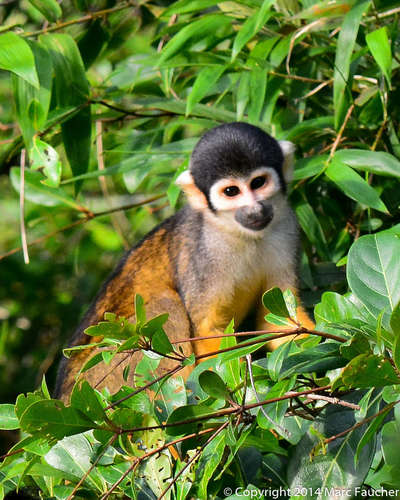
The fur is a mix of olive, grayish, and yellowish-orange tones on the back and limbs, with a whitish throat and chest. The face is pale with a distinctive black or dark muzzle patch, giving it a mask-like appearance, and large expressive eyes.
Size
Body length (head and body) ranges from about 25-37 cm, with an additional tail length of 35-42 cm.
Weight
Adults typically weigh between 750-1100 grams, with males generally slightly heavier than females.
Distinctive features
Distinguished from other Saimiri species by subtle differences in fur coloration and the shape of the black muzzle patch, as well as genetic and geographic separation from closely related taxa like S. collinsi and S. cassiquiarensis.
Differences between males and females
Slight sexual dimorphism exists, with males being marginally larger and heavier than females; males also develop more robust body proportions during the breeding season ('fatted male' phenomenon).
Behaviour and diet of the Guianan Squirrel Monkey
Highly social, living in large multi-male, multi-female groups typically ranging from 20 to 75 individuals, sometimes more. Social structure is generally egalitarian among females, with male dominance hierarchies shifting seasonally.
When it is active
Diurnal, with activity concentrated during daylight hours spent foraging, traveling, and socializing, followed by group sleeping in dense vegetation at night.
Diet
Omnivorous, feeding primarily on insects and small invertebrates, complemented by fruits, flowers, nectar, and occasionally small vertebrates like lizards or nestling birds.
How it feeds and hunts
Forages actively by searching foliage, bark crevices, and leaf litter for insects, often manipulating vegetation with hands to flush out prey; hunting is opportunistic rather than coordinated.
Communication
Communicates through a wide range of vocalizations including chirps, peeps, and alarm calls, as well as scent marking with urine and visual displays such as genital presentation to signal status or reproductive state.
Interactions with other species
Frequently forms mixed-species associations with capuchin monkeys, which may offer protection from predators through increased vigilance; natural predators include large raptors, snakes, and wild cats such as ocelots.
Role in its ecosystem
Plays an important ecological role as both an insect predator, helping regulate arthropod populations, and as a seed disperser for various fruiting plant species within its forest habitat.
Reproduction and lifecycle
Breeding is often seasonal, coinciding with periods of resource abundance; gestation lasts about 150-170 days, typically resulting in a single offspring per birth.
Raising the young
Mothers provide the primary care, carrying infants on their backs from birth; alloparenting by other females is common, and weaning generally occurs by 4-6 months of age.
Maturity and lifespan
Females typically reach sexual maturity around 2.5-3 years, males slightly later around 4-5 years; lifespan in the wild is around 15 years, while captive individuals can live up to 20-25 years.
Taxonomy and naming of the Guianan Squirrel Monkey
Classification
Mammalia > Primates > Cebidae > Saimiri > Saimiri sciureus
Subspecies
Taxonomy debated; some authorities recognize Saimiri sciureus sciureus and S. s. albigena, though many former 'subspecies' (e.g., collinsi, cassiquiarensis) have been elevated to full species status in recent revisions.
Scientific synonyms
Saimiri sciurea (older spelling), formerly included broader Saimiri populations now split into separate species like S. collinsi and S. cassiquiarensis
What research says
Recent studies
Recent molecular phylogenetic studies have refined the taxonomy of the genus Saimiri, splitting what was once considered a single widespread species into several distinct species based on genetic and morphological differences.
Genome and DNA
Diploid chromosome number is 2n=44; genomic studies have been used to help distinguish between different Saimiri species and clarify taxonomic boundaries within the genus.
Compared with similar species
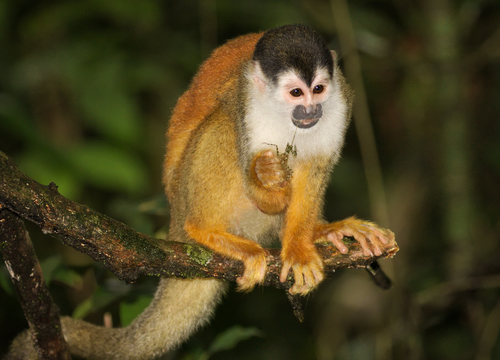
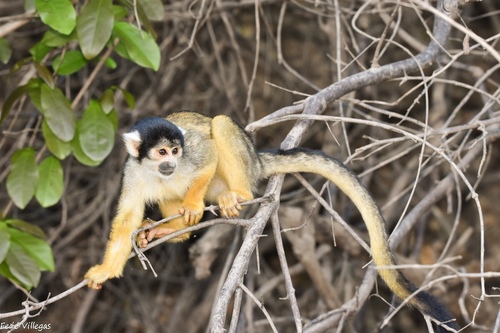
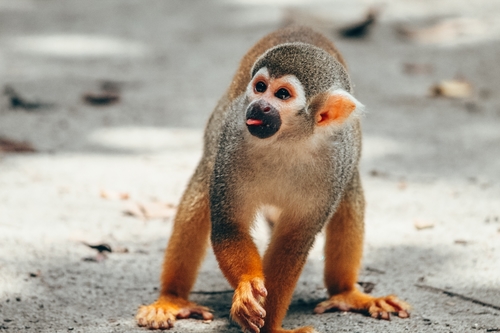
Similar in general appearance to other squirrel monkey species like the Central American squirrel monkey (Saimiri oerstedii) and Bolivian squirrel monkey (Saimiri boliviensis), but distinguished by geographic range, subtle coloration differences, and genetic divergence.
The Guianan Squirrel Monkey and people
Squirrel monkeys have one of the highest brain-to-body mass ratios of any primate. They are known for a peculiar social behavior called 'urine washing,' where they rub urine on their hands and feet, possibly for communication or thermoregulation.
Where and how to see it
Best observed early in the morning in lowland rainforest reserves of French Guiana, Suriname, or Guyana, particularly along riverbanks where groups forage; guided eco-tours in these regions often provide reliable sighting opportunities.
Risks to humans
No notable risk to humans; they are small, non-aggressive animals, though like all primates they can carry zoonotic diseases and should not be handled.
Human uses
Historically used in biomedical research due to physiological similarities with humans, and sometimes kept illegally as exotic pets; also a popular attraction in ecotourism within their native range.
Myths and legends
In some Amazonian indigenous folklore, small monkeys like the squirrel monkey are portrayed as clever tricksters in oral storytelling traditions, though specific legends about this species are not widely documented in written sources.
Countries where the Guianan Squirrel Monkey is recorded
The 4 countries named in the range description of its IUCN Red List assessment.
Questions about the Guianan Squirrel Monkey
Where does the Guianan Squirrel Monkey live?
The Guianan Squirrel Monkey is recorded in Brazil, French Guiana, Guyana and Suriname across South America. These countries come from the range description of its IUCN Red List assessment, and they are what place the species on the interactive map.
Is the Guianan Squirrel Monkey endangered?
The IUCN Red List assesses the Guianan Squirrel Monkey as Least Concern. The species is widespread and abundant enough not to qualify for any threatened category. It does not mean the species is safe forever, only that nothing in the current data raises an alarm.
How many are left in the wild?
No precise global population estimate exists, but the species is considered common and widespread within suitable habitat; populations are believed to be generally stable, though some local declines are reported due to habitat loss. This figure comes from the species assessment on the IUCN Red List; population estimates for wild mammals are ranges, not counts, and are revised at each assessment.
What habitat does the Guianan Squirrel Monkey live in?
Primarily found in lowland tropical rainforest, including primary and secondary forest, gallery forest along rivers, and seasonally flooded forest.
What is the scientific name of the Guianan Squirrel Monkey?
The Guianan Squirrel Monkey is Saimiri sciureus, in the family Cebidae, order Primates.
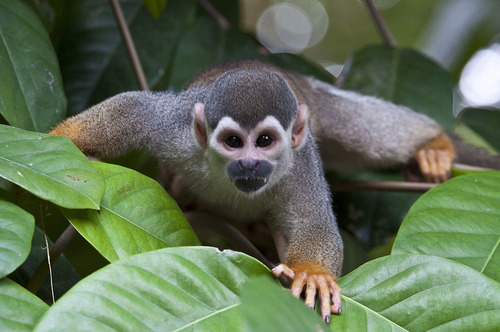
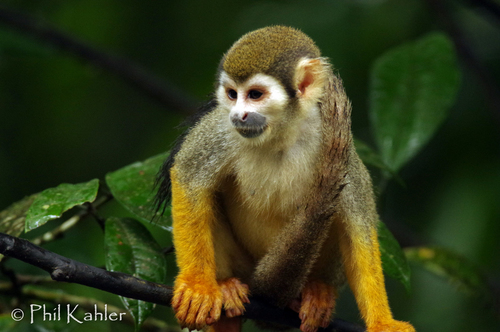
Other species in the genus Saimiri
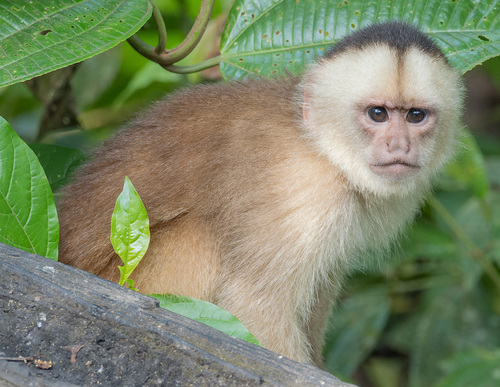
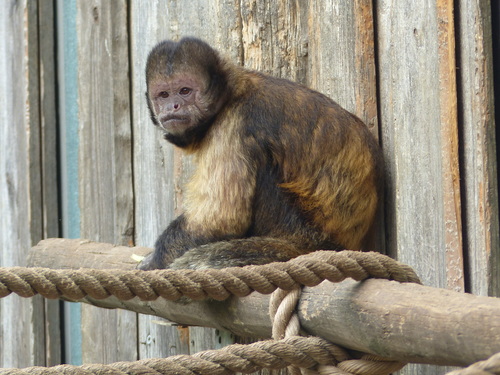
Other species in the family Cebidae
Sources
Conservation status, range description and population estimate come from the IUCN Red List assessment for Saimiri sciureus. Countries are derived from that range description, not from a mapped country list. Last refreshed on .
The distribution map is drawn from the IUCN Red List spatial data compiled in 2020. IUCN (International Union for Conservation of Nature)