
Colombian White-throated Capuchin
Cebus capucinus
Red List assessment
Vulnerableon the IUCN Red List
- EXExtinct
- EWExtinct in the Wild
- CRCritically Endangered
- ENEndangered
- VUVulnerable
- NTNear Threatened
- LCLeast Concern
The Colombian White-throated Capuchin is recorded in 3 countries across North America and South America. The IUCN Red List assesses the Colombian White-throated Capuchin as Vulnerable. Exact numbers are unknown, but populations are believed to be declining across its range, especially in Colombia where deforestation rates remain high.
- Family
- Cebidae
- Order
- Primates
- Genus
- Cebus
- Countries recorded
- 3
- Continents
- North America and South America
- Red List category
- Vulnerable
- Data updated
- August 9, 2026
What is the Colombian White-throated Capuchin?
The Colombian white-throated capuchin is a medium-sized New World monkey found in the forests of Colombia and Ecuador, recognized by its striking white throat, chest, and shoulders contrasting with darker limbs and body. It is highly intelligent, known for tool use and complex social behavior, making it one of the most cognitively advanced primates in the Americas. This species plays a key ecological role as a seed disperser in tropical forests. Its populations are declining due to habitat loss and fragmentation.
Where does the Colombian White-throated Capuchin live?
Colombia and western Ecuador, with a small portion of range extending into Panama
Found in northern and western Colombia, extending into western Ecuador; historically connected to Central American populations but now considered geographically and taxonomically distinct from Cebus imitator found in Panama and northward.
Altitude and depth
0–1500 meters above sea level, though most populations occur below 1000 m.
Seasonal movements
No true migration or hibernation; activity and ranging patterns shift somewhat with wet and dry seasons due to fruit availability.
Habitat of the Colombian White-throated Capuchin
Inhabits primary and secondary tropical moist and dry forests, gallery forests, and forest edges; also found in mangroves and some degraded forest patches near human settlements.
Adaptations to its environment
Prehensile tail aids in arboreal locomotion and food handling; strong hands allow tool use such as cracking nuts with stones; opportunistic omnivorous diet allows flexibility during fruit scarcity.
Conservation status and numbers
Classified as Vulnerable (VU) by the IUCN due to ongoing habitat destruction and fragmentation causing population declines estimated at over 30% over the past three generations.
Estimated population
Exact numbers are unknown, but populations are believed to be declining across its range, especially in Colombia where deforestation rates remain high.
What threatens the Colombian White-throated Capuchin?
Deforestation for agriculture and cattle ranching, illegal pet trade, hunting in some regions, and habitat fragmentation limiting gene flow between populations.
Diseases and parasites
Susceptible to intestinal parasites, botfly larvae infestations, and various viral infections common among New World primates.
What is being done to protect it?
Protected under Colombian and Ecuadorian wildlife laws; found in several protected areas and national parks; included in CITES Appendix II regulating international trade.
Recommended actions
Strengthen enforcement against illegal pet trade, expand and connect protected forest corridors, and support community-based conservation and reforestation programs.
What the Colombian White-throated Capuchin looks like
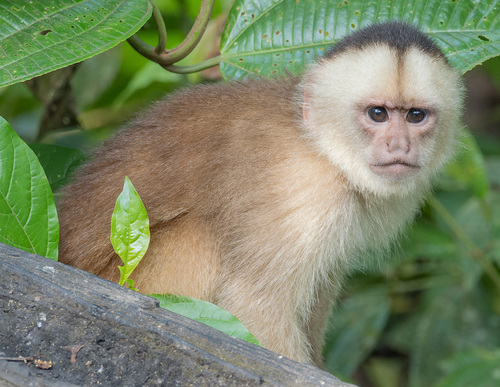
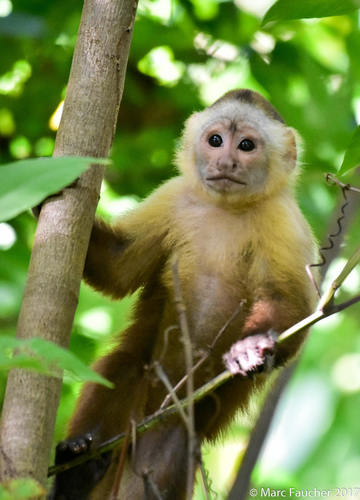
The fur is mostly black or dark brown on the body and limbs, with a creamy white face, throat, chest, and shoulders creating a striking contrasting pattern; the face is pinkish and expressive.
Size
Body length (head and body) ranges from 33 to 45 cm, with a tail of similar or greater length (up to 55 cm), used prehensively.
Weight
Adult males typically weigh 3–4 kg, while females are slightly smaller, averaging 2.5–3.5 kg.
Distinctive features
Distinguished from closely related Cebus imitator by subtle differences in cranial morphology and genetic markers, as well as slight variation in coat coloration and geographic range.
Differences between males and females
Males are generally larger and more heavily built than females, though coloration is similar between sexes.
Behaviour and diet of the Colombian White-throated Capuchin
Highly social, living in mixed-sex groups of 10–35 individuals with a linear dominance hierarchy; strong social bonds and cooperative behaviors such as grooming and alliance formation are common.
When it is active
Diurnal, active mainly during daylight hours, with peaks of foraging activity in early morning and late afternoon.
Diet
Omnivorous diet including fruits, seeds, insects, small vertebrates, eggs, and occasionally plant matter such as flowers and leaves.
How it feeds and hunts
Forages both on the ground and in trees; uses tools such as stones to crack nuts and shellfish, and probes tree bark or leaf litter for insects.
Communication
Uses a range of vocalizations including alarm calls, contact calls, and threat vocalizations, along with facial expressions, body postures, and scent marking for social communication.
Interactions with other species
Preyed upon by large raptors, snakes, and wild cats; competes with other primates and frugivorous mammals for fruit resources; often forms mixed-species associations with squirrel monkeys.
Role in its ecosystem
Acts as an important seed disperser, contributing to forest regeneration and plant diversity within its habitat.
Reproduction and lifecycle
Breeding can occur year-round but may peak seasonally; gestation lasts about 160 days, typically resulting in a single offspring.
Raising the young
Mothers provide most infant care, carrying and nursing the young for several months; other group members, including juveniles, may assist in alloparental care.
Maturity and lifespan
Sexual maturity is reached around 4–5 years in females and slightly later in males; lifespan can reach up to 25 years in the wild and over 40 years in captivity.
Taxonomy and naming of the Colombian White-throated Capuchin
Classification
Mammalia > Primates > Cebidae > Cebus > Cebus capucinus
Subspecies
Some taxonomies previously included Cebus capucinus curtus (Panama) and Cebus capucinus imitator (Central America) as subspecies, but these are now generally recognized as distinct species; Cebus capucinus sensu stricto is largely monotypic within Colombia/Ecuador.
Scientific synonyms
Formerly classified together with Cebus imitator under a broader 'Cebus capucinus' concept; also historically listed as Simia capucina.
What research says
Recent studies
Recent genetic and behavioral studies have confirmed distinct evolutionary lineages between Colombian and Central American capuchin populations, prompting taxonomic revisions.
Genome and DNA
Diploid chromosome number is 2n=54; genetic studies have helped clarify species boundaries within the Cebus genus, particularly separating C. capucinus from C. imitator.
Compared with similar species
Similar in appearance to Cebus imitator (Panamanian white-faced capuchin), but genetically and geographically distinct, with subtle morphological differences in skull shape and coloration.
The Colombian White-throated Capuchin and people
Capuchins are among the few non-human primates known to use tools in the wild, such as cracking nuts with stones; they are also famous for their role in film and media as intelligent, expressive primates.
Where and how to see it
Best observed in protected forest reserves in Colombia such as Tayrona National Natural Park during early morning hours when groups are actively foraging.
Risks to humans
No notable risk to humans, though bites can occur if the animal is provoked or handled; may carry zoonotic parasites transmissible in close contact situations.
Human uses
Historically captured for the pet trade and used in entertainment due to their intelligence, though this practice is now illegal in most range countries.
Myths and legends
In some Indigenous and local Colombian folklore, capuchins are seen as clever tricksters, symbolizing intelligence and mischief in animal fables.
Countries where the Colombian White-throated Capuchin is recorded
The 3 countries named in the range description of its IUCN Red List assessment.
Questions about the Colombian White-throated Capuchin
Where does the Colombian White-throated Capuchin live?
The Colombian White-throated Capuchin is recorded in Colombia, Ecuador and Panama across North America and South America. These countries come from the range description of its IUCN Red List assessment, and they are what place the species on the interactive map.
Is the Colombian White-throated Capuchin endangered?
Yes. The IUCN Red List assesses the Colombian White-throated Capuchin as Vulnerable, one of the three threatened categories. The species faces a high risk of extinction in the wild. It is the first of the three threatened categories: numbers are falling, the range is shrinking, or the population is small enough that a single bad event could do lasting damage.
How many are left in the wild?
Exact numbers are unknown, but populations are believed to be declining across its range, especially in Colombia where deforestation rates remain high. This figure comes from the species assessment on the IUCN Red List; population estimates for wild mammals are ranges, not counts, and are revised at each assessment.
What habitat does the Colombian White-throated Capuchin live in?
Inhabits primary and secondary tropical moist and dry forests, gallery forests, and forest edges; also found in mangroves and some degraded forest patches near human settlements.
What is the scientific name of the Colombian White-throated Capuchin?
The Colombian White-throated Capuchin is Cebus capucinus, in the family Cebidae, order Primates.
Other species in the genus Cebus
Other species in the family Cebidae
Sources
Conservation status, range description and population estimate come from the IUCN Red List assessment for Cebus capucinus. Countries are derived from that range description, not from a mapped country list. Last refreshed on .
The distribution map is drawn from the IUCN Red List spatial data compiled in 2020. IUCN (International Union for Conservation of Nature)