
Ecuadorian White-fronted Capuchin
Cebus aequatorialis
Red List assessment
Critically Endangeredon the IUCN Red List
- EXExtinct
- EWExtinct in the Wild
- CRCritically Endangered
- ENEndangered
- VUVulnerable
- NTNear Threatened
- LCLeast Concern
The Ecuadorian White-fronted Capuchin is recorded in 2 countries across South America. The IUCN Red List assesses the Ecuadorian White-fronted Capuchin as Critically Endangered. Fewer than 2,500 mature individuals remain, with a continuing declining trend.
- Family
- Cebidae
- Order
- Primates
- Genus
- Cebus
- Countries recorded
- 2
- Continents
- South America
- Red List category
- Critically Endangered
- Data updated
- August 9, 2026
What is the Ecuadorian White-fronted Capuchin?
The Ecuadorian white-fronted capuchin is a small, agile New World monkey endemic to the coastal and Andean foothill forests of western Ecuador and adjacent Peru. It is critically endangered due to extreme habitat loss from agriculture and logging, with only fragmented forest patches remaining. Known for its intelligence and dexterous hands, it plays an important role as a seed disperser in its ecosystem. It is one of the most threatened primates in South America.
Where does the Ecuadorian White-fronted Capuchin live?
Western Ecuador and extreme northwestern Peru
Endemic to western Ecuador, ranging from Esmeraldas province south to El Oro province, with a small population possibly extending into extreme northwestern Peru (Tumbes region).
Altitude and depth
0-1600 meters above sea level
Seasonal movements
No true migration or hibernation; activity may shift slightly with wet and dry seasons affecting fruit availability.
Habitat of the Ecuadorian White-fronted Capuchin
Inhabits tropical and subtropical moist lowland forests, dry deciduous forests, and forest edges along the Pacific coast and Andean foothills of Ecuador. It prefers areas with dense canopy cover and mixed fruiting tree species.
Adaptations to its environment
Possesses a prehensile-like grip (though not a prehensile tail) and strong hands for manipulating tools and extracting food from bark and crevices. Its varied diet and cognitive flexibility allow it to exploit fragmented and degraded forest patches.
Conservation status and numbers
Critically Endangered (IUCN) due to an estimated population decline exceeding 80% over three generations, driven primarily by severe habitat loss and fragmentation across its restricted range.
Estimated population
Fewer than 2,500 mature individuals remain, with a continuing declining trend.
What threatens the Ecuadorian White-fronted Capuchin?
Deforestation for agriculture (cacao, banana, oil palm), logging, urban expansion, and illegal pet trade are the primary threats. Habitat fragmentation has isolated populations, increasing extinction risk.
Diseases and parasites
Susceptible to various gastrointestinal parasites and has potential vulnerability to diseases transmissible from humans due to close habitat overlap, though specific studies are limited.
What is being done to protect it?
Protected under Ecuadorian wildlife law and included in some protected areas such as Mache-Chindul Ecological Reserve and Machalilla National Park. Conservation organizations are conducting population surveys and habitat corridor initiatives.
Recommended actions
Expand and connect protected forest fragments, enforce anti-poaching and anti-deforestation laws, support community-based conservation and reforestation, and conduct further population monitoring.
What the Ecuadorian White-fronted Capuchin looks like
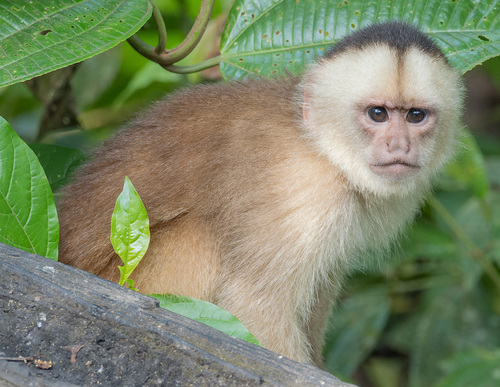
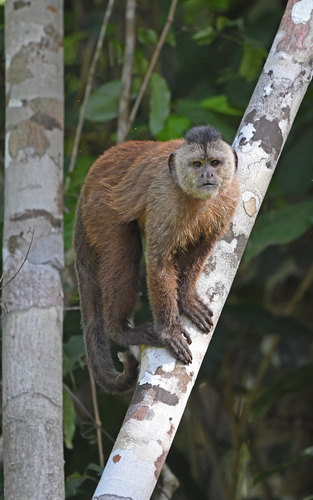
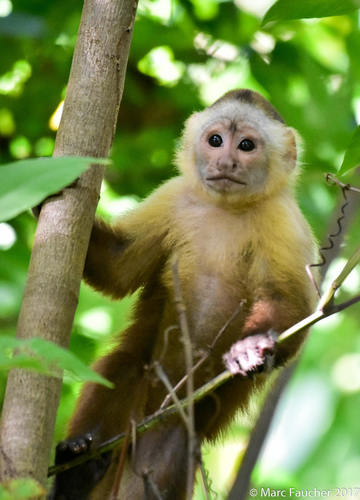
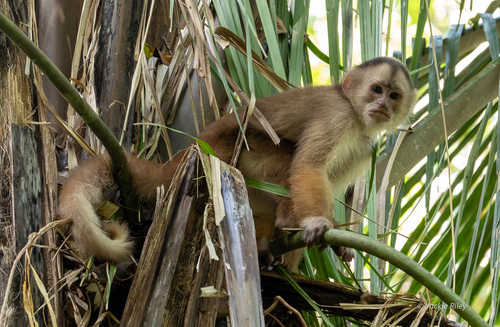
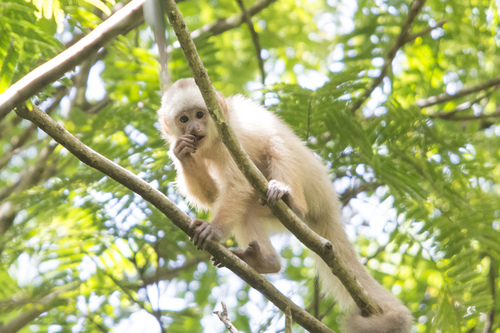
Has a pale cream to whitish face and chest contrasting with brownish-black fur on the back, limbs, and tail. The crown often has a darker cap, and the fur is generally coarse and dense.
Size
Body length approximately 35-45 cm, with a tail of similar or slightly greater length (non-prehensile in function despite curling).
Weight
Adults typically weigh between 2.5 and 3.5 kg, with males generally slightly larger than females.
Distinctive features
Distinguished from other Cebus/ Cebus albifrons populations by its distinct facial coloration pattern, geographic isolation, and slightly different cranial morphology confirmed through genetic studies.
Differences between males and females
Slight sexual dimorphism exists, with males being marginally larger and heavier than females, though coloration is similar between sexes.
Behaviour and diet of the Ecuadorian White-fronted Capuchin
Lives in social groups of 10-30 individuals with a multi-male, multi-female structure and dominance hierarchies. Groups exhibit cooperative behaviors such as mutual grooming and coordinated foraging.
When it is active
Diurnal, most active during daylight hours foraging in the canopy and returning to sleeping sites at dusk.
Diet
Omnivorous, feeding on a wide variety of fruits, seeds, insects, small vertebrates, and occasionally bird eggs. Diet composition shifts seasonally based on fruit availability.
How it feeds and hunts
Uses manual dexterity to extract insects and larvae from bark crevices, and has been observed using tools such as stones to crack open nuts or seeds.
Communication
Communicates through a range of vocalizations including alarm calls, contact calls, and threat vocalizations, along with facial expressions and body postures to convey social status and emotion.
Interactions with other species
Natural predators include large raptors, wild cats (such as ocelots), and snakes. It competes with other frugivorous mammals and birds for fruiting resources but may also form loose mixed-species foraging associations.
Role in its ecosystem
Functions as an important seed disperser for numerous tree species, contributing to forest regeneration and maintaining plant diversity within its habitat.
Reproduction and lifecycle
Breeding is not strictly seasonal; gestation lasts about 150-160 days, typically producing a single offspring. Females usually give birth every 1-2 years.
Raising the young
Mothers provide primary care, carrying infants on their backs for several months; other group members, including juvenile females, may assist in alloparental care.
Maturity and lifespan
Sexual maturity is reached around 4-6 years of age; lifespan in the wild is estimated at 20-25 years, while captive individuals can live up to 40 years.
Taxonomy and naming of the Ecuadorian White-fronted Capuchin
Classification
Class Mammalia > Order Primates > Family Cebidae > Genus Cebus > Species Cebus aequatorialis
Scientific synonyms
Formerly considered a subspecies of Cebus albifrons (Cebus albifrons aequatorialis)
What research says
Recent studies
Recent taxonomic revisions (2010s) elevated this population to full species status based on morphological and genetic distinctiveness, prompting renewed conservation attention.
Genome and DNA
Genetic studies using mitochondrial DNA have helped confirm its status as a distinct species separate from Cebus albifrons, though detailed genome sequencing is limited.
Compared with similar species
Closely related to Cebus albifrons but distinguished by more restricted range, distinct facial and pelage coloration, and greater conservation concern due to smaller population size.
The Ecuadorian White-fronted Capuchin and people
This capuchin has been observed using stone tools to crack nuts, a rare behavior among New World primates. It is also one of the rarest primates in South America, with a range smaller than many countries' capital cities.
Where and how to see it
Best observed in remaining forest fragments such as Machalilla National Park or Mache-Chindul Reserve during early morning hours when groups are actively foraging.
Risks to humans
No notable risk to humans beyond potential disease transmission through close contact in ecotourism settings.
Human uses
Occasionally captured for the illegal pet trade, though it has no significant traditional or commercial use; ecotourism provides some economic incentive for conservation.
Countries where the Ecuadorian White-fronted Capuchin is recorded
The 2 countries named in the range description of its IUCN Red List assessment.
Questions about the Ecuadorian White-fronted Capuchin
Where does the Ecuadorian White-fronted Capuchin live?
The Ecuadorian White-fronted Capuchin is recorded in Ecuador and Peru across South America. These countries come from the range description of its IUCN Red List assessment, and they are what place the species on the interactive map.
Is the Ecuadorian White-fronted Capuchin endangered?
Yes. The IUCN Red List assesses the Ecuadorian White-fronted Capuchin as Critically Endangered, one of the three threatened categories. The species faces an extremely high risk of extinction in the wild. This is the last category before extinction, and it is reached through a very small or steeply declining population, a tiny range, or both.
How many are left in the wild?
Fewer than 2,500 mature individuals remain, with a continuing declining trend. This figure comes from the species assessment on the IUCN Red List; population estimates for wild mammals are ranges, not counts, and are revised at each assessment.
What habitat does the Ecuadorian White-fronted Capuchin live in?
Inhabits tropical and subtropical moist lowland forests, dry deciduous forests, and forest edges along the Pacific coast and Andean foothills of Ecuador.
What is the scientific name of the Ecuadorian White-fronted Capuchin?
The Ecuadorian White-fronted Capuchin is Cebus aequatorialis, in the family Cebidae, order Primates.
Other species in the genus Cebus
Other species in the family Cebidae
Sources
Conservation status, range description and population estimate come from the IUCN Red List assessment for Cebus aequatorialis. Countries are derived from that range description, not from a mapped country list. Last refreshed on .
The distribution map is drawn from the IUCN Red List spatial data compiled in 2020. IUCN (International Union for Conservation of Nature)