
Sand Cat
Felis margarita
Red List assessment
Least Concernon the IUCN Red List
- EXExtinct
- EWExtinct in the Wild
- CRCritically Endangered
- ENEndangered
- VUVulnerable
- NTNear Threatened
- LCLeast Concern
The Sand Cat is recorded in 10 countries across Africa and Asia. The IUCN Red List assesses the Sand Cat as Least Concern. Exact population numbers are unknown due to its cryptic and nocturnal habits, but it is considered stable overall, with some local declines suspected
- Family
- Felidae
- Order
- Carnivora
- Genus
- Felis
- Countries recorded
- 10
- Continents
- Africa and Asia
- Red List category
- Least Concern
- Data updated
- August 9, 2026
What is the Sand Cat?
The sand cat is a small wild cat highly specialized for life in arid, sandy deserts. It is remarkable for its ability to survive without free-standing water, relying entirely on moisture from prey. Its thick fur-covered paws allow it to walk on hot, shifting sand without burning its feet. It is one of the few felids adapted to such extreme desert conditions.
Where does the Sand Cat live?
Deserts of North Africa, the Arabian Peninsula, and Central/Southwest Asia
Found across the Sahara in North Africa (Algeria, Morocco, Niger), the Arabian Peninsula (Saudi Arabia, UAE, Oman), and into Iran, Pakistan, and Central Asian countries such as Turkmenistan and Uzbekistan.
Altitude and depth
Typically found at low elevations, from near sea level up to about 1,500 meters
Seasonal movements
No true migration; activity patterns shift seasonally becoming more nocturnal in hot summer months and more crepuscular/diurnal in cooler seasons
Habitat of the Sand Cat
Sandy and stony deserts with sparse vegetation, dunes, and semi-arid steppe. Avoids rocky mountainous terrain, preferring flat or gently undulating desert plains.
Adaptations to its environment
Dense fur on paw pads insulates against extreme sand temperatures and provides traction on loose substrate. Large ears enhance heat dissipation and acute hearing for detecting subterranean prey. Kidneys are adapted to concentrate urine, minimizing water loss, allowing survival without drinking water.
Conservation status and numbers
Listed as Least Concern by IUCN, though population trends are difficult to assess due to its elusive nature and remote habitat. Some regional populations, particularly in North Africa, may be declining due to habitat degradation.
Estimated population
Exact population numbers are unknown due to its cryptic and nocturnal habits, but it is considered stable overall, with some local declines suspected
What threatens the Sand Cat?
Habitat degradation from livestock grazing and human encroachment, road mortality, predation by domestic and feral dogs, and occasional capture for illegal pet trade.
Diseases and parasites
Susceptible to feline viral diseases such as feline panleukopenia and parasites including ticks and intestinal worms, though specific studies in wild populations are limited
What is being done to protect it?
Protected under national laws in several range countries; included in CITES Appendix II; captive breeding programs exist in zoos, particularly in the Middle East, to support genetic research and potential reintroduction efforts.
Recommended actions
Increased camera-trap and genetic surveys to better estimate populations, stricter enforcement against illegal pet trade, and habitat protection in key desert ecosystems.
What the Sand Cat looks like
Pale sandy-yellow to grayish fur that provides excellent camouflage in desert environments, with faint dark stripes on the legs and tail. Large, low-set ears and a broad, flattened head give it a distinctive appearance. The tail has a black tip and several dark rings near the end.
Size
Body length 39-52 cm, with a tail length of 23-31 cm; shoulder height approximately 24-30 cm
Weight
1.35-3.4 kg, with males generally slightly larger than females
Distinctive features
Distinguished from other small wild cats by its unusually large ears set low on the sides of the head, extremely furry paws, and flattened skull shape adapted for desert life.
Differences between males and females
Minimal sexual dimorphism; males are marginally larger and heavier than females but coloration is similar
Behaviour and diet of the Sand Cat
Solitary and territorial, coming together only briefly for mating. Home ranges can be large, especially in sparse desert habitats, and are typically not strongly defended against overlap.
When it is active
Primarily nocturnal and crepuscular, spending daylight hours resting in burrows or scrapes to avoid extreme desert heat
Diet
Carnivorous, feeding on small rodents (especially gerbils and jerboas), reptiles, insects, and occasionally birds. Highly adapted to hunting subterranean prey.
How it feeds and hunts
Uses acute hearing to detect prey moving underground or under sand, then digs rapidly to capture it; also stalks and pounces on surface-active prey during nocturnal hunts.
Communication
Communicates through scent marking, including urine spraying and cheek rubbing, as well as vocalizations such as a distinctive barking-like call during the breeding season.
Interactions with other species
Faces predation risk from larger carnivores such as foxes, jackals, and domestic dogs, and competes with other small desert predators for similar rodent prey.
Role in its ecosystem
Acts as a mid-level predator in desert ecosystems, helping control populations of small rodents and reptiles, contributing to ecosystem balance in nutrient-poor arid environments.
Reproduction and lifecycle
Breeding season varies by region, often occurring in winter months. Gestation lasts about 59-63 days, with litters of 1-8 kittens, typically averaging 2-4.
Raising the young
Females raise the kittens alone in a den, nursing them for about 5-6 weeks before gradually introducing solid food; kittens become independent at around 5-6 months of age.
Maturity and lifespan
Sexual maturity is reached at around 12-14 months; lifespan in the wild is estimated at 5-6 years, while captive individuals can live up to 13 years
Taxonomy and naming of the Sand Cat
Classification
Class Mammalia > Order Carnivora > Family Felidae > Genus Felis > Species Felis margarita
Subspecies
Felis margarita margarita (Sahara), F. m. harrisoni (Arabian Peninsula), F. m. thinobia (Central Asia), F. m. scheffeli (Pakistan)
Scientific synonyms
Felis margarita margarita was originally described by Loche in 1858; no major synonyms widely used today
What research says
Recent studies
Recent camera-trap studies in the Sahara and Arabian deserts have provided new insights into activity patterns and habitat use, while genetic research continues to refine subspecies classification
Genome and DNA
Diploid chromosome number of 2n=38, consistent with other Felis species; genetic studies have helped clarify subspecies boundaries and phylogenetic relationships within the genus Felis
Compared with similar species
Similar in size to the domestic cat but with proportionally larger ears, flatter head, and furrier paws; distinguishable from the closely related black-footed cat by its paler coloration and desert-specific adaptations.
The Sand Cat and people
Sand cats can survive without drinking water for extended periods, obtaining all necessary moisture from their prey. They can tolerate ambient temperatures ranging from below freezing to over 50°C. Their ears are so sensitive they can detect prey moving beneath the sand.
Where and how to see it
Best observed at night using spotlighting or camera traps in protected desert reserves such as those in the UAE or Morocco; patience and knowledge of burrow locations greatly increase chances of sightings.
Risks to humans
No notable risk to humans; sand cats are shy and avoid human contact
Human uses
Not widely used by humans, though occasionally captured illegally for the exotic pet trade despite legal protections
Myths and legends
Not prominently featured in major mythologies, though it is sometimes referenced in Bedouin folklore as a ghost-like desert dweller due to its elusive, rarely-seen nature
Countries where the Sand Cat is recorded
The 10 countries named in the range description of its IUCN Red List assessment.
Questions about the Sand Cat
Where does the Sand Cat live?
The Sand Cat is recorded in Algeria, Iran, Morocco, Niger and Oman, among 10 countries in total across Africa and Asia. These countries come from the range description of its IUCN Red List assessment, and they are what place the species on the interactive map.
Is the Sand Cat endangered?
The IUCN Red List assesses the Sand Cat as Least Concern. The species is widespread and abundant enough not to qualify for any threatened category. It does not mean the species is safe forever, only that nothing in the current data raises an alarm.
How many are left in the wild?
Exact population numbers are unknown due to its cryptic and nocturnal habits, but it is considered stable overall, with some local declines suspected This figure comes from the species assessment on the IUCN Red List; population estimates for wild mammals are ranges, not counts, and are revised at each assessment.
What habitat does the Sand Cat live in?
Sandy and stony deserts with sparse vegetation, dunes, and semi-arid steppe.
What is the scientific name of the Sand Cat?
The Sand Cat is Felis margarita, in the family Felidae, order Carnivora.
Other species in the genus Felis
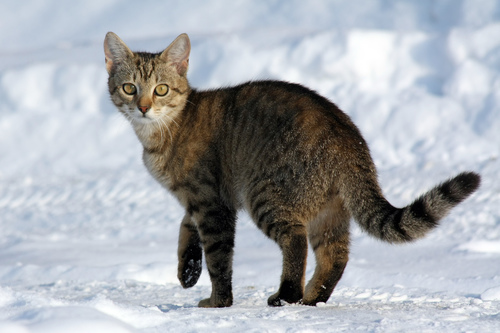
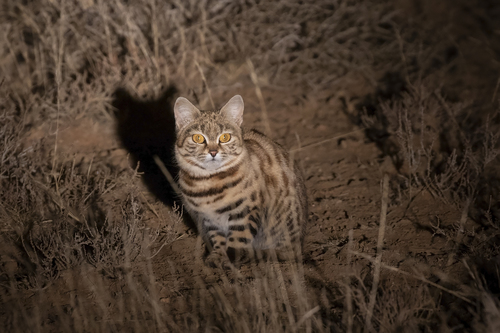
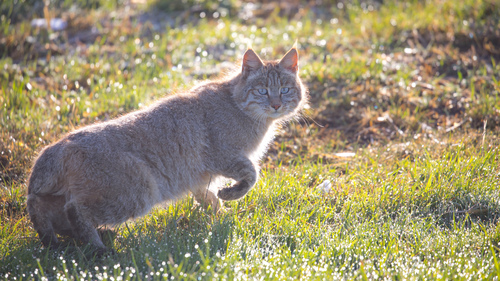
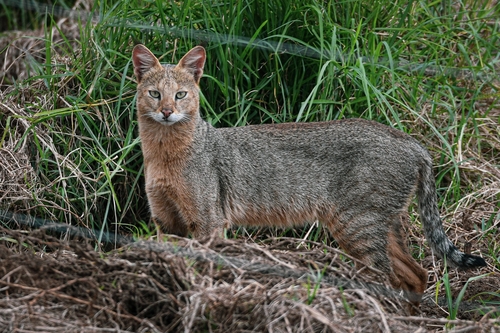
Other species in the family Felidae
Species that share its range
Sources
Conservation status, range description and population estimate come from the IUCN Red List assessment for Felis margarita. Countries are derived from that range description, not from a mapped country list. Last refreshed on .
The distribution map is drawn from the IUCN Red List spatial data compiled in 2016. IUCN (International Union for Conservation of Nature)