
Sage's Rock Rat
Aconaemys sagei
Red List assessment
Data Deficienton the IUCN Red List
- EXExtinct
- EWExtinct in the Wild
- CRCritically Endangered
- ENEndangered
- VUVulnerable
- NTNear Threatened
- LCLeast Concern
Data Deficient has no position on the scale above — it records the absence of an assessment, not a degree of risk.
The Sage's Rock Rat is recorded in 2 countries across South America. The IUCN Red List records the Sage's Rock Rat as Data Deficient. Unknown; no reliable population estimate exists.
- Family
- Octodontidae
- Order
- Rodentia
- Genus
- Aconaemys
- Countries recorded
- 2
- Continents
- South America
- Red List category
- Data Deficient
- Data updated
- August 9, 2026
What is the Sage's Rock Rat?
Sage's Rock Rat is a small, robust Andean rodent belonging to the family Octodontidae, first described by Oliver P. Pearson in 1984. It inhabits rocky outcrops and shrublands in the Patagonian Andes at moderate to high altitudes. It is notable for being one of the least-known members of its genus, with very limited distribution data available, which is reflected in its IUCN Data Deficient status. Like other rock rats, it is adapted to cold, rugged montane environments and relies heavily on rocky substrate for shelter.
Where does the Sage's Rock Rat live?
Patagonian Andes of Argentina (Neuquén and Río Negro provinces), with possible extension into adjacent areas of Chile.
Known primarily from the Neuquén and Río Negro provinces of Argentina along the Andean cordillera. The species may extend into adjacent Chilean territory, but confirmed records from Chile are scarce or absent.
Altitude and depth
Estimated range of approximately 800–2,500 m above sea level, consistent with other Aconaemys species in similar Andean habitats.
Seasonal movements
Likely active year-round without true hibernation, but may show reduced surface activity during the harshest winter months, as is typical for high-altitude Andean rodents in this family.
Habitat of the Sage's Rock Rat
Rocky scrublands, Andean steppe, and shrubby grasslands (mallines and coiron grasslands) in the temperate Andes. The species appears to prefer areas with large boulders or rocky outcrops that provide refuge from predators and harsh weather.
Adaptations to its environment
Compact, robust body morphology reduces heat loss in cold montane environments. Short, densely furred tail and small rounded ears minimize extremity exposure to cold. Heavy-clawed feet aid movement over rocky and uneven terrain. Likely builds runways and burrow systems beneath rocks for insulation and predator avoidance.
Conservation status and numbers
Data Deficient (DD) on the IUCN Red List. Insufficient data exist to assess its population size, trends, or precise range, making formal threat categorization impossible at this time.
Estimated population
Unknown; no reliable population estimate exists. Population trend is undetermined due to lack of survey data.
What threatens the Sage's Rock Rat?
Potential threats include habitat degradation from livestock grazing (overgrazing of Andean shrublands), introduced predators such as cats and foxes, and climate change affecting Andean vegetation zones. The limited known range also makes the species intrinsically vulnerable to localized disturbance.
Diseases and parasites
No specific disease or parasite data are available for this species. Related South American rodents are known hosts for various ectoparasites (fleas, mites) and endoparasites (helminths).
What is being done to protect it?
No specific conservation programs are known for this species. Parts of its range may fall within Argentine national parks such as Lanín or Nahuel Huapi, which offer some level of habitat protection.
Recommended actions
Priority actions include dedicated field surveys to clarify distribution and population size, ecological studies to determine habitat requirements, and assessment of sympatry with related Aconaemys species. Formal inclusion in regional mammal monitoring programs is also recommended.
What the Sage's Rock Rat looks like
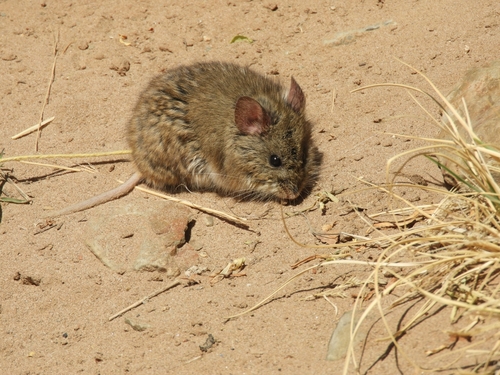
Dense, soft fur typically grayish-brown to brownish-gray dorsally, with a paler or grayish-white ventral surface. The body is stocky and cylindrical, with a blunt head, small eyes, and relatively small, rounded ears. The short tail is sparsely furred.
Size
Body length approximately 14–20 cm; tail relatively short, typically 4–7 cm. Overall body size is comparable to other Aconaemys species.
Weight
Estimated 80–150 g, consistent with related octodontid rodents; sex-specific weight data are not available.
Distinctive features
Distinguished from the closely related Aconaemys fuscus by subtle cranial and dental morphology, and from Aconaemys porteri by geographic range. Genetic and morphometric studies may be needed to reliably differentiate species in the field.
Behaviour and diet of the Sage's Rock Rat
Likely semi-colonial or loosely social, similar to other rock rats in the genus, which are known to live in small family groups sharing burrow systems under rock piles or roots.
When it is active
Presumed to be primarily crepuscular or nocturnal, with activity peaks at dawn and dusk, as observed in related Aconaemys species.
Diet
Strictly herbivorous. Diet likely consists of grasses (especially coiron, Festuca spp.), forbs, seeds, leaves, and shoots of native Andean shrubs and herbs available near rocky habitats.
Communication
Likely uses high-pitched vocalizations, scent marking via urine and glandular secretions, and vibrational signals through substrate-thumping, as documented in related octodontid species.
Interactions with other species
Likely preyed upon by Andean foxes (Lycalopex culpaeus), owls (e.g., Bubo magellanicus), and snakes. May compete with sympatric small rodents such as Phyllotis and Eligmodontia species for food resources.
Role in its ecosystem
As an herbivore, it likely contributes to seed dispersal and vegetation cycling in Andean shrublands. Burrowing activity may also aerate soil and influence local plant community structure.
Reproduction and lifecycle
Reproductive details are poorly documented. Related species have litters of 2–4 young, with breeding likely occurring in the austral spring and summer (October–February). Gestation period is estimated at around 90–100 days based on congeners.
Raising the young
As with other octodontids, females likely provide primary parental care, nursing young in the burrow system. Young are probably weaned after several weeks and reach independence relatively quickly.
Maturity and lifespan
Sexual maturity likely reached at 3–5 months of age, consistent with related octodontids. Wild lifespan is unknown; captive octodontids of similar size typically live 3–6 years.
Taxonomy and naming of the Sage's Rock Rat
Classification
Mammalia > Rodentia > Octodontidae > Aconaemys > Aconaemys sagei
What research says
Recent studies
The species remains very poorly studied. Recent Andean small mammal surveys in Patagonia have occasionally recorded it, but no dedicated ecological or genetic studies have been published as of 2024.
Genome and DNA
No published genomic or karyotypic data specific to Aconaemys sagei are available. The genus Aconaemys has 2n=56 chromosomes documented in some members, but this has not been confirmed for this species.
Compared with similar species
Most closely related to Aconaemys fuscus and Aconaemys porteri within the genus. All three share similar body plans and rocky Andean habitats but differ in geographic range, with A. sagei occupying the most southern and eastern distribution among the three.
The Sage's Rock Rat and people
Sage's Rock Rat is named in honor of naturalist John D. Sage and was only formally described in 1984, making it one of the more recently recognized rodent species of the Andes. Despite its small body size, it thrives in some of the harshest Andean terrain, navigating boulder fields and steep rocky slopes with ease. Its entire known range is so restricted that a single major volcanic eruption or severe drought could theoretically affect the majority of its global population.
Where and how to see it
Best sought in rocky outcrops and boulder fields in the Patagonian Andes of Neuquén province, Argentina, particularly around Lanín and Nahuel Huapi national parks. Crepuscular hours at dusk and dawn offer the highest chance of sighting. Patience near rocky refugia with visible runways or droppings is the most effective strategy.
Risks to humans
No notable risk to humans. This small rodent is not aggressive and poses no significant threat.
Countries where the Sage's Rock Rat is recorded
The 2 countries named in the range description of its IUCN Red List assessment.
Questions about the Sage's Rock Rat
Where does the Sage's Rock Rat live?
The Sage's Rock Rat is recorded in Argentina and Chile across South America. These countries come from the range description of its IUCN Red List assessment, and they are what place the species on the interactive map.
Is the Sage's Rock Rat endangered?
The IUCN Red List assesses the Sage's Rock Rat as Data Deficient. There is not enough information to judge the risk of extinction, usually because the species is rarely seen or has never been surveyed. It is not a reassuring category: several species were Data Deficient right up to the point they were found to be Critically Endangered.
How many are left in the wild?
Unknown; no reliable population estimate exists. This figure comes from the species assessment on the IUCN Red List; population estimates for wild mammals are ranges, not counts, and are revised at each assessment.
What habitat does the Sage's Rock Rat live in?
Rocky scrublands, Andean steppe, and shrubby grasslands (mallines and coiron grasslands) in the temperate Andes.
What is the scientific name of the Sage's Rock Rat?
The Sage's Rock Rat is Aconaemys sagei, in the family Octodontidae, order Rodentia.
Other species in the genus Aconaemys
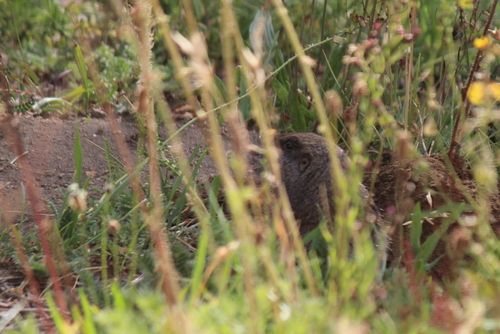
Species that share its range
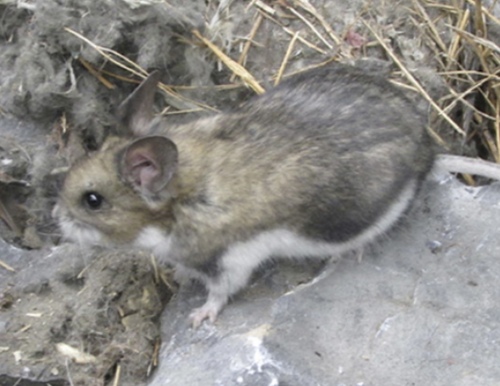
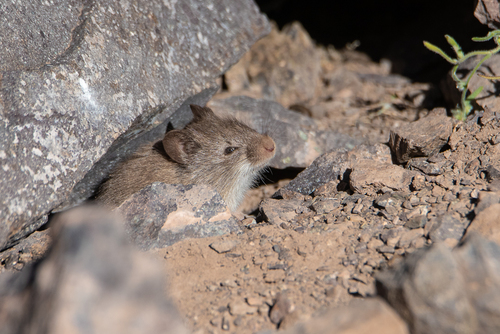
Sources
Conservation status, range description and population estimate come from the IUCN Red List assessment for Aconaemys sagei. Countries are derived from that range description, not from a mapped country list. Last refreshed on .
The distribution map is drawn from the IUCN Red List spatial data compiled in 2016. IUCN SSC Small Mammal Specialist Group