
Chilean Rock Rat
Aconaemys fuscus
Red List assessment
Least Concernon the IUCN Red List
- EXExtinct
- EWExtinct in the Wild
- CRCritically Endangered
- ENEndangered
- VUVulnerable
- NTNear Threatened
- LCLeast Concern
The Chilean Rock Rat is recorded in 2 countries across South America. The IUCN Red List assesses the Chilean Rock Rat as Least Concern. No precise global population estimate is available.
- Family
- Octodontidae
- Order
- Rodentia
- Genus
- Aconaemys
- Countries recorded
- 2
- Continents
- South America
- Red List category
- Least Concern
- Data updated
- August 9, 2026
What is the Chilean Rock Rat?
The Chilean Rock Rat (Aconaemys fuscus) is a small, robust fossorial rodent belonging to the family Octodontidae, which also includes the well-known degu. It inhabits rocky Andean slopes, scrublands, and forest edges of central Chile, where it shelters in rock crevices and burrow systems. It is the most widespread and common representative of the genus Aconaemys. Its semi-fossorial lifestyle and tolerance of a range of vegetation types contribute to its relative success across its range.
Where does the Chilean Rock Rat live?
Central Chile; also found in adjacent Andean foothills of Argentina
Restricted to central Chile, ranging roughly from the Coquimbo Region (~30°S) south to the Araucanía Region (~40°S), primarily along the Andean Cordillera and its foothills, as well as parts of the coastal mountain range. Marginal populations may occur in adjacent western Argentina.
Altitude and depth
Typically found between approximately 500 m and 2,500 m above sea level in Andean and pre-Andean zones; most records are concentrated between 1,000 m and 2,000 m.
Seasonal movements
No long-distance seasonal migration is known. The species likely reduces surface activity during the coldest winter months but does not appear to undergo true hibernation. Breeding activity increases in austral spring and summer.
Habitat of the Chilean Rock Rat
Primary habitats include rocky outcrops, Andean shrublands (matorral), forest edges dominated by native Chilean sclerophyllous vegetation, and areas of mixed shrub-grassland with abundant rocky substrate. The species shows a strong association with boulders and rocky terrain that provide shelter from predators.
Adaptations to its environment
The Chilean Rock Rat has a compact, muscular body well suited to navigating rocky terrain and narrow burrow passages. Its dense, dark fur provides insulation against cold Andean temperatures. Strong claws and forelimbs facilitate digging and clambering over rocks. Behavioral adaptation includes colonial living, which improves predator detection and thermal regulation.
Conservation status and numbers
Least Concern (LC) on the IUCN Red List. The population is considered relatively stable with no major range-wide decline currently documented. It has a sufficiently broad distribution and tolerates a range of habitat conditions, which supports its LC assessment.
Estimated population
No precise global population estimate is available. The species is considered locally common within suitable habitats; population trend is presumed stable.
What threatens the Chilean Rock Rat?
Habitat loss due to agricultural expansion, livestock grazing (which degrades native shrubland and rocky habitats), and urban development in the Andean foothills represent the primary threats. Predation pressure from introduced species (domestic cats, foxes) and climate-driven changes in Andean snowpack and vegetation composition may pose emerging risks.
Diseases and parasites
Specific parasites of A. fuscus have not been extensively studied. Like other Chilean rodents, it may host hantaviruses, ectoparasites (fleas, mites, ticks), and intestinal helminths, though no confirmed outbreaks have been documented for this species.
What is being done to protect it?
The species occurs within several Chilean national parks and protected areas, including Radal Siete Tazas and portions of the Andes protected corridor. Chile's general wildlife protection legislation (Ley de Caza, Ley 19.473) provides baseline protection against direct take.
Recommended actions
Long-term population monitoring across its range is needed to detect any future declines. Protection and restoration of native shrubland and rocky habitats in central Chile, along with control of invasive predators in key areas, are recommended priority actions.
What the Chilean Rock Rat looks like
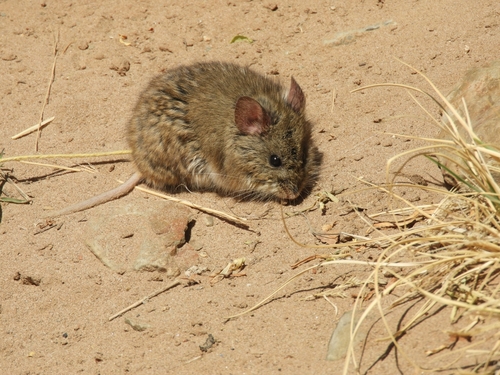
The dorsal fur is dark grayish-brown to fuscous (dusky brown), giving rise to both the common and scientific names. The ventral surface is paler, often grayish-white. The body is stocky with a rounded head, small rounded ears, relatively short limbs, and a short, scarcely haired tail.
Size
Head-body length approximately 14–20 cm; tail length relatively short, roughly 5–9 cm. Overall body form is compact and robust.
Weight
Typically 80–180 g; no strong sexual size dimorphism has been reported, though males may be marginally heavier.
Distinctive features
Distinguished from its congener Aconaemys porteri by its larger size and darker, more uniformly dusky dorsal coloration. Compared to Aconaemys sagei, A. fuscus has a broader geographic distribution and occupies lower-elevation habitats. The short tail and robust body differentiate it from sympatric sigmodontine rodents.
Differences between males and females
Sexual dimorphism is minimal. Males and females are similar in size and coloration; no significant external differences have been described in the literature.
Behaviour and diet of the Chilean Rock Rat
The species is reported to be semi-colonial, living in loose groups centered on shared burrow systems or rock crevice shelters. Social interactions within groups include mutual grooming and alarm calling. Group sizes appear to be small (typically fewer than 10 individuals).
When it is active
Primarily diurnal and crepuscular, with peak foraging activity during morning and late afternoon hours. Activity may shift to avoid the hottest midday temperatures during summer.
Diet
Strictly herbivorous. Diet consists of roots, bulbs, rhizomes, grasses, forbs, seeds, and the bark and leaves of native shrubs available in its rocky shrubland habitat. Food caching behavior may occur, though this has not been well documented.
Communication
Uses vocalizations for alarm and social coordination, including short squeaks and chattering sounds. Scent marking via anogenital glands likely plays a role in territory and social signaling, as in related octodontids. Tactile communication through contact and grooming is observed in group members.
Interactions with other species
Natural predators include raptors (e.g., Buteo spp., Geranoaetus melanoleucus), Andean foxes (Lycalopex culpaeus), and various snake species. The species competes with other small rodents for plant food resources. It may share burrow structures or rocky refuges with other small mammals in its community.
Role in its ecosystem
As an herbivore, A. fuscus contributes to seed dispersal and influences vegetation structure through selective feeding. Its burrowing activity aerates soil and modifies microhabitat. It constitutes an important prey item in Andean food webs, supporting raptor and carnivore populations.
Reproduction and lifecycle
Breeding season coincides with austral spring and summer (October–February). Gestation is estimated at approximately 90–100 days, consistent with other octodontids. Litter sizes are typically 1–3 offspring (precocial young, characteristic of the family Octodontidae).
Raising the young
Young are born relatively precocial (eyes open, well-furred) as is typical for Octodontidae. Maternal care involves nursing and sheltering the young in burrows or rock crevices. The duration of parental care and any paternal involvement are not well documented for this species.
Maturity and lifespan
Sexual maturity is likely reached at 6–10 months, consistent with other octodontids. Lifespan in the wild is estimated at 2–4 years; captive longevity data for this species are limited.
Taxonomy and naming of the Chilean Rock Rat
Classification
Mammalia > Rodentia > Octodontidae > Aconaemys > Aconaemys fuscus (Waterhouse, 1842)
Scientific synonyms
Formerly placed under various generic arrangements; Mus fuscus Waterhouse, 1842 is the basionym. Sometimes referenced as the 'dark rock rat' in older literature.
What research says
Recent studies
Phylogeographic studies of Andean rodents have investigated the diversification of Aconaemys and its relatives across the Andes, highlighting the role of past glacial cycles in shaping current distribution patterns. Taxonomic revisions of the genus have refined species boundaries within Aconaemys in the early 21st century.
Genome and DNA
The diploid chromosome number for Aconaemys fuscus is reported as 2n = 56, consistent with several other members of the family Octodontidae. Detailed genomic studies are limited.
Compared with similar species
Aconaemys fuscus is most closely related to A. porteri (Porter's Rock Rat) and A. sagei (Sage's Rock Rat), which share the rocky Andean habitat but have more restricted distributions. All three share the stocky body plan and fossorial tendencies of the family Octodontidae. It differs from the better-known degu (Octodon degus) in its preference for rocky rather than open scrubland habitats and its more colonial social structure.
The Chilean Rock Rat and people
Like other octodontids, the Chilean Rock Rat is a precocial species—its newborns are born with eyes open, fully furred, and capable of moving shortly after birth, which is unusual among small rodents. The genus name Aconaemys derives from Greek words meaning 'without a shin' or alluding to the leg structure, reflecting the stocky limb proportions noticed by early taxonomists. Despite living in the shadow of the more famous degu, this species has inhabited Chilean rocky landscapes for millions of years and is a key indicator of Andean shrubland health.
Where and how to see it
Best observed in the Andean foothills of central Chile, particularly in protected areas such as Radal Siete Tazas National Reserve (Maule Region) and Altos de Lircay. Early morning and late afternoon are optimal viewing times. Observers should look carefully among boulder fields and rocky outcrops within native shrubland for movement along runways between rocks.
Risks to humans
No notable risk to humans. Like all wild rodents, it may potentially carry zoonotic pathogens and should not be handled without appropriate precautions.
Countries where the Chilean Rock Rat is recorded
The 2 countries named in the range description of its IUCN Red List assessment.
Questions about the Chilean Rock Rat
Where does the Chilean Rock Rat live?
The Chilean Rock Rat is recorded in Argentina and Chile across South America. These countries come from the range description of its IUCN Red List assessment, and they are what place the species on the interactive map.
Is the Chilean Rock Rat endangered?
The IUCN Red List assesses the Chilean Rock Rat as Least Concern. The species is widespread and abundant enough not to qualify for any threatened category. It does not mean the species is safe forever, only that nothing in the current data raises an alarm.
How many are left in the wild?
No precise global population estimate is available. This figure comes from the species assessment on the IUCN Red List; population estimates for wild mammals are ranges, not counts, and are revised at each assessment.
What habitat does the Chilean Rock Rat live in?
Primary habitats include rocky outcrops, Andean shrublands (matorral), forest edges dominated by native Chilean sclerophyllous vegetation, and areas of mixed shrub-grassland with abundant rocky substrate.
What is the scientific name of the Chilean Rock Rat?
The Chilean Rock Rat is Aconaemys fuscus, in the family Octodontidae, order Rodentia.
Other species in the genus Aconaemys

Species that share its range
Sources
Conservation status, range description and population estimate come from the IUCN Red List assessment for Aconaemys fuscus. Countries are derived from that range description, not from a mapped country list. Last refreshed on .
The distribution map is drawn from the IUCN Red List spatial data compiled in 2016. IUCN SSC Small Mammal Specialist Group