
Russet Wrinkle-lipped Bat
Mops russatus
Red List assessment
Data Deficienton the IUCN Red List
- EXExtinct
- EWExtinct in the Wild
- CRCritically Endangered
- ENEndangered
- VUVulnerable
- NTNear Threatened
- LCLeast Concern
Data Deficient has no position on the scale above — it records the absence of an assessment, not a degree of risk.
The Russet Wrinkle-lipped Bat is recorded in 3 countries across Africa. The IUCN Red List records the Russet Wrinkle-lipped Bat as Data Deficient. Unknown; no reliable population estimates exist due to the species' rarity in survey records and taxonomic confusion with related Mops species.
- Family
- Molossidae
- Order
- Chiroptera
- Genus
- Mops
- Countries recorded
- 3
- Continents
- Africa
- Red List category
- Data Deficient
- Data updated
- August 9, 2026
What is the Russet Wrinkle-lipped Bat?
Mops russatus is a small free-tailed bat endemic to the forested regions of West Africa, notable for its russet-brown fur and characteristic wrinkled lips typical of molossid bats. It is a poorly studied species classified as Data Deficient due to limited records and taxonomic uncertainty. Its known range centers on the Upper Guinea forest ecosystem of Ivory Coast and Ghana.
Where does the Russet Wrinkle-lipped Bat live?
West Africa, primarily Ivory Coast, Ghana, and surrounding forested regions of the Upper Guinea forest block
Known distribution is restricted to parts of West Africa, with confirmed records from Ivory Coast and Ghana within the Upper Guinea forest region; the full extent of its range remains uncertain due to sparse survey data.
Altitude and depth
Lowland habitats, typically below 500 meters elevation
Seasonal movements
No documented seasonal migration; likely exhibits some behavioral changes correlating with wet and dry season insect availability, though this is not well studied.
Habitat of the Russet Wrinkle-lipped Bat
Primarily found in lowland tropical rainforest and forest-edge habitats, often roosting in tree hollows, caves, or crevices in rocky outcrops. May also utilize secondary forest and forest fragments near human settlements.
Adaptations to its environment
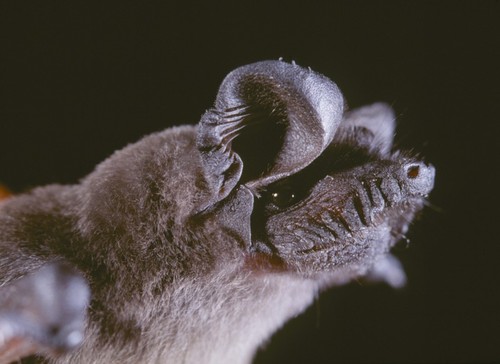
Possesses long narrow wings typical of molossids, enabling fast, high-altitude flight for aerial insectivory. Wrinkled lips and specialized dentition aid in capturing and processing flying insects; echolocation calls are adapted for open-air hunting above the forest canopy.
Conservation status and numbers
Listed as Data Deficient (DD) by the IUCN due to insufficient information on population size, distribution, and ecological requirements to assess extinction risk accurately.
Estimated population
Unknown; no reliable population estimates exist due to the species' rarity in survey records and taxonomic confusion with related Mops species.
What threatens the Russet Wrinkle-lipped Bat?
Habitat loss from deforestation, logging, and agricultural expansion in the Upper Guinea forest region poses a likely threat, though specific impacts on this species are not quantified.
What is being done to protect it?
No species-specific conservation programs exist; the species may benefit indirectly from protected areas within its range, such as Taï National Park in Ivory Coast.
Recommended actions
Increased field surveys and taxonomic clarification are urgently needed, along with habitat protection in the Upper Guinea forest hotspot and genetic studies to resolve species boundaries within the genus Mops.
What the Russet Wrinkle-lipped Bat looks like
Fur is reddish-brown to russet in color, giving the species its common name, with paler underparts. Like other molossids, it has a robust body, short broad wings, and a tail that extends beyond the interfemoral membrane.
Size
Forearm length approximately 35-40 mm; total body length estimated at 8-10 cm
Weight
Estimated 8-15 grams, consistent with similarly sized Mops species
Distinctive features
Distinguished from related Mops species primarily by its distinctive russet coloration and specific cranial and dental measurements noted in original taxonomic descriptions.
Behaviour and diet of the Russet Wrinkle-lipped Bat
Likely colonial, roosting in small to moderate-sized groups in tree hollows or rock crevices, consistent with social behavior observed in related molossid bats.
When it is active
Nocturnal, emerging at dusk to forage for flying insects
Diet
Insectivorous, feeding on a variety of flying insects such as moths, beetles, and other nocturnal insects typical of forest and forest-edge environments
How it feeds and hunts
Uses echolocation to detect and capture flying insects in open airspace above or near the forest canopy, employing fast, agile flight typical of free-tailed bats.
Communication
Likely uses echolocation calls for navigation and prey detection, along with social vocalizations for roost-mate communication, though acoustic studies specific to this species are limited.
Interactions with other species
May co-roost or compete for insect prey with other sympatric molossid and insectivorous bat species in West African forests; potential predators include owls and small carnivores.
Role in its ecosystem
Plays a role as an insectivorous predator, contributing to natural pest control within forest ecosystems by consuming large quantities of nocturnal flying insects.
Reproduction and lifecycle
Reproductive biology is poorly documented; likely follows a pattern similar to related molossids with possible seasonal breeding tied to insect abundance and a single pup per litter.
Raising the young
Presumed maternal care typical of bats, with females nursing a single pup until it is capable of flight and independent foraging, though specific data for this species is lacking.
Maturity and lifespan
Unknown specifically for this species; related molossid bats typically reach sexual maturity within the first year and may live 5-10 years in the wild.
Taxonomy and naming of the Russet Wrinkle-lipped Bat
Classification
Class Mammalia > Order Chiroptera > Family Molossidae > Genus Mops > Species Mops russatus
Scientific synonyms
Xiphonycteris russata (Allen, 1917)
What research says
Recent studies
Limited recent research exists; most knowledge stems from historical museum specimens and taxonomic revisions of the genus Mops in West Africa.
Compared with similar species
Similar in general appearance to other West African Mops species such as Mops thersites and Mops nanulus, but distinguished by its russet fur coloration and specific morphometric traits used in original species descriptions.
The Russet Wrinkle-lipped Bat and people
This bat's reddish fur color, unusual among many drab-colored molossids, likely inspired both its common and scientific names ('russatus' meaning reddish in Latin). It remains one of the least-studied bat species in West Africa, known mainly from a handful of museum specimens.
Where and how to see it
Best observed at dusk near forest edges or roosting sites in protected areas like Taï National Park in Ivory Coast; specialized bat detectors are recommended to identify its echolocation calls given its cryptic nature.
Risks to humans
No notable risk to humans
Countries where the Russet Wrinkle-lipped Bat is recorded
The 3 countries named in the range description of its IUCN Red List assessment.
Questions about the Russet Wrinkle-lipped Bat
Where does the Russet Wrinkle-lipped Bat live?
The Russet Wrinkle-lipped Bat is recorded in Ghana, Guinea and Ivory Coast across Africa. These countries come from the range description of its IUCN Red List assessment, and they are what place the species on the interactive map.
Is the Russet Wrinkle-lipped Bat endangered?
The IUCN Red List assesses the Russet Wrinkle-lipped Bat as Data Deficient. There is not enough information to judge the risk of extinction, usually because the species is rarely seen or has never been surveyed. It is not a reassuring category: several species were Data Deficient right up to the point they were found to be Critically Endangered.
How many are left in the wild?
Unknown; no reliable population estimates exist due to the species' rarity in survey records and taxonomic confusion with related Mops species. This figure comes from the species assessment on the IUCN Red List; population estimates for wild mammals are ranges, not counts, and are revised at each assessment.
What habitat does the Russet Wrinkle-lipped Bat live in?
Primarily found in lowland tropical rainforest and forest-edge habitats, often roosting in tree hollows, caves, or crevices in rocky outcrops.
What is the scientific name of the Russet Wrinkle-lipped Bat?
The Russet Wrinkle-lipped Bat is Mops russatus, in the family Molossidae, order Chiroptera.
Other species in the genus Mops

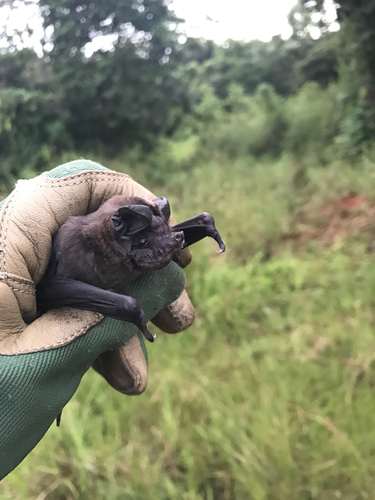
Other species in the family Molossidae
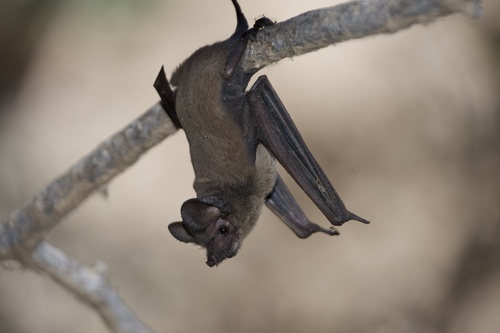

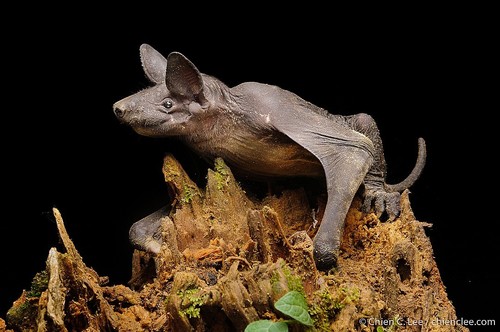
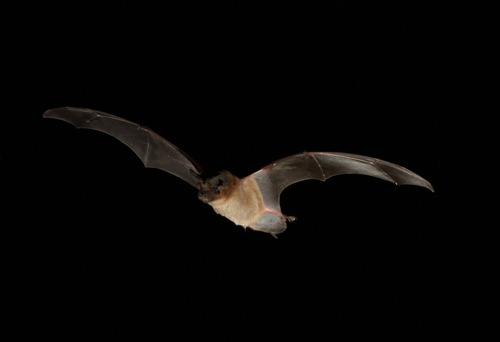
Sources
Conservation status, range description and population estimate come from the IUCN Red List assessment for Mops russatus. Countries are derived from that range description, not from a mapped country list. Last refreshed on .
The distribution map is drawn from the IUCN Red List spatial data compiled in 2019. IUCN (International Union for Conservation of Nature)