
Riverine Rabbit
Bunolagus monticularis
Red List assessment
Critically Endangeredon the IUCN Red List
- EXExtinct
- EWExtinct in the Wild
- CRCritically Endangered
- ENEndangered
- VUVulnerable
- NTNear Threatened
- LCLeast Concern
The Riverine Rabbit is recorded in one country, South Africa across Africa. The IUCN Red List assesses the Riverine Rabbit as Critically Endangered. Estimated fewer than 500 mature individuals remaining in the wild, with a declining population trend.
- Family
- Leporidae
- Order
- Lagomorpha
- Genus
- Bunolagus
- Countries recorded
- 1
- Continents
- Africa
- Red List category
- Critically Endangered
- Data updated
- August 9, 2026
What is the Riverine Rabbit?
The Riverine Rabbit is one of the most endangered mammals in the world, endemic to the seasonal riverine scrub of South Africa's Karoo region. It is a distinctive, medium-sized rabbit with a slender build adapted to dense vegetation along ephemeral rivers. Its extreme habitat specificity and low reproductive rate make it highly vulnerable to habitat loss. Discovered relatively late by science and rarely seen, it remains one of Africa's least-known mammals.
Where does the Riverine Rabbit live?
South Africa (Karoo region, Western Cape, Northern Cape, and Free State provinces)
Endemic to South Africa, found in narrow strips along seasonal rivers in the Karoo, spanning parts of the Western Cape, Northern Cape, and Free State provinces. Total occupied habitat is estimated at less than a few hundred square kilometers, highly fragmented.
Altitude and depth
Approximately 400-1000 meters above sea level
Seasonal movements
No migration; breeding activity may increase slightly during warmer, wetter months, but the species is largely non-migratory and active year-round.
Habitat of the Riverine Rabbit
Restricted to dense riparian scrub vegetation, particularly stands of Salsola and other shrubs growing along seasonal, sandy-bottomed rivers in semi-arid Karoo landscapes. Requires deep, alluvial soils for digging breeding burrows. Habitat is naturally fragmented and extremely limited in extent.
Adaptations to its environment
Long limbs and slender body allow efficient movement through dense riverine scrub. Its coloration provides camouflage against sandy soils and shadowed vegetation. Solitary, cryptic behavior reduces predation risk in an open, exposed semi-desert landscape.
Conservation status and numbers
Critically Endangered (IUCN) due to an extremely restricted and fragmented range, ongoing habitat destruction for agriculture, and a naturally low reproductive rate. Population continues to decline despite conservation interventions.
Estimated population
Estimated fewer than 500 mature individuals remaining in the wild, with a declining population trend.
What threatens the Riverine Rabbit?
Habitat destruction from agricultural expansion (especially irrigation and crop cultivation along riverbanks), livestock grazing degrading riparian vegetation, road mortality, and predation by domestic and feral animals.
Diseases and parasites
Specific disease data is limited, but like other lagomorphs it may be susceptible to myxomatosis-related viruses and internal parasites, though no major outbreaks have been documented in wild populations.
What is being done to protect it?
Conservation programs led by the Endangered Wildlife Trust include habitat protection, landowner engagement, captive breeding research, and establishment of conservancies in the Karoo. Some populations occur within protected reserves and private land under conservation agreements.
Recommended actions
Expand protected riparian habitat corridors, incentivize sustainable land-use practices among farmers, control invasive predators, and continue genetic and ecological monitoring to guide targeted conservation.
What the Riverine Rabbit looks like
Grayish-brown fur with a distinctive black stripe running along the lower jaw to the neck, and a woolly, soft coat. The tail is dark and relatively short, and the ears are long compared to body size.
Size
Body length approximately 33-47 cm
Weight
Approximately 1-1.8 kg
Distinctive features
The black stripe on the cheek and the fluffy tail distinguish it from other African hares and rabbits; it also has a more slender, elongated body shape adapted to dense scrub movement.
Differences between males and females
Minimal external dimorphism; females may be slightly larger than males, but coloration and size differences are not pronounced.
Behaviour and diet of the Riverine Rabbit
Primarily solitary and territorial, with individuals maintaining separate home ranges along river systems; direct social interactions are rare outside of breeding.
When it is active
Primarily nocturnal and crepuscular, resting in burrows or dense vegetation during the day and foraging at dusk and throughout the night.
Diet
Herbivorous, feeding on a variety of Karoo shrubs, grasses, and riverine vegetation; diet shifts seasonally based on availability of green forage versus dry-season shrubs.
Communication
Communication is not well studied but likely includes scent marking of territory and subtle body postures typical of solitary lagomorphs; vocalizations are minimal.
Interactions with other species
Preyed upon by native predators such as caracals, jackals, and birds of prey, as well as domestic dogs and cats near farmland; competes indirectly with livestock for riparian forage.
Role in its ecosystem
Plays a role as a herbivore within the fragile Karoo riverine ecosystem, contributing to seed dispersal and vegetation dynamics in a habitat type that is itself ecologically important and increasingly rare.
Reproduction and lifecycle
Breeding can occur throughout the year but peaks after rains; gestation lasts about a month, with typically only one or two altricial young born per litter, an unusually small litter size for a lagomorph.
Raising the young
Females dig shallow nesting burrows called 'stops' where young are kept hidden and visited briefly for nursing, minimizing scent trails to avoid predators; parental care is limited to females.
Maturity and lifespan
Sexual maturity is reached at around 6-8 months; lifespan in the wild is estimated at up to 3-4 years, with limited data from captivity.
Taxonomy and naming of the Riverine Rabbit
Classification
Class Mammalia > Order Lagomorpha > Family Leporidae > Genus Bunolagus > Species Bunolagus monticularis
Scientific synonyms
Lepus monticularis (original combination)
What research says
Recent studies
Recent studies have used camera trapping and genetic sampling to refine population estimates and habitat use, revealing even more fragmented distribution than previously thought and highlighting the urgency of corridor protection.
Compared with similar species
Compared to the more widespread Cape hare (Lepus capensis) or scrub hare (Lepus saxatilis), the Riverine Rabbit is smaller, more secretive, and far more habitat-restricted, relying exclusively on riverine scrub rather than open grassland.
The Riverine Rabbit and people
The Riverine Rabbit was not formally described until 1903 and remained one of the least-studied mammals for decades due to its elusive nature. It has one of the lowest reproductive rates of any rabbit species, producing only one or two young per litter rather than large broods.
Where and how to see it
Best observed at dusk or dawn along protected riverine scrub habitats in the Karoo, particularly within conservancies working with the Endangered Wildlife Trust; sightings are rare and require patience and knowledgeable local guides.
Risks to humans
No notable risk to humans.
Countries where the Riverine Rabbit is recorded
The 1 countries named in the range description of its IUCN Red List assessment.
Questions about the Riverine Rabbit
Where does the Riverine Rabbit live?
The Riverine Rabbit is recorded in South Africa across Africa. These countries come from the range description of its IUCN Red List assessment, and they are what place the species on the interactive map.
Is the Riverine Rabbit endangered?
Yes. The IUCN Red List assesses the Riverine Rabbit as Critically Endangered, one of the three threatened categories. The species faces an extremely high risk of extinction in the wild. This is the last category before extinction, and it is reached through a very small or steeply declining population, a tiny range, or both.
How many are left in the wild?
Estimated fewer than 500 mature individuals remaining in the wild, with a declining population trend. This figure comes from the species assessment on the IUCN Red List; population estimates for wild mammals are ranges, not counts, and are revised at each assessment.
What habitat does the Riverine Rabbit live in?
Restricted to dense riparian scrub vegetation, particularly stands of Salsola and other shrubs growing along seasonal, sandy-bottomed rivers in semi-arid Karoo landscapes.
What is the scientific name of the Riverine Rabbit?
The Riverine Rabbit is Bunolagus monticularis, in the family Leporidae, order Lagomorpha.
Other species in the family Leporidae
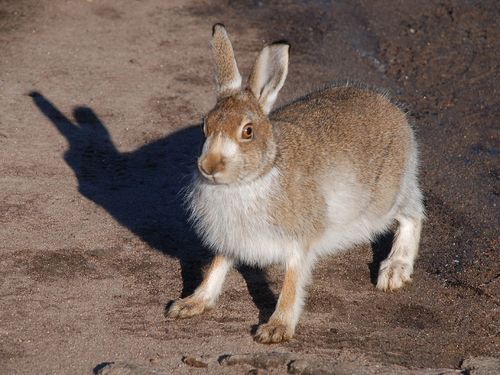
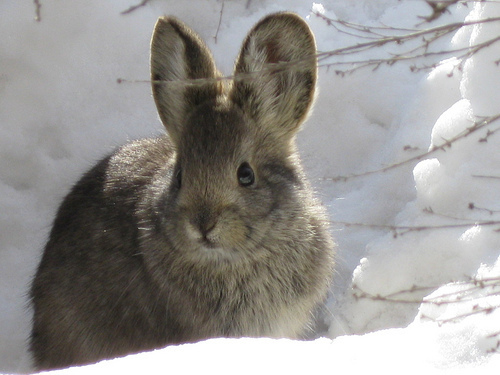
Species that share its range
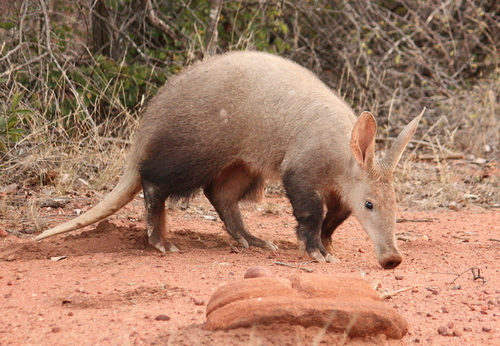
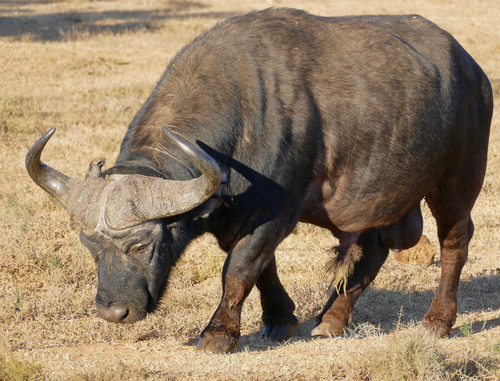
Sources
Conservation status, range description and population estimate come from the IUCN Red List assessment for Bunolagus monticularis. Countries are derived from that range description, not from a mapped country list. Last refreshed on .
The distribution map is drawn from the IUCN Red List spatial data compiled in 2018. IUCN (International Union for Conservation of Nature)