
Arctic Hare
Lepus arcticus
Red List assessment
Least Concernon the IUCN Red List
- EXExtinct
- EWExtinct in the Wild
- CRCritically Endangered
- ENEndangered
- VUVulnerable
- NTNear Threatened
- LCLeast Concern
The Arctic Hare is recorded in 2 countries across North America. The IUCN Red List assesses the Arctic Hare as Least Concern. Population size is not precisely quantified but believed to be large and stable across its extensive range, with some regional fluctuations.
- Family
- Leporidae
- Order
- Lagomorpha
- Genus
- Lepus
- Countries recorded
- 2
- Continents
- North America
- Red List category
- Least Concern
- Data updated
- August 9, 2026
What is the Arctic Hare?
The Arctic Hare is a large lagomorph superbly adapted to life in the harsh Arctic tundra of North America and Greenland. It is known for its thick white winter coat, powerful hind legs, and ability to survive extreme cold. Remarkable for forming large aggregations in some regions and for its speed, reaching up to 60 km/h when fleeing predators.
Where does the Arctic Hare live?
Canadian Arctic islands, Greenland, and northern mainland Canada
Found across the Canadian Arctic Archipelago, northern Quebec and Labrador, Newfoundland, and Greenland; range extends from the high Arctic islands south to the northern boreal treeline.
Altitude and depth
Sea level to approximately 900m, generally in flat or rolling tundra terrain
Seasonal movements
Molts seasonally, turning white in winter and grayish-brown in summer (except in far northern populations which may remain white year-round); does not hibernate and remains active through winter.
Habitat of the Arctic Hare
Arctic tundra, rocky barrens, and polar desert with sparse vegetation; also found in coastal areas and low shrub tundra where food is more available.
Adaptations to its environment
Thick insulating fur, short ears and compact body to reduce heat loss, large furred feet for snow traction, and seasonal camouflage coloring; can dig shallow burrows or use rock crevices for shelter from wind.
Conservation status and numbers
Listed as Least Concern by IUCN due to a large range and stable overall population, though some localized populations face pressure from climate change.
Estimated population
Population size is not precisely quantified but believed to be large and stable across its extensive range, with some regional fluctuations.
What threatens the Arctic Hare?
Climate change altering snow cover and vegetation patterns, increased predation pressure from range-shifting species, and habitat disturbance from human development in some areas.
Diseases and parasites
Susceptible to various parasites including ticks, fleas, and internal parasites such as tapeworms and coccidia, though specific disease impacts are not well documented.
What is being done to protect it?
Protected within various national parks and reserves across the Canadian Arctic and Greenland; monitored as part of broader Arctic biodiversity and climate change research programs.
Recommended actions
Continued monitoring of population trends in relation to climate change, protection of critical tundra habitat, and research into subspecies taxonomy and range shifts.
What the Arctic Hare looks like
Thick white fur in winter (grayish in some southern populations in summer), black-tipped ears, large hind feet, and a compact rounded body shape adapted to cold retention.
Size
Body length 43-70 cm, with males typically slightly smaller than females
Weight
2.5-5.5 kg, with females generally slightly heavier than males
Distinctive features
Distinguished from other hares by its stockier build, shorter ears, and pure white winter coat; often stands upright on hind legs like a small kangaroo, a distinctive posture among hares.
Differences between males and females
Minimal visual dimorphism; females are typically slightly larger and heavier than males but coloration and general appearance are similar.
Behaviour and diet of the Arctic Hare
Can be solitary or form large groups of dozens to over 100 individuals, especially in open tundra areas, likely for predator vigilance and thermoregulation.
When it is active
Primarily crepuscular and diurnal, though activity patterns shift with the extreme seasonal daylight changes of the Arctic (24-hour daylight in summer, darkness in winter).
Diet
Herbivorous, feeding on woody plants, roots, buds, mosses, lichens, and berries; will dig through snow to access buried vegetation in winter.
Communication
Communicates through body postures, thumping hind feet as an alarm signal, and scent marking; visual cues such as ear position are important in social groups.
Interactions with other species
Preyed upon by Arctic foxes, gray wolves, snowy owls, and golden eagles; competes with other herbivores like caribou and lemmings for limited tundra vegetation.
Role in its ecosystem
Serves as an important prey species supporting Arctic predators and helps shape vegetation dynamics through grazing on tundra plants.
Reproduction and lifecycle
Breeding occurs in spring (April-May), with a gestation period of about 50 days; litters typically contain 2-8 leverets, born fully furred and relatively mobile.
Raising the young
Females provide most care, nursing leverets for about 8-9 weeks; young are precocial and become independent relatively quickly compared to altricial mammals.
Maturity and lifespan
Reaches sexual maturity around 1 year of age; lifespan in the wild is typically 3-5 years, though some individuals may live longer.
Taxonomy and naming of the Arctic Hare
Classification
Class Mammalia > Order Lagomorpha > Family Leporidae > Genus Lepus > Species Lepus arcticus
Subspecies
Lepus arcticus arcticus (northern Canadian Arctic and Greenland), Lepus arcticus bangsii (Newfoundland and Labrador), Lepus arcticus monstrabilis (Melville Peninsula) - taxonomy debated with some considering these separate species
Scientific synonyms
Lepus groenlandicus (formerly used for Greenland populations, now considered synonymous or a subspecies)
What research says
Recent studies
Recent research has focused on hybridization zones with snowshoe hares in areas of range overlap and on how climate change is affecting coat color mismatch during shortened snow seasons.
Genome and DNA
Diploid chromosome number of 2n=48, consistent with other Lepus species; genetic studies have helped clarify subspecies relationships and divergence from other Arctic-adapted hares.
Compared with similar species
Similar to the mountain hare (Lepus timidus) and snowshoe hare (Lepus americanus) but larger, with a more compact body and shorter ears adapted to extreme cold; ranges do not typically overlap significantly with the mountain hare.
The Arctic Hare and people
Arctic Hares can run up to 60 km/h and often stand upright on their hind legs like a small kangaroo to survey their surroundings. Large groups of hundreds have been observed gathering together in open tundra, an unusual behavior for typically solitary lagomorphs.
Where and how to see it
Best observed in the Canadian Arctic islands such as Ellesmere Island during the summer months (June-August) when hares are active and easier to spot against non-snow terrain; early morning or evening light offers optimal viewing.
Risks to humans
No notable risk to humans
Human uses
Historically hunted by Inuit and other Arctic peoples for meat and fur, used for clothing and food; continues to have minor subsistence hunting importance in some northern communities.
Myths and legends
Featured in some Inuit folklore and traditional stories as a symbol of speed and adaptability to the harsh Arctic environment, though specific detailed myths are not widely documented in mainstream sources.
Countries where the Arctic Hare is recorded
The 2 countries named in the range description of its IUCN Red List assessment.
Questions about the Arctic Hare
Where does the Arctic Hare live?
The Arctic Hare is recorded in Canada and Greenland across North America. These countries come from the range description of its IUCN Red List assessment, and they are what place the species on the interactive map.
Is the Arctic Hare endangered?
The IUCN Red List assesses the Arctic Hare as Least Concern. The species is widespread and abundant enough not to qualify for any threatened category. It does not mean the species is safe forever, only that nothing in the current data raises an alarm.
How many are left in the wild?
Population size is not precisely quantified but believed to be large and stable across its extensive range, with some regional fluctuations. This figure comes from the species assessment on the IUCN Red List; population estimates for wild mammals are ranges, not counts, and are revised at each assessment.
What habitat does the Arctic Hare live in?
Arctic tundra, rocky barrens, and polar desert with sparse vegetation; also found in coastal areas and low shrub tundra where food is more available.
What is the scientific name of the Arctic Hare?
The Arctic Hare is Lepus arcticus, in the family Leporidae, order Lagomorpha.
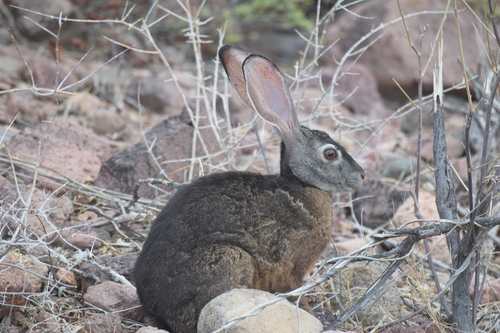
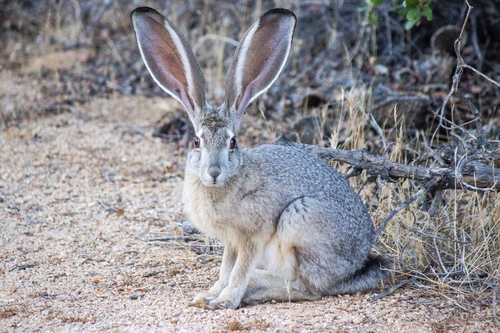
Other species in the genus Lepus
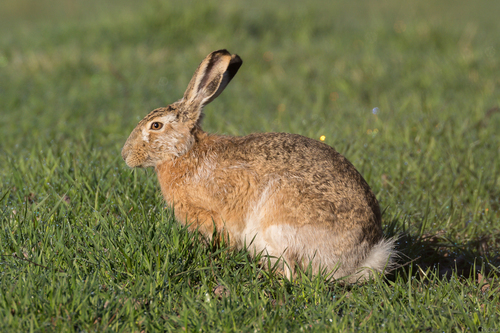
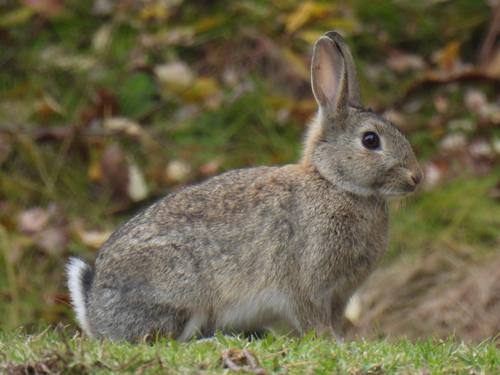
Other species in the family Leporidae
Sources
Conservation status, range description and population estimate come from the IUCN Red List assessment for Lepus arcticus. Countries are derived from that range description, not from a mapped country list. Last refreshed on .
The distribution map is drawn from the IUCN Red List spatial data compiled in 2019. IUCN (International Union for Conservation of Nature)