
Przewalski's Jird
Brachiones przewalskii
Red List assessment
Least Concernon the IUCN Red List
- EXExtinct
- EWExtinct in the Wild
- CRCritically Endangered
- ENEndangered
- VUVulnerable
- NTNear Threatened
- LCLeast Concern
The Przewalski's Jird is recorded in 2 countries across Asia. The IUCN Red List assesses the Przewalski's Jird as Least Concern. No precise global population estimate exists; considered common to locally abundant within suitable habitat, with a presumed stable trend
- Family
- Muridae
- Order
- Rodentia
- Genus
- Brachiones
- Countries recorded
- 2
- Continents
- Asia
- Red List category
- Least Concern
- Data updated
- August 9, 2026
What is the Przewalski's Jird?
Przewalski's Jird is a small desert-dwelling rodent endemic to the arid regions of northwestern China and southern Mongolia. It is a specialized burrowing gerbil-like rodent adapted to extreme desert conditions, notable for its distinctive hairy soles that aid locomotion on loose sand. It is the sole species in its genus, making it taxonomically unique among jirds.
Where does the Przewalski's Jird live?
Northwestern China and southern Mongolia, primarily in the Gobi and adjacent desert regions
Found in the Gobi Desert spanning northwestern China (Gansu, Xinjiang, Inner Mongolia, Ningxia) and extending into southern Mongolia. Range is patchy, following suitable sandy desert habitat.
Altitude and depth
Typically found at elevations between 900-1500m in desert basins
Seasonal movements
Reduces surface activity during the coldest winter months and may enter a state of torpor; breeding activity peaks in spring and summer months
Habitat of the Przewalski's Jird
Inhabits sandy and gravel deserts, semi-desert steppe, and areas with sparse xerophytic vegetation such as saxaul shrubland. Prefers loose, sandy substrates suitable for burrowing.
Adaptations to its environment
Possesses densely furred soles on its hind feet, an unusual trait among jirds, which aids in traction on loose sand and may provide insulation from hot substrate. Nocturnal habits and efficient kidneys reduce water loss in the arid environment, and burrowing behavior provides thermal refuge from extreme desert temperatures.
Conservation status and numbers
Listed as Least Concern by IUCN due to its relatively wide distribution across suitable desert habitat in China and Mongolia and presumed stable population, though localized data are limited.
Estimated population
No precise global population estimate exists; considered common to locally abundant within suitable habitat, with a presumed stable trend
What threatens the Przewalski's Jird?
Habitat degradation from overgrazing by livestock, desertification processes altering vegetation cover, and potential impacts from agricultural expansion in marginal desert areas
Diseases and parasites
Susceptible to fleas and other ectoparasites common to desert rodents, which may play a role in local plague (Yersinia pestis) cycles in Central Asian deserts
What is being done to protect it?
No species-specific conservation programs are known; benefits indirectly from protected desert areas and nature reserves within its range in China and Mongolia
Recommended actions
Continued monitoring of population trends, habitat protection in key desert ecosystems, and further taxonomic and ecological research to clarify subspecies status and distribution limits
What the Przewalski's Jird looks like
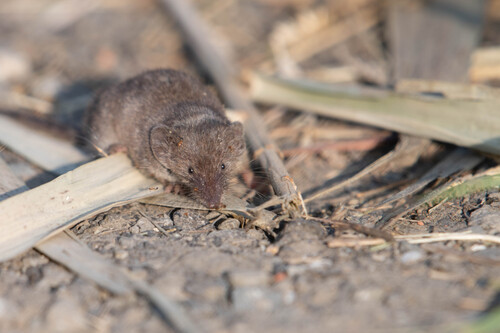
Sandy-brown to pale grayish dorsal fur that provides camouflage against desert substrates, with a whitish or cream-colored underside. It has large eyes suited for nocturnal activity and a moderately long, sparsely-haired tail.
Size
Head-body length approximately 9-12 cm, with a tail of similar or slightly shorter length
Weight
Approximately 20-35 grams
Distinctive features
Distinguished from other jirds and gerbils by its uniquely hairy foot soles (most jirds have naked soles), a trait that led to its placement in a separate monotypic genus, Brachiones.
Differences between males and females
Minimal sexual dimorphism; males and females are similar in size and coloration
Behaviour and diet of the Przewalski's Jird
Generally solitary or found in small family groups, occupying individual or shared burrow systems within loose colonial arrangements in favorable habitat patches
When it is active
Primarily nocturnal, emerging after dusk to forage and reducing surface activity during daytime heat
Diet
Herbivorous, feeding mainly on seeds, desert plant shoots, and vegetation such as saxaul and other xerophytic plants; may also consume some insects opportunistically
Communication
Likely uses a combination of vocalizations, foot-drumming (common in jirds and gerbils for alarm signaling), and scent marking via specialized glands to communicate with conspecifics
Interactions with other species
Preyed upon by desert-adapted raptors, foxes, and snakes; may compete with other small desert rodents for food and burrow resources
Role in its ecosystem
Plays a role in desert ecosystem as a seed disperser and prey species, and its burrowing activity contributes to soil aeration and turnover in arid substrates
Reproduction and lifecycle
Breeding occurs mainly in spring and summer, with females producing multiple litters per year; gestation lasts approximately 20-25 days, and litters typically contain 3-7 pups
Raising the young
Females provide primary care, nursing and protecting young within the burrow until weaning, which occurs at a few weeks of age
Maturity and lifespan
Sexual maturity likely reached within a few months; lifespan in the wild is estimated at 1-3 years, potentially longer in captivity
Taxonomy and naming of the Przewalski's Jird
Classification
Class Mammalia > Order Rodentia > Family Muridae > Genus Brachiones > Species Brachiones przewalskii
Subspecies
Several subspecies have been proposed (e.g., B. p. przewalskii, B. p. callaesomus, B. p. pratensis) distributed across different parts of the arid Gobi region, though taxonomic status of these forms remains debated
Scientific synonyms
Meriones przewalskii (original combination); genus Brachiones was later erected to separate this species from Meriones
What research says
Recent studies
Recent taxonomic studies have used molecular phylogenetics to confirm the distinct generic status of Brachiones relative to Meriones, clarifying its evolutionary relationships within the Gerbillinae subfamily
Compared with similar species
Similar in general body plan to other small jirds and gerbils (genus Meriones) but distinguished by hairy foot soles; smaller in size compared to larger jird species like the Mongolian jird (Meriones unguiculatus)
The Przewalski's Jird and people
Its hairy footpads are a rare adaptation among jirds and gerbils, functioning almost like natural 'snowshoes' for sand. It is named after the Russian explorer Nikolai Przhevalsky, who conducted extensive expeditions in Central Asia.
Where and how to see it
Best observed at night using red-light flashlights in sandy desert areas of the Gobi in China's Gansu or Inner Mongolia provinces, particularly around dusk when foraging activity begins
Risks to humans
No notable risk to humans directly, though as with many desert rodents, it may be a peripheral host in flea-borne disease cycles
Countries where the Przewalski's Jird is recorded
The 2 countries named in the range description of its IUCN Red List assessment.
Questions about the Przewalski's Jird
Where does the Przewalski's Jird live?
The Przewalski's Jird is recorded in China and Mongolia across Asia. These countries come from the range description of its IUCN Red List assessment, and they are what place the species on the interactive map.
Is the Przewalski's Jird endangered?
The IUCN Red List assesses the Przewalski's Jird as Least Concern. The species is widespread and abundant enough not to qualify for any threatened category. It does not mean the species is safe forever, only that nothing in the current data raises an alarm.
How many are left in the wild?
No precise global population estimate exists; considered common to locally abundant within suitable habitat, with a presumed stable trend This figure comes from the species assessment on the IUCN Red List; population estimates for wild mammals are ranges, not counts, and are revised at each assessment.
What habitat does the Przewalski's Jird live in?
Inhabits sandy and gravel deserts, semi-desert steppe, and areas with sparse xerophytic vegetation such as saxaul shrubland.
What is the scientific name of the Przewalski's Jird?
The Przewalski's Jird is Brachiones przewalskii, in the family Muridae, order Rodentia.
Other species in the family Muridae
Species that share its range
Sources
Conservation status, range description and population estimate come from the IUCN Red List assessment for Brachiones przewalskii. Countries are derived from that range description, not from a mapped country list. Last refreshed on .
The distribution map is drawn from the IUCN Red List spatial data compiled in 2008. IUCN (International Union for Conservation of Nature)