
Northern Chamois
Rupicapra rupicapra
Red List assessment
Least Concernon the IUCN Red List
- EXExtinct
- EWExtinct in the Wild
- CRCritically Endangered
- ENEndangered
- VUVulnerable
- NTNear Threatened
- LCLeast Concern
The Northern Chamois is recorded in 12 countries across Europe, South America and Oceania. The IUCN Red List assesses the Northern Chamois as Least Concern. Estimated total population of over 400,000 individuals across Europe, with the overall trend considered stable, though some localized populations are declining.
- Family
- Bovidae
- Order
- Artiodactyla
- Genus
- Rupicapra
- Countries recorded
- 12
- Continents
- Europe, South America and Oceania
- Red List category
- Least Concern
- Data updated
- August 9, 2026
What is the Northern Chamois?
The Northern Chamois is a agile goat-antelope native to the mountainous regions of Europe, renowned for its remarkable climbing and jumping abilities on steep, rocky terrain. It inhabits alpine meadows, cliffs, and forested slopes at high elevations. This species is a symbol of alpine wildlife and is prized by hunters and wildlife watchers alike for its elusive nature and striking appearance.
Where does the Northern Chamois live?
European Alps and mountain ranges of Central and Southeastern Europe, including France, Switzerland, Austria, Italy, Germany, Slovenia, and the Carpathians
Found throughout the European Alps (France, Switzerland, Italy, Austria, Germany, Slovenia), the Carpathian Mountains (Romania, Slovakia, Poland, Ukraine), the Balkans, and parts of Turkey; introduced populations exist in New Zealand and Argentina.
Altitude and depth
Typically found between 800m and 3200m, with seasonal shifts to higher elevations in summer and lower forested areas in winter.
Seasonal movements
Chamois undergo seasonal altitudinal migration, moving to higher pastures in summer and descending to sheltered forested valleys in winter to avoid deep snow and access food.
Habitat of the Northern Chamois
Alpine meadows, rocky cliffs, coniferous forests, and subalpine shrublands; often found near the treeline where rocky outcrops provide escape terrain from predators.
Adaptations to its environment
Chamois have specialized hooves with rubbery pads and sharp edges for grip on rocky, icy terrain, along with a dense double-layered winter coat for insulation. Their excellent balance and powerful hind legs allow leaps of up to 2 meters vertically and 6 meters horizontally across chasms.
Conservation status and numbers
Listed as Least Concern by the IUCN due to a large, stable overall population across its range, though some isolated subspecies like R. r. tatrica are critically endangered with only a few hundred individuals remaining.
Estimated population
Estimated total population of over 400,000 individuals across Europe, with the overall trend considered stable, though some localized populations are declining.
What threatens the Northern Chamois?
Habitat fragmentation, competition with livestock, climate change reducing snow cover and alpine habitat, disease outbreaks (e.g., pestivirus), and unregulated hunting in some regions.
Diseases and parasites
Susceptible to pestivirus (border disease), sarcoptic mange, and various internal parasites such as lungworms and gastrointestinal nematodes, which can cause significant local population declines.
What is being done to protect it?
Protected within numerous national parks (e.g., Gran Paradiso, Berchtesgaden, Tatra National Park) and regulated through hunting quotas in most European countries; some subspecies benefit from specific breeding and reintroduction programs.
Recommended actions
Continued habitat connectivity efforts, monitoring of disease outbreaks, sustainable hunting management, and targeted conservation for critically endangered subspecies like the Tatra chamois.
What the Northern Chamois looks like
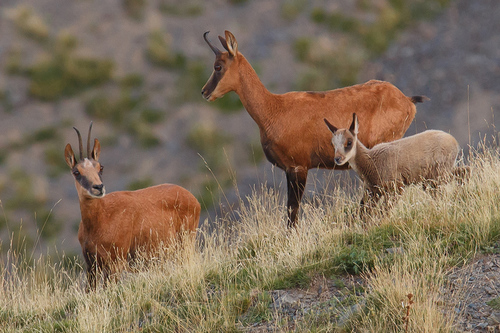
Chamois have a tan to reddish-brown summer coat that turns dark brown to blackish in winter, with a distinctive white face marked by dark stripes running through the eyes. Both sexes possess short, hooked black horns that curve sharply backward at the tip.
Size
Body length of 100-130 cm with a shoulder height of 70-80 cm; both sexes are similar in size.
Weight
Males (bucks) typically weigh 30-50 kg, while females (does) weigh 25-40 kg.
Distinctive features
Distinguished from the closely related Southern Chamois (Rupicapra pyrenaica) by slightly larger size, horn shape, and geographic range; the sharply hooked horn tips and facial mask pattern are key identifying features.
Differences between males and females
Males are slightly larger and heavier than females, with thicker horns and a more pronounced neck during the rutting season; horn shape is similar in both sexes but males' horns are generally more robust.
Behaviour and diet of the Northern Chamois
Chamois are social animals, typically forming small herds of females and young (5-30 individuals), while adult males are often solitary or in small bachelor groups outside the rutting season.
When it is active
Primarily diurnal, with peak activity during early morning and late afternoon; they rest in sheltered spots during the heat of midday.
Diet
Herbivorous, feeding on grasses, herbs, lichens, mosses, and shrubs in summer, and switching to conifer needles, bark, and dried vegetation in winter when food is scarce.
Communication
Chamois communicate through a combination of body postures, stamping, and a distinctive alarm whistle produced through the nose to warn others of predators.
Interactions with other species
Natural predators include wolves, lynx, golden eagles (which prey on kids), and occasionally bears; chamois often share alpine habitats with ibex and red deer, with some resource competition.
Role in its ecosystem
As herbivores, chamois play a role in shaping alpine vegetation through grazing and serve as an important prey species supporting populations of large alpine predators like wolves and lynx.
Reproduction and lifecycle
Breeding season (rut) occurs in late autumn (November-December), with males competing for access to females; gestation lasts about 170 days, resulting in a single kid born in May or June.
Raising the young
Females give birth away from the herd and nurse their kids for several months, with young chamois able to follow their mothers within hours of birth and remaining closely bonded for about a year.
Maturity and lifespan
Sexual maturity is reached at 2-3 years of age; lifespan in the wild is typically 14-17 years, while captive individuals can live slightly longer with reduced predation and disease risk.
Taxonomy and naming of the Northern Chamois
Classification
Class Mammalia > Order Artiodactyla > Family Bovidae > Genus Rupicapra > Species Rupicapra rupicapra
Subspecies
Includes R. r. rupicapra (Alps), R. r. carpatica (Carpathian Mountains), R. r. balcanica (Balkans), R. r. tatrica (Tatra Mountains), and R. r. cartusiana (Chartreuse Mountains, France); taxonomy of subspecies is still debated.
Scientific synonyms
Antilope rupicapra, Capra rupicapra
What research says
Recent studies
Recent research has focused on the impacts of climate change on chamois habitat use and phenology, as well as genetic studies clarifying the taxonomic status of isolated populations like the Tatra chamois.
Genome and DNA
Chamois have a diploid chromosome number of 2n=58; genetic studies have been used to clarify subspecies boundaries and assess population connectivity across fragmented alpine ranges.
Compared with similar species
Compared to the Southern Chamois (Rupicapra pyrenaica) found in the Pyrenees and Apennines, the Northern Chamois is slightly larger with subtle differences in horn curvature and coat coloration patterns.
The Northern Chamois and people
Chamois can leap distances of up to 6 meters and jump vertically over 2 meters, rivaling some of the most agile mammals on Earth. Their name gives rise to 'chamois leather,' traditionally made from their hide, prized for its softness and absorbency.
Where and how to see it
Best observed at dawn or dusk in national parks such as Gran Paradiso (Italy), Berchtesgaden (Germany), or the Swiss National Park, especially during summer when they graze in open alpine meadows above the treeline.
Risks to humans
No notable risk to humans; chamois are shy and avoid human contact, though they can become defensive if cornered.
Human uses
Historically hunted for meat, hide (chamois leather), and as a trophy species; today they remain an important game species managed through regulated hunting in many European countries.
Myths and legends
In alpine folklore, the chamois is often associated with mountain spirits and is considered a symbol of freedom, agility, and the untamed wilderness of the Alps; hunting chamois has historically been seen as a test of skill and bravery.
Countries where the Northern Chamois is recorded
The 12 countries named in the range description of its IUCN Red List assessment.
Questions about the Northern Chamois
Where does the Northern Chamois live?
The Northern Chamois is recorded in Argentina, Austria, France, Germany and Italy, among 12 countries in total across Europe, South America and Oceania. These countries come from the range description of its IUCN Red List assessment, and they are what place the species on the interactive map.
Is the Northern Chamois endangered?
The IUCN Red List assesses the Northern Chamois as Least Concern. The species is widespread and abundant enough not to qualify for any threatened category. It does not mean the species is safe forever, only that nothing in the current data raises an alarm.
How many are left in the wild?
Estimated total population of over 400,000 individuals across Europe, with the overall trend considered stable, though some localized populations are declining. This figure comes from the species assessment on the IUCN Red List; population estimates for wild mammals are ranges, not counts, and are revised at each assessment.
What habitat does the Northern Chamois live in?
Alpine meadows, rocky cliffs, coniferous forests, and subalpine shrublands; often found near the treeline where rocky outcrops provide escape terrain from predators.
What is the scientific name of the Northern Chamois?
The Northern Chamois is Rupicapra rupicapra, in the family Bovidae, order Artiodactyla.
Other species in the genus Rupicapra
Other species in the family Bovidae
Species that share its range
Sources
Conservation status, range description and population estimate come from the IUCN Red List assessment for Rupicapra rupicapra. Countries are derived from that range description, not from a mapped country list. Last refreshed on .
The distribution map is drawn from the IUCN Red List spatial data compiled in 2021. IUCN (International Union for Conservation of Nature)