
Natal Red Duiker
Cephalophus natalensis
Red List assessment
Least Concernon the IUCN Red List
- EXExtinct
- EWExtinct in the Wild
- CRCritically Endangered
- ENEndangered
- VUVulnerable
- NTNear Threatened
- LCLeast Concern
The Natal Red Duiker is recorded in 4 countries across Africa. The IUCN Red List assesses the Natal Red Duiker as Least Concern. Population estimated in the tens of thousands, with stable to slightly declining trend depending on region; precise continent-wide counts are difficult due to secretive forest-dwelling nature
- Family
- Bovidae
- Order
- Artiodactyla
- Genus
- Cephalophus
- Countries recorded
- 4
- Continents
- Africa
- Red List category
- Least Concern
- Data updated
- August 9, 2026
What is the Natal Red Duiker?
The Natal Red Duiker is a small, forest-dwelling antelope native to coastal and montane forests of southeastern Africa. It is notable for its rich reddish-brown coat and secretive, solitary habits within dense vegetation. This species plays an important ecological role as a seed disperser in forest ecosystems. Despite habitat pressures, it remains one of the more widespread and adaptable duiker species.
Where does the Natal Red Duiker live?
Southeastern Africa, primarily South Africa (KwaZulu-Natal), Mozambique, Eswatini (Swaziland), and Malawi
Found along the eastern coastal belt of South Africa (KwaZulu-Natal province), extending into Eswatini, southern Mozambique, and parts of Malawi. Range is fragmented due to forest habitat loss but historically continuous along the coastal forest corridor.
Altitude and depth
Sea level to approximately 1500 meters, with most populations found in lowland and coastal forest zones below 1000m
Seasonal movements
No significant migratory behavior; relatively sedentary year-round with fixed home ranges, though breeding activity may show slight seasonal peaks
Habitat of the Natal Red Duiker
Prefers dense coastal forests, riverine thickets, montane forests, and woodland with thick undergrowth. Requires cover for concealment from predators and typically avoids open grasslands. Found in both lowland and mid-altitude forest patches.
Adaptations to its environment
Compact body size and flexible spine allow rapid movement through dense undergrowth; reddish coat provides camouflage in dappled forest light. Acute hearing and a habit of freezing or diving into cover help evade predators in thick vegetation.
Conservation status and numbers
Listed as Least Concern by IUCN due to relatively stable populations and wide distribution, though localized declines occur from habitat fragmentation. Population trends vary regionally, with some protected areas showing stability while unprotected habitats face ongoing pressure.
Estimated population
Population estimated in the tens of thousands, with stable to slightly declining trend depending on region; precise continent-wide counts are difficult due to secretive forest-dwelling nature
What threatens the Natal Red Duiker?
Habitat loss from agricultural expansion, coastal development, and deforestation; illegal snaring and subsistence hunting for bushmeat; forest fragmentation isolating populations
Diseases and parasites
Susceptible to various tick-borne diseases and internal parasites common to forest antelope; specific pathogen studies are limited
What is being done to protect it?
Protected within numerous South African reserves including iSimangaliso Wetland Park and various KwaZulu-Natal provincial reserves; benefits from broader forest conservation initiatives and anti-poaching patrols in protected areas
Recommended actions
Expand and connect protected forest corridors to reduce fragmentation; strengthen anti-snaring enforcement; conduct population monitoring in unprotected habitat areas; promote community-based conservation incentives
What the Natal Red Duiker looks like
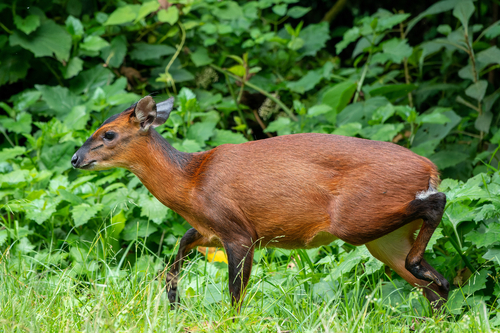
Rich chestnut to reddish-brown coat, lighter underparts, with a slightly darker face and short erectile crest of hair on the forehead. Legs are slender and dark, ears are relatively large and rounded.
Size
Shoulder height approximately 40-45 cm; body length around 70-100 cm
Weight
Typically 10-14 kg, with males and females of similar size
Distinctive features
Distinguished from other red duikers by its darker reddish coloration and specific range; overlaps in appearance with Cephalophus harveyi but is generally geographically distinct
Differences between males and females
Both sexes possess short, straight horns though females may have smaller or absent horns in some individuals; minimal size difference between sexes
Behaviour and diet of the Natal Red Duiker
Primarily solitary or found in pairs (monogamous bonded pairs); maintains and defends a home territory marked with scent glands
When it is active
Primarily crepuscular and nocturnal, though also active during early morning and late afternoon hours; rests in dense cover during hottest parts of the day
Diet
Herbivorous, feeding on fallen fruits, leaves, flowers, seeds, and fungi; opportunistically consumes some insects and other small protein sources
Communication
Uses scent marking via preorbital glands to mark territory; vocalizations include alarm snorts and bleats; body postures signal alertness or submission
Interactions with other species
Preyed upon by leopards, pythons, large raptors, and domestic dogs; may share habitat with other duiker species and forest antelope with minimal direct competition due to dietary flexibility
Role in its ecosystem
Functions as an important seed disperser within forest ecosystems, aiding regeneration of fruiting trees and shrubs; serves as prey base supporting forest predator populations
Reproduction and lifecycle
Breeding occurs year-round with no strict seasonal pattern; gestation lasts approximately 210 days (about 7 months), typically producing a single calf
Raising the young
Calves are hidden in dense vegetation for the first weeks of life while the mother forages nearby, returning periodically to nurse; independence is reached within several months
Maturity and lifespan
Sexual maturity reached around 9-12 months; lifespan averages 10-12 years in the wild, potentially longer in captivity
Taxonomy and naming of the Natal Red Duiker
Classification
Class Mammalia > Order Artiodactyla > Family Bovidae > Genus Cephalophus > Species Cephalophus natalensis
Subspecies
Some authorities recognize regional variations, but no widely accepted distinct subspecies are currently classified; taxonomic status remains under review with some populations previously considered separate species now synonymized.
Scientific synonyms
Cephalophus robertsi (sometimes considered synonym); previously classified with closer ties to Cephalophus harveyi in some taxonomies
What research says
Recent studies
Recent camera-trap studies in KwaZulu-Natal forests have provided improved data on population density and activity patterns; ongoing genetic studies aim to clarify taxonomic relationships within the Cephalophus genus
Compared with similar species
Similar in size and habits to other red duiker species such as Cephalophus harveyi (Harvey's duiker) and Cephalophus rufilatus, but distinguished by geographic range and subtle coat coloration differences
The Natal Red Duiker and people
Natal Red Duikers can vocalize with a sharp bark-like alarm call when startled; they are known to dive headfirst into dense brush to escape predators, giving rise to the name 'duiker' meaning 'diver' in Afrikaans/Dutch.
Where and how to see it
Best observed at dawn or dusk in coastal forest reserves of KwaZulu-Natal, such as iSimangaliso Wetland Park; patience and quiet movement along forest edges increase sighting chances
Risks to humans
No notable risk to humans; the species is shy and avoids human contact
Human uses
Hunted locally for bushmeat in some rural areas; occasionally kept in wildlife parks and zoos for conservation education and breeding programs
Myths and legends
In some regional folklore, small forest antelope like duikers are associated with cunning and elusiveness, occasionally featured in local oral traditions as clever forest spirits
Countries where the Natal Red Duiker is recorded
The 4 countries named in the range description of its IUCN Red List assessment.
Questions about the Natal Red Duiker
Where does the Natal Red Duiker live?
The Natal Red Duiker is recorded in Eswatini, Malawi, Mozambique and South Africa across Africa. These countries come from the range description of its IUCN Red List assessment, and they are what place the species on the interactive map.
Is the Natal Red Duiker endangered?
The IUCN Red List assesses the Natal Red Duiker as Least Concern. The species is widespread and abundant enough not to qualify for any threatened category. It does not mean the species is safe forever, only that nothing in the current data raises an alarm.
How many are left in the wild?
Population estimated in the tens of thousands, with stable to slightly declining trend depending on region; precise continent-wide counts are difficult due to secretive forest-dwelling nature This figure comes from the species assessment on the IUCN Red List; population estimates for wild mammals are ranges, not counts, and are revised at each assessment.
What habitat does the Natal Red Duiker live in?
Prefers dense coastal forests, riverine thickets, montane forests, and woodland with thick undergrowth.
What is the scientific name of the Natal Red Duiker?
The Natal Red Duiker is Cephalophus natalensis, in the family Bovidae, order Artiodactyla.
Other species in the genus Cephalophus
Other species in the family Bovidae
Sources
Conservation status, range description and population estimate come from the IUCN Red List assessment for Cephalophus natalensis. Countries are derived from that range description, not from a mapped country list. Last refreshed on .
The distribution map is drawn from the IUCN Red List spatial data compiled in 2008. IUCN (International Union for Conservation of Nature)