
Namaqua Rock Rat
Micaelamys namaquensis
Red List assessment
Least Concernon the IUCN Red List
- EXExtinct
- EWExtinct in the Wild
- CRCritically Endangered
- ENEndangered
- VUVulnerable
- NTNear Threatened
- LCLeast Concern
The Namaqua Rock Rat is recorded in 8 countries across Africa. The IUCN Red List assesses the Namaqua Rock Rat as Least Concern. No precise global population estimate is available; the species is described as common and locally abundant across its wide range.
- Family
- Muridae
- Order
- Rodentia
- Genus
- Micaelamys
- Countries recorded
- 8
- Continents
- Africa
- Red List category
- Least Concern
- Data updated
- August 9, 2026
What is the Namaqua Rock Rat?
The Namaqua Rock Rat is a medium-sized murid rodent endemic to the rocky landscapes of southern Africa, named after the Namaqualand region straddling South Africa and Namibia. It is strongly associated with rocky outcrops, kopjes, and boulder fields, where it shelters in crevices and among stones. It is one of the most widespread rock-dwelling rodents in the subcontinent and is particularly notable as a reservoir host for several zoonotic pathogens. Its adaptability to a wide variety of semi-arid and rocky habitats across diverse biomes makes it ecologically significant.
Where does the Namaqua Rock Rat live?
Southern Africa: South Africa, Namibia, Botswana, Zimbabwe, Mozambique, Zambia, Angola, and Lesotho
Distributed widely across southern and south-central Africa. Core range covers South Africa (including Northern Cape, Western Cape, Eastern Cape, and beyond), Namibia, Botswana, Zimbabwe, Mozambique, southern Zambia, southern Angola, and parts of Lesotho. Absent from forested lowlands and true desert interiors.
Altitude and depth
Found from near sea level up to approximately 2,000 m in montane rocky terrain. Most commonly recorded between 500 and 1,500 m in highland plateau and escarpment zones.
Seasonal movements
Non-migratory and active year-round without true hibernation. Breeding activity may intensify during wetter, warmer months (austral summer) when food resources peak. No marked seasonal behavioral dormancy has been recorded.
Habitat of the Namaqua Rock Rat
Primarily inhabits rocky outcrops, kopjes, boulder-strewn hillsides, and escarpments across a range of biomes including fynbos, Succulent Karoo, Nama-Karoo, savanna, and dry woodland. Rock cover is the essential habitat feature regardless of vegetation type. It occasionally occurs in scrubland adjacent to rocky substrates.
Adaptations to its environment
Strongly adapted to rocky substrates, with agile climbing ability and a slender body that permits movement through narrow crevices. Its tawny-buff coloration provides cryptic camouflage against rocky and sandy surfaces. Capable of surviving with minimal free water by extracting moisture from food. Behavioral flexibility allows it to exploit both invertebrate and plant food depending on seasonal availability.
Conservation status and numbers
Least Concern (LC) on the IUCN Red List. The species is widespread, locally abundant, occurs in numerous protected areas, and faces no major range-wide threats that would trigger a threatened category. Population trend is considered stable.
Estimated population
No precise global population estimate is available; the species is described as common and locally abundant across its wide range. Population trend is considered stable overall.
What threatens the Namaqua Rock Rat?
Locally threatened by habitat degradation from overgrazing, mining activities around rocky outcrops, and urban expansion in parts of South Africa. Rodenticide use in agricultural areas adjacent to rocky habitats may cause localized mortality. Predator pressure from domestic cats and dogs near human settlements is also a factor.
Diseases and parasites
Documented as a reservoir host or carrier of plague (Yersinia pestis) through flea vectors, particularly in the Northern Cape region of South Africa. Also hosts various ectoparasites including fleas (e.g., Xenopsylla species), mites, and ticks. Possible hantavirus associations have been investigated in southern African murids.
What is being done to protect it?
Protected within numerous national parks and nature reserves across its range, including the Karoo National Park, Richtersveld National Park (South Africa), and Namib-Naukluft National Park (Namibia). Covered by national wildlife legislation in South Africa under the National Environmental Management: Biodiversity Act.
Recommended actions
Continued monitoring of local populations in areas with intensive agriculture and mining; control of feral and domestic predators near rocky habitats; inclusion in biodiversity surveys for disease surveillance given its role as a reservoir host. Research on genetic diversity among subspecies is a priority.
What the Namaqua Rock Rat looks like
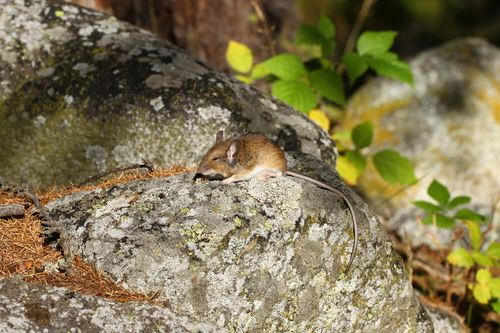
Dorsal fur is tawny to reddish-buff or greyish-brown, often with a slightly speckled appearance due to dark-tipped guard hairs. Ventral surface is white to pale grey, usually clearly demarcated from the dorsum. The tail is long, sparsely haired, and scaly. Eyes are large and dark, adapted for dim-light activity. Ears are moderately large and rounded.
Size
Head-body length approximately 90–150 mm; tail length 110–175 mm (typically slightly longer than body). Hind foot length 21–27 mm; ear length 18–23 mm.
Weight
Typically 30–80 g; adults average around 50–60 g, with some variation between populations and sexes.
Distinctive features
Distinguished from Micaelamys granti (Grant's Rock Rat) by larger size, broader skull, and different distribution. Compared to Aethomys species, Micaelamys has a relatively longer tail, distinct cranial morphology, and exclusive association with rocky habitats. The clear white ventral surface and tawny dorsum combined with rocky-habitat preference are reliable field identifiers.
Differences between males and females
Sexual dimorphism is minimal; males are generally slightly larger and heavier than females but the difference is not pronounced. No significant differences in fur coloration between sexes.
Behaviour and diet of the Namaqua Rock Rat
Predominantly solitary or found in loosely associated pairs or small family groups sharing rock crevice refugia. Home ranges of individuals may overlap, especially around prime rocky shelters. Social interactions are limited outside of breeding contexts.
When it is active
Strictly nocturnal. Emerges after dark to forage and returns to rocky refugia before dawn. Daytime is spent sheltering deep within rock crevices, which also provide thermal regulation and protection from predators.
Diet
Omnivorous. Primary diet consists of seeds, plant material (leaves, stems, bulbs), and fruits. Invertebrates including insects, spiders, and larvae are also consumed, particularly during the dry season when plant matter is scarce. Diet composition shifts opportunistically with seasonal availability.
How it feeds and hunts
Forages on the ground and among rocks, using its vibrissae (whiskers) and olfaction to locate seeds and invertebrates in dark conditions. It may cache seeds in or near rocky shelters for later consumption, though this behavior is not extensively documented.
Communication
Communicates via ultrasonic vocalizations typical of murids, used particularly during reproductive contexts. Scent marking with urine and glandular secretions is used to delineate territories or signal reproductive status. Agonistic encounters may involve tooth chattering and postural displays.
Interactions with other species
Preyed upon by a wide range of predators including barn owls (Tyto alba), other raptors, rock monitor lizards (Varanus albigularis), boomslangs, puff adders, and small carnivorous mammals such as genets and mongooses. Competes with other small rock-dwelling rodents for crevice space and food. Acts as a host for fleas, mites, and other ectoparasites, some of which are vectors of zoonotic disease.
Role in its ecosystem
Important prey species for numerous predators, contributing to rocky-habitat food webs. Functions as a seed disperser through scatter-hoarding. Its role as a reservoir for plague (Yersinia pestis) and potentially hantaviruses links it to broader disease ecology in southern Africa.
Reproduction and lifecycle
Breeding occurs throughout much of the year in warm regions, with peaks in austral summer (October–March). Gestation lasts approximately 22–28 days. Litter size ranges from 2 to 6 pups, with an average around 3–4. Females can produce multiple litters per year under favorable conditions.
Raising the young
Females provide primary parental care; pups are born altorical (blind, hairless) and are nursed in the rocky refuge nest. Weaning occurs at approximately 3–4 weeks. Males show little or no direct parental investment.
Maturity and lifespan
Sexual maturity is reached at approximately 2–3 months of age. Lifespan in the wild is estimated at 1–3 years; captive individuals may live somewhat longer, potentially up to 4–5 years.
Taxonomy and naming of the Namaqua Rock Rat
Classification
Mammalia > Rodentia > Muridae > Micaelamys > Micaelamys namaquensis
Subspecies
Several subspecies have been described, including M. n. namaquensis (southwestern South Africa, including Cape Province), M. n. cabrali (Angola), and additional regional forms; taxonomy remains partially unresolved and some forms may warrant full species status.
Scientific synonyms
Formerly classified as Aethomys namaquensis (Smith, 1834); original basionym is Mus namaquensis A. Smith, 1834. The genus Micaelamys was resurrected to separate this and closely related species from Aethomys sensu stricto.
What research says
Recent studies
Recent epidemiological studies have highlighted this species as a key flea host and potential plague reservoir in semi-arid South Africa, with implications for public health surveillance. Phylogeographic studies have revealed significant genetic structuring across its range, suggesting that some regional populations may represent cryptic lineages warranting further taxonomic investigation.
Genome and DNA
Diploid chromosome number (2n) is 56, with a fundamental number (FN) of 60–66, consistent with other members of the tribe Murini. Molecular phylogenetic studies contributed to the reclassification from Aethomys to the resurrected genus Micaelamys, supporting its distinctness from other African rats.
Compared with similar species
Most closely related to Micaelamys granti (Grant's Rock Rat), which is smaller and has a more restricted range in the central South African highlands. Compared to Aethomys chrysophilus (Red Veld Rat), M. namaquensis is more strictly associated with rocky substrates, smaller on average, and occupies more arid environments. It is sometimes confused with Elephantulus (elephant shrews) in the field due to similar rocky habitat use but is distinguishable by its murid morphology.
The Namaqua Rock Rat and people
The Namaqua Rock Rat is named after Namaqualand, a region famous for spectacular spring wildflower blooms, making it one of the few mammals named after one of the world's most colorful landscapes. Despite its small size, it can navigate complex three-dimensional boulder fields with remarkable agility at night, effectively using rock crevices as a labyrinthine refuge system. It has been implicated in plague outbreaks in South Africa, meaning this inconspicuous little rodent has historically had an outsized impact on regional public health.
Where and how to see it
Best observed at rocky outcrops and kopjes in the Karoo region, the Richtersveld, or the Cederberg mountains of South Africa after sunset using a red-filtered torch to minimize disturbance. Cape Point (near the known coordinates) and surrounding Cape Peninsula rocky outcrops are accessible observation sites. Patient, quiet observation near boulder piles at dusk increases the chance of sightings.
Risks to humans
Low direct risk to humans. May bite if handled. Of greater concern is its role as a flea host in plague-endemic areas; contact with dead individuals or their ectoparasites should be avoided in known plague zones of the Northern Cape. Standard rodent-handling hygiene precautions are advised.
Human uses
Not commercially harvested or kept as a pet. Used in biomedical and ecological research, particularly in disease ecology studies related to plague and vector-borne pathogens in southern Africa. Of no significant use in traditional medicine or local subsistence.
Myths and legends
No specific myths or legends are widely documented for this species among southern African cultures, though rodents in general feature in some San (Bushmen) folklore as resourceful and clever creatures of the rocky landscape.
Countries where the Namaqua Rock Rat is recorded
The 8 countries named in the range description of its IUCN Red List assessment.
Questions about the Namaqua Rock Rat
Where does the Namaqua Rock Rat live?
The Namaqua Rock Rat is recorded in Angola, Botswana, Lesotho, Mozambique and Namibia, among 8 countries in total across Africa. These countries come from the range description of its IUCN Red List assessment, and they are what place the species on the interactive map.
Is the Namaqua Rock Rat endangered?
The IUCN Red List assesses the Namaqua Rock Rat as Least Concern. The species is widespread and abundant enough not to qualify for any threatened category. It does not mean the species is safe forever, only that nothing in the current data raises an alarm.
How many are left in the wild?
No precise global population estimate is available; the species is described as common and locally abundant across its wide range. This figure comes from the species assessment on the IUCN Red List; population estimates for wild mammals are ranges, not counts, and are revised at each assessment.
What habitat does the Namaqua Rock Rat live in?
Primarily inhabits rocky outcrops, kopjes, boulder-strewn hillsides, and escarpments across a range of biomes including fynbos, Succulent Karoo, Nama-Karoo, savanna, and dry woodland.
What is the scientific name of the Namaqua Rock Rat?
The Namaqua Rock Rat is Micaelamys namaquensis, in the family Muridae, order Rodentia.
Other species in the genus Micaelamys
Other species in the family Muridae
Species that share its range

Sources
Conservation status, range description and population estimate come from the IUCN Red List assessment for Micaelamys namaquensis. Countries are derived from that range description, not from a mapped country list. Last refreshed on .
The distribution map is drawn from the IUCN Red List spatial data compiled in 2008. IUCN (International Union for Conservation of Nature)