
Grant's Rock Rat
Micaelamys granti
Red List assessment
Least Concernon the IUCN Red List
- EXExtinct
- EWExtinct in the Wild
- CRCritically Endangered
- ENEndangered
- VUVulnerable
- NTNear Threatened
- LCLeast Concern
The Grant's Rock Rat is recorded in 5 countries across Africa. The IUCN Red List assesses the Grant's Rock Rat as Least Concern. No precise global population estimate is available.
- Family
- Muridae
- Order
- Rodentia
- Genus
- Micaelamys
- Countries recorded
- 5
- Continents
- Africa
- Red List category
- Least Concern
- Data updated
- August 9, 2026
What is the Grant's Rock Rat?
Grant's Rock Rat is a medium-sized murid rodent endemic to the rocky savanna and bushveld landscapes of southern Africa. It is a specialist of rocky outcrops (locally called 'koppies'), where it shelters in crevices and among boulders. The species was reclassified from Aethomys to Micaelamys based on phylogenetic evidence, making it one of only two members of its genus alongside the Namaqua Rock Rat. Though not well-studied, it represents an important component of rocky-habitat small mammal communities in the region.
Where does the Grant's Rock Rat live?
Northern and northeastern South Africa (Limpopo, North West, Mpumalanga provinces), eastern Botswana, western and central Zimbabwe, and possibly adjacent areas of Mozambique and Zambia.
Southern Africa: northern and northeastern South Africa (primarily Limpopo province and surrounding areas), eastern Botswana, western and central Zimbabwe. Marginal records exist from adjacent parts of Mozambique and possibly Zambia. The range broadly overlaps with the Limpopo River basin and surrounding elevated plateau regions.
Altitude and depth
Typically found from lowland savanna (~300 m) up to approximately 1,500 m above sea level, wherever suitable rocky habitat exists. It is most frequently recorded at intermediate altitudes on rocky hillsides and plateaus.
Seasonal movements
No known seasonal migrations. Activity patterns may shift slightly with seasonal rainfall, as food resources (seeds, invertebrates) fluctuate between wet and dry seasons. No hibernation recorded.
Habitat of the Grant's Rock Rat
Primarily rocky outcrops (koppies/kopjes) embedded within savanna, bushveld, and dry woodland landscapes. It relies on rock crevices, boulder piles, and talus slopes for shelter and nesting. It is less associated with dense vegetation and more strongly tied to granite or sandstone rocky formations than many other murids in its range.
Adaptations to its environment
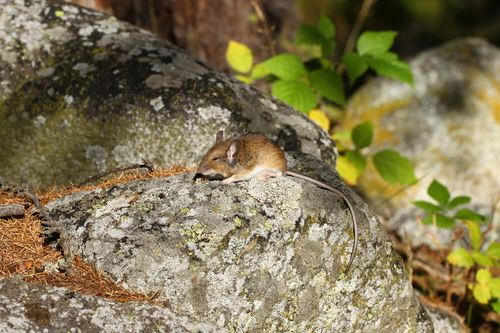
Its compact, agile body is well-suited for navigating rocky terrain. Long, sensitive vibrissae aid in moving through dark crevices. It likely stores food or exploits cached seeds during the dry season. Cryptic brownish coloration provides camouflage against granite and sandstone substrates.
Conservation status and numbers
Least Concern (LC) on the IUCN Red List. The species has a sufficiently wide distribution across southern Africa, is presumed to maintain a relatively stable population, and faces no immediate range-wide threats that would qualify it for a threatened category.
Estimated population
No precise global population estimate is available. The population is considered stable, with no evidence of significant decline. Densities likely vary considerably depending on the availability of rocky habitat.
What threatens the Grant's Rock Rat?
Habitat degradation through overgrazing, agricultural expansion, and mining activities that disturb or destroy rocky outcrops. Invasive predators (feral cats, rats) may pose localized threats. Climate-driven changes to savanna vegetation structure could indirectly reduce food availability.
Diseases and parasites
Like other southern African murids, it likely hosts ectoparasites (fleas, mites, ticks) and endoparasites (nematodes, cestodes). Potential reservoir host for hantaviruses or other zoonotic pathogens common to African murids, though no specific studies have been published for this species.
What is being done to protect it?
No species-specific conservation programs exist. The species benefits from protection within national parks and game reserves across its range, including Kruger National Park (South Africa), Hwange National Park (Zimbabwe), and Chobe National Park (Botswana).
Recommended actions
Systematic surveys to better define range limits and population densities. Monitoring of rocky-outcrop habitats for degradation from mining and quarrying. Inclusion in broader small mammal monitoring programs in southern African protected areas.
What the Grant's Rock Rat looks like
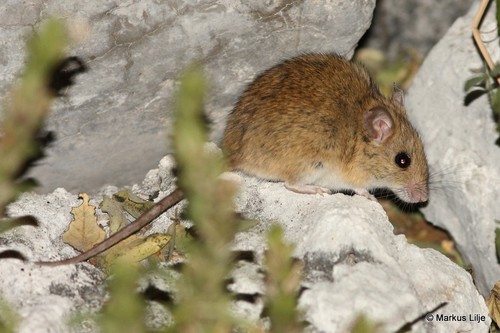
Dorsal fur is brownish to greyish-brown, often with a slightly buffy or tawny tinge. The underparts are pale grey to whitish. The tail is uniformly brownish, finely scaled, and sparsely haired. Ears are moderately large and rounded, and the eyes are relatively large, reflecting its nocturnal lifestyle.
Size
Head-body length approximately 120–165 mm; tail length approximately 140–175 mm (tail typically subequal to or slightly longer than body). A medium-sized murid comparable in size to its congener M. namaquensis.
Weight
Approximately 50–100 g, with some variation between individuals. Sexual dimorphism in size is minimal but males may be slightly heavier on average.
Distinctive features
Distinguished from the closely related Namaqua Rock Rat (M. namaquensis) by its generally more restricted northeastern distribution, slightly different cranial morphology, and molecular characters. It tends to be slightly larger than some populations of M. namaquensis and occupies wetter, more wooded savanna environments rather than the arid western habitats preferred by M. namaquensis.
Differences between males and females
Minimal sexual dimorphism. Males and females are similar in external appearance and size, though males may average marginally heavier. No striking differences in color or structure.
Behaviour and diet of the Grant's Rock Rat
Believed to be semi-social, living in small family groups or loose colonies within a rocky outcrop. Multiple individuals may share a network of crevices. Dominance hierarchies among males have not been formally documented for this species.
When it is active
Primarily nocturnal, emerging after dark to forage in and around rocky outcrops. Some crepuscular activity may occur. During the heat of the day it rests in cool, sheltered rock crevices.
Diet
Omnivorous, with a diet consisting primarily of seeds, plant material (leaves, stems, fruits), and invertebrates (insects, spiders). Seed consumption is likely dominant, particularly during the dry season. Foraging takes place mainly on and among rocks and in adjacent ground litter.
How it feeds and hunts
Uses olfaction and vibrissae to locate invertebrate prey in crevices and under rocks. Seeds are gathered opportunistically while foraging along the ground surface near rocky outcrops. No active pursuit hunting of vertebrate prey is known.
Communication
Likely communicates via ultrasonic vocalizations (as in most murids), olfactory signals through urine and glandular secretions used for territory marking, and tactile interactions between group members. Specific call repertoires have not been formally described for this species.
Interactions with other species
Predators include owls (e.g., barn owl Tyto alba, spotted eagle-owl Bubo africanus), diurnal raptors, monitor lizards (Varanus spp.), and small carnivores such as mongooses and genets. It may compete for rocky crevice space and food resources with other small rock-dwelling rodents and elephant shrews.
Role in its ecosystem
Plays a role as a secondary seed consumer and prey item within savanna rocky-outcrop ecosystems. May contribute modestly to seed dispersal through scatter-hoarding behavior. As prey, it is an important energy link between plant production and mesopredators.
Reproduction and lifecycle
Breeding is likely seasonal, peaking during or after the wet season (summer, October–March in southern Africa), when food resources are most abundant. Litter size is estimated at 2–5 pups, consistent with related murids. Gestation is approximately 21–25 days.
Raising the young
Pups are born altricial (eyes closed, hairless) and are nursed in a nest within rock crevices. The female provides primary parental care. Weaning likely occurs at approximately 3–4 weeks of age, after which juveniles begin foraging independently.
Maturity and lifespan
Sexual maturity is likely reached at 6–10 weeks of age, consistent with related murid species. Wild lifespan is estimated at 1–3 years; captive individuals of related species may live up to 4–5 years under optimal conditions.
Taxonomy and naming of the Grant's Rock Rat
Classification
Mammalia > Rodentia > Muridae > Micaelamys > Micaelamys granti
Scientific synonyms
Aethomys granti (Thomas, 1918) — previously placed in the genus Aethomys before molecular and morphological analyses supported reclassification into the resurrected genus Micaelamys.
What research says
Recent studies
The key recent taxonomic development was the molecular reclassification from Aethomys granti to Micaelamys granti, supported by phylogenomic analyses of southern African Muridae published in the 2000s–2010s. Detailed ecological or behavioral studies specific to this species remain scarce.
Genome and DNA
Exact chromosome number not confirmed in published literature for M. granti specifically. Molecular phylogenetic studies (cytochrome b and other markers) were pivotal in separating Micaelamys from Aethomys, placing M. granti sister to M. namaquensis.
Compared with similar species
Most closely related to M. namaquensis (Namaqua Rock Rat), from which it differs in range (northeastern vs. western/southwestern southern Africa), habitat preferences (wetter bushveld vs. arid Karoo and Namaqualand), and subtle morphological and molecular characters. Both are ecologically distinct from the broader Aethomys genus (e.g., A. chrysophilus, the red veld rat), which tends to use open savanna rather than rocky substrates.
The Grant's Rock Rat and people
1) Grant's Rock Rat was shuffled between two genera — described as Aethomys granti in 1918, then reclassified into the resurrected genus Micaelamys nearly a century later following DNA analysis. 2) Rocky outcrops (koppies) where it lives act as biodiversity 'islands' in the sea of surrounding savanna, harboring disproportionately high species richness. 3) Its tail is often as long as — or longer than — its body, helping it balance while clambering over boulders in the dark.
Where and how to see it
Best observed at night in rocky outcrop habitats (koppies) in Limpopo province, South Africa, or in the Matobo Hills of Zimbabwe, where rock rats are relatively accessible with a spotlight or headlamp. The dry season (May–September) reduces vegetation cover and makes spotting easier. Listening for rustling among boulders at dusk is a reliable detection method.
Risks to humans
No notable risk. Like all wild rodents it can bite if handled, and may theoretically carry zoonotic pathogens, but there are no documented cases of significant health risk to humans from this specific species.
Countries where the Grant's Rock Rat is recorded
The 5 countries named in the range description of its IUCN Red List assessment.
Questions about the Grant's Rock Rat
Where does the Grant's Rock Rat live?
The Grant's Rock Rat is recorded in Botswana, Mozambique, South Africa, Zambia and Zimbabwe across Africa. These countries come from the range description of its IUCN Red List assessment, and they are what place the species on the interactive map.
Is the Grant's Rock Rat endangered?
The IUCN Red List assesses the Grant's Rock Rat as Least Concern. The species is widespread and abundant enough not to qualify for any threatened category. It does not mean the species is safe forever, only that nothing in the current data raises an alarm.
How many are left in the wild?
No precise global population estimate is available. This figure comes from the species assessment on the IUCN Red List; population estimates for wild mammals are ranges, not counts, and are revised at each assessment.
What habitat does the Grant's Rock Rat live in?
Primarily rocky outcrops (koppies/kopjes) embedded within savanna, bushveld, and dry woodland landscapes.
What is the scientific name of the Grant's Rock Rat?
The Grant's Rock Rat is Micaelamys granti, in the family Muridae, order Rodentia.
Other species in the genus Micaelamys
Other species in the family Muridae
Species that share its range
Sources
Conservation status, range description and population estimate come from the IUCN Red List assessment for Micaelamys granti. Countries are derived from that range description, not from a mapped country list. Last refreshed on .
The distribution map is drawn from the IUCN Red List spatial data compiled in 2017. IUCN (International Union for Conservation of Nature)