
Muskox
Ovibos moschatus
Red List assessment
Least Concernon the IUCN Red List
- EXExtinct
- EWExtinct in the Wild
- CRCritically Endangered
- ENEndangered
- VUVulnerable
- NTNear Threatened
- LCLeast Concern
The Muskox is recorded in 5 countries across Europe and North America. The IUCN Red List assesses the Muskox as Least Concern. Estimated global population of approximately 170,000-250,000 individuals, with populations generally stable or increasing in most managed areas, though some regional declines have been noted due to climate-related die-offs.
- Family
- Bovidae
- Order
- Artiodactyla
- Genus
- Ovibos
- Countries recorded
- 5
- Continents
- Europe and North America
- Red List category
- Least Concern
- Data updated
- August 9, 2026
What is the Muskox?
The muskox is a large, shaggy Arctic bovid uniquely adapted to survive extreme cold, being one of the few large mammals to have survived the Pleistocene megafauna extinction. It roams tundra landscapes in small herds, relying on its dense wool coat (qiviut) for insulation. Despite its name, it is more closely related to sheep and goats than to true oxen. It is remarkable for its ancient lineage, defensive herd behavior, and ability to thrive in some of the harshest environments on Earth.
Where does the Muskox live?
Arctic Canada, Greenland, Alaska (USA), with introduced populations in Norway (Svalbard, Dovrefjell) and Russia (Wrangel Island, Taimyr Peninsula)
Native to northern Canada (Nunavut, Northwest Territories) and Greenland; reintroduced or introduced populations exist in Alaska, Russia (Wrangel Island, Taimyr), and Scandinavia (Norway's Dovrefjell and Svalbard). Historically ranged across Eurasia and North America during the Pleistocene.
Altitude and depth
Typically found at low to moderate elevations, from sea level up to around 1,000 meters in Arctic tundra and mountainous tundra regions.
Seasonal movements
Muskoxen do not migrate long distances but shift between summer and winter ranges seasonally, moving to windswept areas in winter where snow is shallower for easier foraging. They form larger mixed herds in winter for protection and smaller groups in summer during calving.
Habitat of the Muskox
Arctic tundra, including polar deserts, coastal plains, river valleys, and rocky uplands with sparse vegetation. Prefers areas with wind-swept ridges where snow cover is minimal, allowing access to forage year-round.
Adaptations to its environment
Possess an extremely dense underwool (qiviut) beneath long guard hairs, providing superior insulation against Arctic cold. Their compact body shape minimizes heat loss, and they form defensive circles with calves protected inside when threatened by predators.
Conservation status and numbers
Listed as Least Concern (LC) by IUCN due to stable or increasing populations across most of its range, following successful reintroductions and protective hunting regulations after near-extirpation in the 19th century.
Estimated population
Estimated global population of approximately 170,000-250,000 individuals, with populations generally stable or increasing in most managed areas, though some regional declines have been noted due to climate-related die-offs.
What threatens the Muskox?
Climate change causing icing events that block access to forage, increased predation from expanding wolf and grizzly populations, unregulated hunting in some regions, and potential disease transmission from domestic livestock.
Diseases and parasites
Susceptible to parasites such as lungworms and gastrointestinal nematodes, as well as diseases like brucellosis and contagious ecthyma; warming climate may increase parasite loads and disease transmission risks.
What is being done to protect it?
Protected under wildlife management programs in Canada, Greenland, and the US; successful reintroduction programs in Alaska, Russia, and Scandinavia; regulated subsistence and trophy hunting quotas help maintain sustainable populations.
Recommended actions
Continued monitoring of climate change impacts on forage availability, management of predator-prey dynamics, disease surveillance, and maintaining genetic diversity through careful population management across fragmented ranges.
What the Muskox looks like
Muskoxen have a robust, barrel-shaped body covered in long, shaggy dark brown to black guard hair that nearly reaches the ground, with a soft grayish undercoat (qiviut). Both sexes possess large, curved horns that meet in a helmet-like boss on the forehead.
Size
Shoulder height ranges from 1.1 to 1.5 meters, with body length between 1.9 and 2.3 meters.
Weight
Males (bulls) typically weigh 285-410 kg, while females (cows) weigh 180-255 kg.
Distinctive features
Distinguished by their massive horn boss, extremely long guard hair skirt, compact stocky build, and shoulder hump, differentiating them from other bovids like bison or yak.
Differences between males and females
Males are notably larger and heavier than females, with thicker, more pronounced horn bosses; males also possess a stronger musky odor during rutting season.
Behaviour and diet of the Muskox
Highly social, living in herds of 10-20 individuals (up to 100 in winter), with a linear dominance hierarchy among both sexes; herds provide protection through cooperative defensive formations.
When it is active
Primarily diurnal, though activity patterns adjust to the extreme seasonal daylight variations of the Arctic, being active during continuous summer daylight and adapting to minimal winter light.
Diet
Herbivorous, feeding on tundra vegetation including sedges, grasses, willows, forbs, and lichens, adjusting diet seasonally based on availability beneath snow cover.
Communication
Communicate through body postures, head-butting displays during rutting, snorting sounds, and scent marking via preorbital glands; strong musky odor from males serves as olfactory signaling during breeding season.
Interactions with other species
Primary predators include Arctic wolves and grizzly bears, which target calves, the sick, or elderly individuals; muskoxen may compete with caribou for limited tundra forage in overlapping ranges.
Role in its ecosystem
As key tundra herbivores, muskoxen influence vegetation structure and nutrient cycling in Arctic ecosystems; their grazing patterns shape plant community composition and they serve as an important prey base for Arctic predators.
Reproduction and lifecycle
Breeding (rutting) occurs in late summer (August-September); gestation lasts about 8-8.5 months, resulting in a single calf born in April-June; females typically breed every 1-2 years.
Raising the young
Calves are cared for primarily by the mother, nursing for 6-12 months while quickly gaining mobility to keep pace with the herd; herd members collectively protect calves from predators using defensive formations.
Maturity and lifespan
Sexual maturity reached around 2-3 years for females and 5-6 years for males; lifespan in the wild averages 12-20 years, with some individuals living longer in captivity.
Taxonomy and naming of the Muskox
Classification
Class Mammalia > Order Artiodactyla > Family Bovidae > Genus Ovibos > Species Ovibos moschatus
Subspecies
Two recognized subspecies: Ovibos moschatus moschatus (Barren-ground muskox, mainland Canada and Greenland) and Ovibos moschatus wardi (Arctic islands muskox, Canadian Arctic Archipelago), though genetic distinction is debated.
Scientific synonyms
Bos moschatus (original Zimmermann 1780 classification), Ovibos moschatus was formerly classified within the genus Bos before being reclassified into its own genus.
What research says
Recent studies
Recent research has focused on climate change impacts, particularly rain-on-snow icing events causing mass mortality, as well as genomic studies examining population structure and adaptive traits for cold tolerance.
Genome and DNA
Diploid chromosome number is 2n=48; genetic studies have revealed relatively low genetic diversity due to historical population bottlenecks from near-extinction events in the 1800s-1900s.
Compared with similar species
Unlike true oxen or cattle, muskoxen are more closely related to sheep and goats within Caprinae; they differ from bison in their much longer coat, distinct horn structure, and smaller overall size.
The Muskox and people
Muskoxen produce qiviut, one of the softest and warmest natural fibers in the world, finer than cashmere; when threatened, herds form a defensive circle with horns facing outward and calves protected in the center, a behavior effective against wolves but exploited by human hunters historically.
Where and how to see it
Best observed in Canadian Arctic national parks (like Ivvavik or Sirmilik), Greenland, or Alaska's Nunivak Island during summer months (June-August) when daylight is continuous and herds are more visible on open tundra.
Risks to humans
Generally low risk to humans, but bulls can become aggressive and dangerous during the rutting season or if approached too closely; their powerful charge and horns can cause serious injury if provoked.
Human uses
Indigenous communities have historically hunted muskoxen for meat, hides, and qiviut wool; qiviut is now commercially harvested and knitted into luxury textiles, and managed hunting provides subsistence and economic value in northern communities.
Myths and legends
Indigenous Arctic peoples, including the Inuit, have long revered the muskox as a symbol of resilience and survival, featuring it in traditional stories and utilizing every part of the animal for food, clothing, and tools.
Countries where the Muskox is recorded
The 5 countries named in the range description of its IUCN Red List assessment.
Questions about the Muskox
Where does the Muskox live?
The Muskox is recorded in Canada, Greenland, Norway, Russia and United States across Europe and North America. These countries come from the range description of its IUCN Red List assessment, and they are what place the species on the interactive map.
Is the Muskox endangered?
The IUCN Red List assesses the Muskox as Least Concern. The species is widespread and abundant enough not to qualify for any threatened category. It does not mean the species is safe forever, only that nothing in the current data raises an alarm.
How many are left in the wild?
Estimated global population of approximately 170,000-250,000 individuals, with populations generally stable or increasing in most managed areas, though some regional declines have been noted due to climate-related die-offs. This figure comes from the species assessment on the IUCN Red List; population estimates for wild mammals are ranges, not counts, and are revised at each assessment.
What habitat does the Muskox live in?
Arctic tundra, including polar deserts, coastal plains, river valleys, and rocky uplands with sparse vegetation.
What is the scientific name of the Muskox?
The Muskox is Ovibos moschatus, in the family Bovidae, order Artiodactyla.
Other species in the family Bovidae
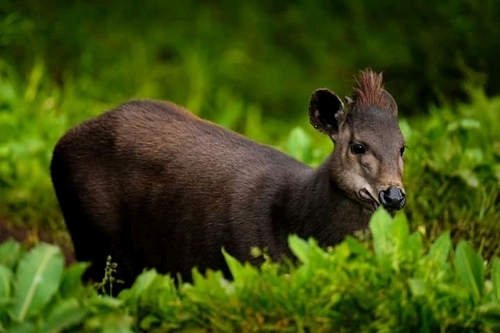
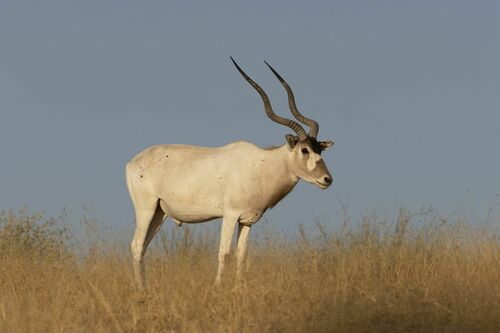
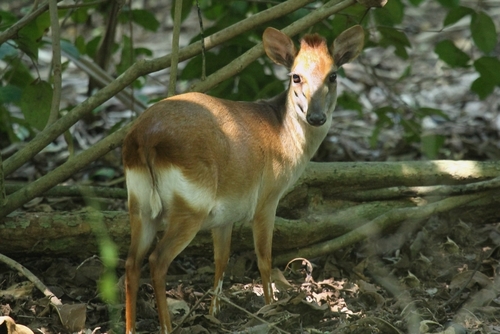
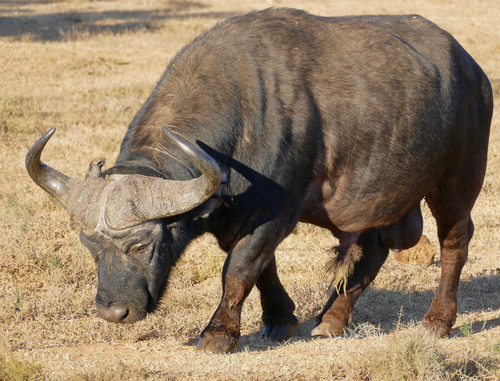
Species that share its range
Sources
Conservation status, range description and population estimate come from the IUCN Red List assessment for Ovibos moschatus. Countries are derived from that range description, not from a mapped country list. Last refreshed on .
The distribution map is drawn from the IUCN Red List spatial data compiled in 2022. IUCN SSC Caprinae Specialist Group