
Montane Chrotomys
Chrotomys whiteheadi
Red List assessment
Least Concernon the IUCN Red List
- EXExtinct
- EWExtinct in the Wild
- CRCritically Endangered
- ENEndangered
- VUVulnerable
- NTNear Threatened
- LCLeast Concern
The Montane Chrotomys is recorded in one country, Philippines across Asia. The IUCN Red List assesses the Montane Chrotomys as Least Concern. No precise population estimate exists, but the species is considered relatively common within suitable habitat; overall population trend is believed to be stable to slightly declining due to habitat loss.
- Family
- Muridae
- Order
- Rodentia
- Genus
- Chrotomys
- Countries recorded
- 1
- Continents
- Asia
- Red List category
- Least Concern
- Data updated
- August 9, 2026
What is the Montane Chrotomys?
Chrotomys whiteheadi, also known as the Montane Chrotomys or Whitehead's Luzon Mouse, is a small terrestrial rodent endemic to the mountainous forests of Luzon Island in the Philippines. It belongs to a unique group of Philippine 'shrew-rats' specialized for a vermivorous diet, feeding primarily on earthworms. Named after British naturalist John Whitehead who collected the first specimens in the late 19th century, it is notable for its striking dorsal stripe pattern.
Where does the Montane Chrotomys live?
Endemic to the island of Luzon, Philippines, primarily found in the Cordillera Central and Sierra Madre mountain ranges.
Restricted to the island of Luzon in the northern Philippines, with populations documented in the Cordillera Central range (including Mount Data, Mount Pulag) and the Sierra Madre mountain range.
Altitude and depth
Typically found at elevations between 1,000 and 3,000 meters above sea level, favoring mid- to high-elevation montane forest zones.
Seasonal movements
No significant migration or hibernation; activity levels may fluctuate slightly with the wet and dry seasons affecting earthworm availability.
Habitat of the Montane Chrotomys
Inhabits primary and secondary montane and mossy forests, typically in areas with deep leaf litter and moist soil favorable for earthworm populations. Often found near forest streams and in areas with dense understory vegetation.
Adaptations to its environment
Possesses elongated claws and a pointed snout adapted for digging in soil and leaf litter to locate earthworms. Its dense fur provides insulation against the cooler temperatures found at high montane elevations.
Conservation status and numbers
Listed as Least Concern (LC) by the IUCN due to its relatively wide distribution across Luzon's mountain ranges and presumed stable population, though localized habitat loss is a concern.
Estimated population
No precise population estimate exists, but the species is considered relatively common within suitable habitat; overall population trend is believed to be stable to slightly declining due to habitat loss.
What threatens the Montane Chrotomys?
Primary threats include deforestation for agriculture, logging, and mining activities within its montane forest habitat, as well as forest degradation from human encroachment.
What is being done to protect it?
Occurs within several protected areas in Luzon, including parts of the Cordillera and Sierra Madre mountain ranges that have some level of legal forest protection under Philippine environmental law.
Recommended actions
Continued protection and expansion of montane forest reserves, monitoring of population trends, and prevention of illegal logging and mining in key habitat areas.
What the Montane Chrotomys looks like
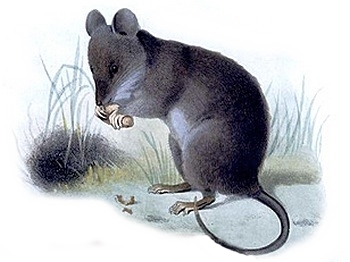
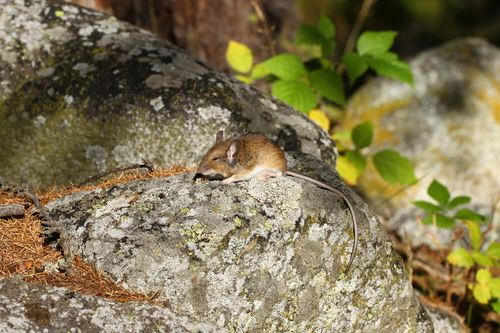
Has a distinctive blackish or dark brown dorsal stripe running down the middle of its back, contrasting with lighter brown or grayish fur on the sides. The underparts are typically paler, grayish-white in coloration.
Size
Head-body length approximately 120-150 mm, with a tail length roughly equal to or slightly shorter than the body, around 100-130 mm.
Weight
Typically weighs between 60 and 100 grams, with limited evidence of significant size difference between sexes.
Distinctive features
Distinguished from related Chrotomys species by subtle differences in stripe width, skull morphology, and overall body size; the dorsal stripe pattern is a key diagnostic feature across the genus.
Behaviour and diet of the Montane Chrotomys
Generally solitary, with individuals maintaining separate home ranges except during breeding encounters; not known to form social groups.
When it is active
Primarily nocturnal or crepuscular, foraging for food during the night and early morning hours while resting in burrows or dense cover during the day.
Diet
Highly specialized vermivore, feeding predominantly on earthworms, with occasional consumption of other soft-bodied invertebrates found in leaf litter and soil.
How it feeds and hunts
Uses its elongated snout and claws to probe and dig through soil and leaf litter, detecting earthworms likely through scent and tactile cues rather than active pursuit.
Communication
Likely relies on scent marking and olfactory cues for territory demarcation and mate location, as is typical for nocturnal terrestrial rodents; vocalizations are not well studied.
Interactions with other species
Potential predators include forest raptors, snakes, and small carnivorous mammals native to Luzon's montane ecosystems; may compete with other soil-foraging small mammals for earthworm resources.
Role in its ecosystem
Plays a role in soil ecosystem dynamics through predation on earthworm populations, potentially influencing soil invertebrate community structure in montane forest floor habitats.
Reproduction and lifecycle
Breeding biology is not well documented, but likely follows a pattern similar to related murid rodents with litters of a few altricial young born after a gestation period of approximately three weeks.
Raising the young
Presumed that females provide sole parental care, nursing and protecting young in a nest until they are weaned and capable of independent foraging.
Maturity and lifespan
Specific data on age of sexual maturity is limited, but likely reaches maturity within a few months as with related murine rodents; lifespan in the wild is estimated at 1-3 years.
Taxonomy and naming of the Montane Chrotomys
Classification
Class Mammalia > Order Rodentia > Family Muridae > Genus Chrotomys > Species Chrotomys whiteheadi
Scientific synonyms
Celaenomys whiteheadi (original combination by Thomas, 1897)
What research says
Recent studies
Recent phylogenetic studies using molecular data have helped clarify the relationships within the genus Chrotomys and its placement among Philippine endemic murine rodents, contributing to understanding of Luzon's unique faunal radiation.
Compared with similar species
Similar to other Chrotomys species such as C. mindorensis and C. silaceus, but distinguished by geographic range restricted to Luzon's higher elevations and subtle morphological differences in stripe pattern and skull structure.
The Montane Chrotomys and people
This species is part of a remarkable group of 'earthworm specialist' rodents unique to the Philippines, a dietary specialization rarely seen in rodents worldwide. It was first described from specimens collected by the pioneering naturalist John Whitehead during his explorations of Luzon's mountains in the 1890s.
Where and how to see it
Best observed during nighttime surveys in undisturbed montane forest areas of the Cordillera Central or Sierra Madre, using live-trapping methods as the species is elusive and rarely seen without targeted effort.
Risks to humans
No notable risk to humans; it is a small, non-aggressive rodent that poses no direct threat.
Countries where the Montane Chrotomys is recorded
The 1 countries named in the range description of its IUCN Red List assessment.
Questions about the Montane Chrotomys
Where does the Montane Chrotomys live?
The Montane Chrotomys is recorded in Philippines across Asia. These countries come from the range description of its IUCN Red List assessment, and they are what place the species on the interactive map.
Is the Montane Chrotomys endangered?
The IUCN Red List assesses the Montane Chrotomys as Least Concern. The species is widespread and abundant enough not to qualify for any threatened category. It does not mean the species is safe forever, only that nothing in the current data raises an alarm.
How many are left in the wild?
No precise population estimate exists, but the species is considered relatively common within suitable habitat; overall population trend is believed to be stable to slightly declining due to habitat loss. This figure comes from the species assessment on the IUCN Red List; population estimates for wild mammals are ranges, not counts, and are revised at each assessment.
What habitat does the Montane Chrotomys live in?
Inhabits primary and secondary montane and mossy forests, typically in areas with deep leaf litter and moist soil favorable for earthworm populations.
What is the scientific name of the Montane Chrotomys?
The Montane Chrotomys is Chrotomys whiteheadi, in the family Muridae, order Rodentia.
Other species in the genus Chrotomys


Other species in the family Muridae
Species that share its range
Sources
Conservation status, range description and population estimate come from the IUCN Red List assessment for Chrotomys whiteheadi. Countries are derived from that range description, not from a mapped country list. Last refreshed on .
The distribution map is drawn from the IUCN Red List spatial data compiled in 2008. IUCN (International Union for Conservation of Nature)