
Isarog Shrew-rat
Chrotomys gonzalesi
Red List assessment
Near Threatenedon the IUCN Red List
- EXExtinct
- EWExtinct in the Wild
- CRCritically Endangered
- ENEndangered
- VUVulnerable
- NTNear Threatened
- LCLeast Concern
The Isarog Shrew-rat is recorded in one country, Philippines across Asia. The IUCN Red List assesses the Isarog Shrew-rat as Near Threatened. No precise population estimate exists; the species is considered rare and is inferred to have a declining population trend correlated with ongoing habitat loss on Mount Isarog.
- Family
- Muridae
- Order
- Rodentia
- Genus
- Chrotomys
- Countries recorded
- 1
- Continents
- Asia
- Red List category
- Near Threatened
- Data updated
- August 9, 2026
What is the Isarog Shrew-rat?
Chrotomys gonzalesi is a rare shrew-rat endemic to a single mountain, Mount Isarog, in the Bicol region of Luzon, Philippines. It belongs to the 'earthworm mice' genus Chrotomys, specialized rodents that dig for invertebrate prey in forest leaf litter. Its extremely restricted range and dependence on intact montane forest make it a species of high conservation concern despite its NT listing. It is one of the least-studied members of its genus, known from only a handful of specimens.
Where does the Isarog Shrew-rat live?
Philippines, endemic to Mount Isarog on the island of Luzon
Restricted entirely to Mount Isarog National Park in Camarines Sur Province, Bicol Region, southeastern Luzon, Philippines. No other populations are known elsewhere on Luzon or other islands.
Altitude and depth
Approximately 1,000-1,800 meters above sea level, mainly in mid- to upper-montane forest zones.
Habitat of the Isarog Shrew-rat
Primary and secondary mossy montane and mid-elevation tropical forest with thick leaf litter and moist soil, essential for its earthworm-hunting lifestyle. It appears to avoid heavily disturbed or agricultural land.
Adaptations to its environment
Possesses an elongated, flexible snout and strong claws adapted for probing and digging in soil and leaf litter to extract earthworms and other invertebrates. Its dense fur provides insulation in the cooler montane climate of Mount Isarog.
Conservation status and numbers
Listed as Near Threatened by IUCN due to its extremely restricted single-mountain range, ongoing habitat degradation, and small inferred population, though it does not yet meet the stricter thresholds for a threatened category.
Estimated population
No precise population estimate exists; the species is considered rare and is inferred to have a declining population trend correlated with ongoing habitat loss on Mount Isarog.
What threatens the Isarog Shrew-rat?
Deforestation and habitat conversion for agriculture, illegal logging, and encroachment on Mount Isarog's forest are the primary threats, along with the inherent vulnerability of having a single-site distribution.
What is being done to protect it?
The species occurs within the boundaries of Mount Isarog Natural Park, a protected area under Philippine law, which provides some legal protection against logging and land conversion.
Recommended actions
Priority actions include strengthening enforcement of protection within Mount Isarog Natural Park, conducting further population surveys, and monitoring habitat quality to prevent further forest loss.
What the Isarog Shrew-rat looks like
Likely exhibits the characteristic Chrotomys pattern of a dark dorsal stripe running down the back contrasted against paler brownish or grayish fur on the flanks, though detailed descriptions remain limited due to scarce specimens.
Size
Head-body length is estimated at approximately 12-16 cm, based on related Chrotomys species, with a tail roughly equal to or slightly shorter than body length.
Weight
Estimated body weight of around 60-100 grams, comparable to other mid-sized Chrotomys species.
Distinctive features
Distinguished from congeners primarily by subtle cranial and dental characteristics identified in taxonomic descriptions, as well as its unique and highly restricted geographic occurrence on Mount Isarog.
Behaviour and diet of the Isarog Shrew-rat
Presumed to be solitary or living in loose associations, consistent with the generally solitary behavior observed in other Chrotomys species.
When it is active
Likely nocturnal or crepuscular, foraging in leaf litter during low-light hours, similar to related shrew-rat species.
Diet
Primarily insectivorous/vermivorous, feeding on earthworms and other soil-dwelling invertebrates found in the forest floor leaf litter.
How it feeds and hunts
Uses its elongated snout and claws to probe and dig through moist soil and leaf litter to locate and extract earthworms and invertebrate prey.
Communication
Likely uses olfactory (scent marking) and tactile cues typical of nocturnal terrestrial rodents; vocalizations are not well documented.
Interactions with other species
Likely preyed upon by forest raptors, snakes, and small carnivores present on Mount Isarog; may compete with other small mammals for invertebrate food resources.
Role in its ecosystem
Plays a role as an invertebrate predator within the montane forest food web, helping regulate soil invertebrate populations and serving as prey for higher predators.
Reproduction and lifecycle
Breeding biology is poorly documented; related Chrotomys species typically produce small litters of a few young after a short gestation period.
Raising the young
Presumed maternal care similar to related murid rodents, with females nursing and protecting young in nest sites within forest litter or burrows.
Maturity and lifespan
Specific data unavailable; likely similar to related murid rodents with sexual maturity reached within a few months and a wild lifespan of 1-3 years.
Taxonomy and naming of the Isarog Shrew-rat
Classification
Mammalia > Rodentia > Muridae > Chrotomys > Chrotomys gonzalesi
What research says
Recent studies
Recent taxonomic and biodiversity surveys on Mount Isarog have aimed to clarify the distribution and conservation status of this poorly known species, though detailed ecological studies remain scarce.
Compared with similar species
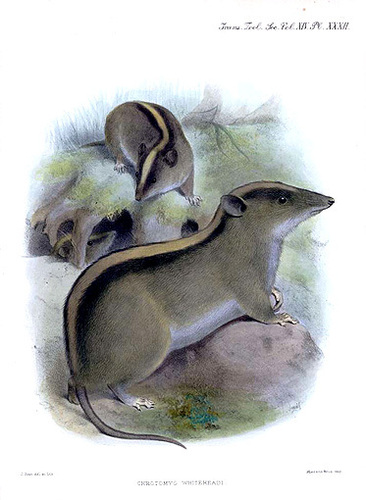
Compared to its congener Chrotomys whiteheadi, which has a wider distribution across Luzon, C. gonzalesi is distinguished by its single-mountain endemism and subtle morphological differences noted in original species descriptions.
The Isarog Shrew-rat and people
It is one of the rarest and most narrowly distributed rodents in the Philippines, found on just one single mountain in the entire world. It belongs to a unique group of 'earthworm-eating' rodents unlike typical omnivorous rats.
Where and how to see it
Observation is extremely difficult due to its rarity and nocturnal habits; any potential sighting would require guided access to protected montane forest zones within Mount Isarog Natural Park with permission from park authorities.
Risks to humans
No notable risk to humans.
Countries where the Isarog Shrew-rat is recorded
The 1 countries named in the range description of its IUCN Red List assessment.
Questions about the Isarog Shrew-rat
Where does the Isarog Shrew-rat live?
The Isarog Shrew-rat is recorded in Philippines across Asia. These countries come from the range description of its IUCN Red List assessment, and they are what place the species on the interactive map.
Is the Isarog Shrew-rat endangered?
The IUCN Red List assesses the Isarog Shrew-rat as Near Threatened. The species does not qualify as threatened today, but it is close to the thresholds and likely to cross them soon. It is the category that most often changes at the next assessment.
How many are left in the wild?
No precise population estimate exists; the species is considered rare and is inferred to have a declining population trend correlated with ongoing habitat loss on Mount Isarog. This figure comes from the species assessment on the IUCN Red List; population estimates for wild mammals are ranges, not counts, and are revised at each assessment.
What habitat does the Isarog Shrew-rat live in?
Primary and secondary mossy montane and mid-elevation tropical forest with thick leaf litter and moist soil, essential for its earthworm-hunting lifestyle.
What is the scientific name of the Isarog Shrew-rat?
The Isarog Shrew-rat is Chrotomys gonzalesi, in the family Muridae, order Rodentia.
Other species in the genus Chrotomys


Other species in the family Muridae
Species that share its range
Sources
Conservation status, range description and population estimate come from the IUCN Red List assessment for Chrotomys gonzalesi. Countries are derived from that range description, not from a mapped country list. Last refreshed on .
The distribution map is drawn from the IUCN Red List spatial data compiled in 2017. IUCN SSC Small Mammal Specialist Group