
Lowland Chrotomys
Chrotomys mindorensis
Red List assessment
Least Concernon the IUCN Red List
- EXExtinct
- EWExtinct in the Wild
- CRCritically Endangered
- ENEndangered
- VUVulnerable
- NTNear Threatened
- LCLeast Concern
The Lowland Chrotomys is recorded in one country, Philippines across Asia. The IUCN Red List assesses the Lowland Chrotomys as Least Concern. No precise population figures exist, but the species is considered locally common in suitable forest habitat; population trend is presumed stable to slightly declining with habitat loss.
- Family
- Muridae
- Order
- Rodentia
- Genus
- Chrotomys
- Countries recorded
- 1
- Continents
- Asia
- Red List category
- Least Concern
- Data updated
- August 9, 2026
What is the Lowland Chrotomys?
The Lowland Chrotomys is a small terrestrial rodent endemic to Mindoro Island in the Philippines, notable for its specialized diet of earthworms and other soil invertebrates. It belongs to a unique Philippine radiation of 'striped shrew-rats' that have evolved a vermivorous lifestyle unusual among murine rodents. It inhabits lowland to lower montane forests and forest-edge habitats, making it an important indicator species for Mindoro's remaining forest ecosystems.
Where does the Lowland Chrotomys live?
Endemic to Mindoro Island, in the central Philippines.
Restricted entirely to Mindoro Island in the Philippines, occurring in scattered forest patches across the island's lowland and mid-elevation zones.
Altitude and depth
Approximately 0 to 1,200 meters above sea level, with most records from lowland forest below 800m.
Habitat of the Lowland Chrotomys
Primary and secondary lowland tropical forest, forest edges, and sometimes agricultural areas adjacent to forest, particularly where leaf litter and moist soil support earthworm populations.
Adaptations to its environment
Possesses an elongated, flexible snout and specialized dentition adapted for probing soil and leaf litter to extract earthworms. Its digging forepaws and keen olfactory senses aid in locating subterranean prey in the humid forest floor environment.
Conservation status and numbers
Listed as Least Concern (LC) by the IUCN due to its relatively wide distribution across Mindoro and tolerance of some habitat disturbance, though its single-island endemism makes it inherently vulnerable to future habitat loss.
Estimated population
No precise population figures exist, but the species is considered locally common in suitable forest habitat; population trend is presumed stable to slightly declining with habitat loss.
What threatens the Lowland Chrotomys?
Ongoing deforestation and conversion of lowland forest to agriculture on Mindoro, along with habitat fragmentation, pose long-term risks despite the current stable status.
What is being done to protect it?
Some populations occur within protected areas such as Mounts Iglit-Baco Natural Park and other Mindoro forest reserves, which help safeguard remaining habitat.
Recommended actions
Continued protection and expansion of forest reserves on Mindoro, monitoring of population trends, and prevention of further lowland forest conversion to agriculture.
What the Lowland Chrotomys looks like
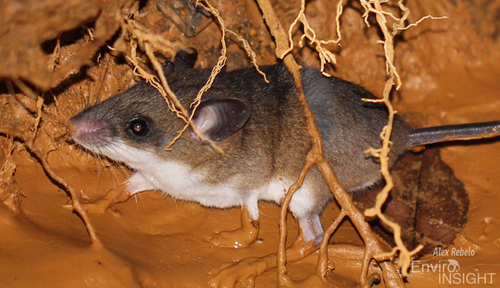
Grizzled brown to blackish dorsal fur with a distinctive dark mid-dorsal stripe running from head to rump, paler grayish underparts, and a relatively short, sparsely-haired tail.
Size
Head-body length approximately 120-150 mm, with a tail shorter than the body length, typically 80-110 mm.
Weight
Approximately 60-110 grams, with limited data suggesting no strong sexual size dimorphism.
Distinctive features
Distinguished from related Chrotomys species by its more restricted island range, body proportions, and subtle differences in stripe coloration and skull morphology.
Behaviour and diet of the Lowland Chrotomys
Generally solitary and terrestrial, foraging alone on the forest floor with limited social interaction outside of breeding encounters.
When it is active
Primarily nocturnal to crepuscular, foraging on the forest floor during low-light hours.
Diet
Specialized vermivore feeding mainly on earthworms, supplemented by other soil invertebrates such as insect larvae and small arthropods found in leaf litter.
How it feeds and hunts
Forages by probing snout and forepaws into soft soil and leaf litter to locate and extract earthworms, relying heavily on smell and touch rather than sight.
Communication
Likely relies on scent marking and tactile cues typical of small terrestrial rodents; vocal communication has not been well studied in this species.
Interactions with other species
Preyed upon by forest raptors, snakes, and small carnivores; competes with other soil-foraging small mammals for invertebrate prey resources.
Role in its ecosystem
Plays a role in soil ecosystem dynamics by regulating earthworm populations and contributing to nutrient cycling through its foraging activity on the forest floor.
Reproduction and lifecycle
Breeding biology is poorly documented, but like related murines it likely produces small litters of a few altricial young, with breeding possible year-round in the tropical climate of Mindoro.
Raising the young
Presumed maternal care typical of murine rodents, with females nursing and sheltering young in nests until weaning, though specific behavioral studies are lacking.
Maturity and lifespan
Specific data unavailable, but likely reaches sexual maturity within a few months as typical for small murine rodents, with a wild lifespan probably under 2-3 years.
Taxonomy and naming of the Lowland Chrotomys
Classification
Class Mammalia > Order Rodentia > Family Muridae > Genus Chrotomys > Species Chrotomys mindorensis.
Scientific synonyms
Celaenomys mindorensis (older combination); sometimes listed under synonym Chrotomys whiteheadi mindorensis in older literature.
What research says
Recent studies
Recent phylogenetic studies of Philippine Chrotomys species have helped clarify relationships within the genus and confirmed the distinctiveness of island-endemic lineages like C. mindorensis.
Compared with similar species
Similar to other Chrotomys species such as C. whiteheadi and C. silaceus from other Philippine islands, but distinguished by geographic isolation on Mindoro and subtle morphological differences in size and stripe pattern.
The Lowland Chrotomys and people
This rodent is one of the few mammals worldwide specialized almost entirely on eating earthworms; it belongs to a unique Philippine evolutionary radiation of 'shrew-rats' found nowhere else on Earth.
Where and how to see it
Best observed at night in remaining lowland forest patches on Mindoro Island, using careful searching of leaf litter areas with a flashlight; patience and knowledge of local forest trails greatly improve chances of sighting.
Risks to humans
No notable risk to humans; it is a small, non-aggressive rodent that avoids human contact.
Countries where the Lowland Chrotomys is recorded
The 1 countries named in the range description of its IUCN Red List assessment.
Questions about the Lowland Chrotomys
Where does the Lowland Chrotomys live?
The Lowland Chrotomys is recorded in Philippines across Asia. These countries come from the range description of its IUCN Red List assessment, and they are what place the species on the interactive map.
Is the Lowland Chrotomys endangered?
The IUCN Red List assesses the Lowland Chrotomys as Least Concern. The species is widespread and abundant enough not to qualify for any threatened category. It does not mean the species is safe forever, only that nothing in the current data raises an alarm.
How many are left in the wild?
No precise population figures exist, but the species is considered locally common in suitable forest habitat; population trend is presumed stable to slightly declining with habitat loss. This figure comes from the species assessment on the IUCN Red List; population estimates for wild mammals are ranges, not counts, and are revised at each assessment.
What habitat does the Lowland Chrotomys live in?
Primary and secondary lowland tropical forest, forest edges, and sometimes agricultural areas adjacent to forest, particularly where leaf litter and moist soil support earthworm populations.
What is the scientific name of the Lowland Chrotomys?
The Lowland Chrotomys is Chrotomys mindorensis, in the family Muridae, order Rodentia.
Other species in the genus Chrotomys


Other species in the family Muridae
Species that share its range
Sources
Conservation status, range description and population estimate come from the IUCN Red List assessment for Chrotomys mindorensis. Countries are derived from that range description, not from a mapped country list. Last refreshed on .
The distribution map is drawn from the IUCN Red List spatial data compiled in 2017. IUCN SSC Small Mammal Specialist Group